
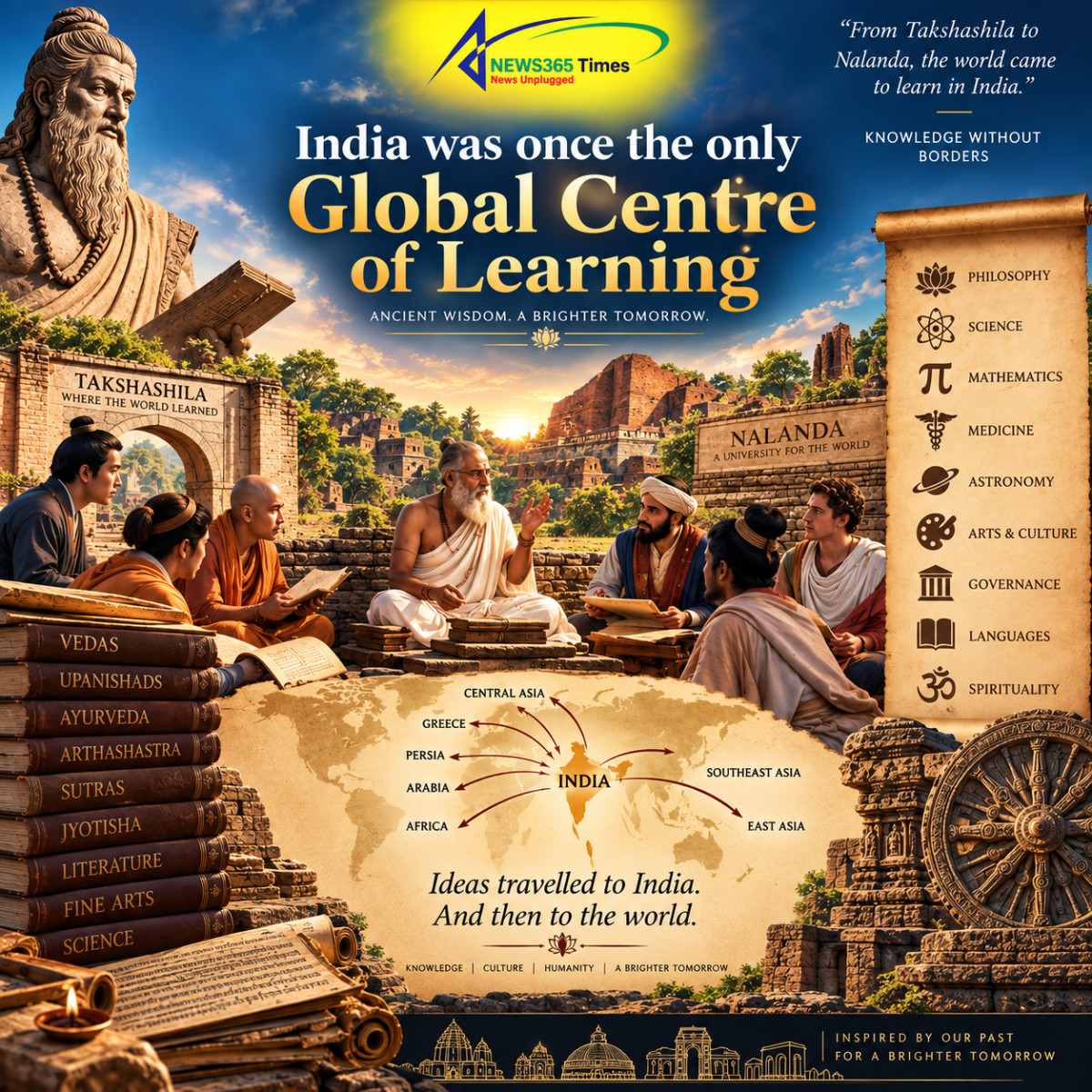
India was once the only Global Centre of Learning
The Architecture of Ancient Indian Learning: From Forest Ashrama to Global Synthesis
When modern history reflects on ancient Indian education, the gaze almost instinctively fixes upon Nalanda. Its towering brick monasteries, sprawling multi-story libraries like Dharmaganja, and cosmopolitan prestige make it an enduring symbol of higher education. Yet, treating Nalanda as the genesis of Indian learning mistakes the summit for the mountain. Nalanda was neither the beginning nor an isolated anomaly; it was the institutional culmination of an intellectual lineage that had operated, evolved, and matured over millennia.
To comprehend this knowledge ecosystem requires reframing the inquiry away from when universities emerged, toward an examination of how a civilization structured, sustained, and transmitted advanced inquiry across vast temporal spans.
The Evolutionary Continuum: Ashrama to Mahavihara
The institutionalization of knowledge in India did not begin with urban architectural complexes, but through a decentralised, ecological pedagogy that gradually consolidated into international universities. There were multiple stages to this starting with the, Ashrama & Gurukul Age, then came the decentralized, forest-based academies, then came the lineage-based specialization (Rishi Paramparas), then came the rigorous oral mnemonic preservation (Shruti/Smriti), then came the formation of regional learning guilds & centers, then came the seminal centers emerge (e.g., Takshashila during 700 BCE), quickly to adopt to multi-faculty curricula (Panini, Chanakya, Jivaka), and the shift toward cross-disciplinary aggregation. Thereby started another phase the International Mahaviharas, namely Nalanda, Vikramashila, Valabhi, Odantapuri, Somapura all by current standards huge multi disciplinary universities, fully residential, state-endowed international campuses, gatekeeper of admissions being (Dvarapanditas) & global influx.
The Ashrama and Gurukul Foundations
Long before brick cloisters were laid, knowledge was developed within forest academies (ashramas) and domestic learning communities (gurukuls). Lineages traced to figures such as Maharishi's Vasistha, Vishvamitra, Bharadvaja, Atri, Bhrigu, and Agastya operated as autonomous research institutions.
Far from purely mystical sanctuaries, these centers developed rigorous disciplinary specializations:
- Jyotisha & Ganita: Mathematical astronomy, planetary motion, and computational geometry (exemplified in the Sulba Sutras).
- Ayurveda: Botanical pharmacology, clinical taxonomy, and internal medicine.
- Linguistics (Vyakarana & Shiksha): Phonetics, semantics, and structural grammar designed to preserve texts orally without phonetic drift across generations.
- Applied Sciences: Metallurgy, agriculture, architecture (Sthapatya Veda), and governance.
The pedagogical contract was residential and sustained. Students lived within the household of the preceptor, integrating ethical formation, domestic maintenance, and intellectual labor.
By the mid-first millennium BCE, individual lineages began congregating into regional educational networks. The foremost exemplar was Takshashila (Taxila), thriving from at least the 7th to 6th century BCE along key northwestern trade corridors. Unlike modern universities governed by a single centralized board, Takshashila operated as an aggregation of sovereign masters teaching under an shared civic umbrella. It attracted scholars like Panini, the master of formal grammar; Chanakya, theorist of statecraft and economy; and Jivaka, physician to royal courts. Here, academic admission demanded demonstrated competence, personal maturity, and intellectual rigor.
The International Mahaviharas
By the 5th century CE, the Imperial Guptas and later dynasties provided the royal charters and agricultural endowments necessary to sustain vast, fully institutionalized campuses. Nalanda Mahavihara, established around 427 CE during the reign of Kumaragupta, pioneered a residential model on a scale previously unseen in antiquity:
- Admission Standards: Applicants faced rigorous viva voce examinations at the outer entrance conducted by Dvarapanditas (gatekeeper scholars), where modern estimates based on Xuanzang accounts indicate only 20 to 30 percent gained admission.
- Global Student Cohorts: Beyond scholars across the subcontinent, records explicitly document students arriving from China (including Xuanzang and Yijing), Korea (such as Hye-eop and Aryavarman), Tibet, and regions across Central and Southeast Asia.
- A Cohesive Network: Nalanda was the most famous nexus within a wider regional fabric of learning centers, working in close relation to Vikramashila, Valabhi, Odantapuri, Somapura, Pushpagiri, and Jagaddala.
Institutional Blueprints: Life, Curriculum, and Purpose
The internal architecture of these institutions integrated life, philosophy, and practical application into an organic whole.
The ultimate aspiration of the system was never pure utilitarian credentialing. The traditional taxonomy categorized education into two complementary tiers:
- Apara-vidya: Lower or empirical knowledge the structural mechanics of grammar, mathematics, natural phenomena, economics, and medicine.
- Para-vidya: Higher or intuitive knowledge the comprehension of consciousness, perception, ethics, and ultimate liberation (Moksha or Nirvana).
To master the mechanism of the world without understanding the locus of consciousness observing it was regarded as an unfinished education.
The Rupture: Destruction and the Dynamics of Dispersal
The catastrophic sack of Nalanda, Vikramashila, and Odantapuri around the late 12th century remains one of the seminal ruptures in civilizational history. Multi-story libraries including Ratnasagara and Ratnodadhi burned, monastic quarters were leveled, and the centralized scholarly ecosystem was systematically dismantled. Yet analyzing this destruction purely as absolute extinction overlooks the mechanics of historical transmission. While the physical infrastructure and institutional centers perished, the intellectual tradition responded through diasporic survival:
- Textual and Doctrinal Migration: Long before the physical destruction of the Gangetic plains' universities, crucial corpora had already been translated and transported to Tibet, Nepal, Central Asia, and East Asia by travelling masters like Padmasambhava, Shantarakshita, and Atisha Dipankara.
- Lineage Decentralization: Scholars displaced by invasions dispersed into southern and eastern sanctuaries. The rigorous analytical traditions of Navya-Nyaya (New Logic) migrated into Mithila and later Bengal (Navadvipa), while astronomy and mathematics established an extraordinarily sophisticated school along the coastal belts of Kerala.
- Resilience of the Mnemonic Stream: Indian transmission had never been purely codicological. Because texts were continuously lived, memorized, debated, and transmitted via lineage (parampara), the knowledge survived the burning of its material substrate. A library can be leveled in days; an internal mnemonic tradition demands generations of cultural erasure to extinguish entirely.
Modern Parallels: Synthesis in the Age of Reconnection
Following the collapse of classical centers, global intellectual inquiry fragmented across geographic and ideological domains. For centuries, discrete civilizations specialized in distinct quadrants of knowledge:
- India deepened systems of metaphysics, structural linguistics, and consciousness studies.
- China, Japan, Korea honed systemic bureaucratic organization, agricultural hydrology, and material technology.
- The Mediterranean world preserved, developed, and bridged scientific, medical, and algebraic treatises across continents.
- Europe accelerated experimental empiricism, industrial mechanization, and the scientific method.
The destruction of the ancient universities scattered the seeds of systematic inquiry across the earth; the current frontier gathers those scattered fragments, challenging the modern world to once again build a unified, universal science of life.
What's Your Reaction?
 Like
0
Like
0
 Dislike
0
Dislike
0
 Love
0
Love
0
 Funny
0
Funny
0
 Wow
0
Wow
0
 Sad
0
Sad
0
 Angry
0
Angry
0

English Daily News Platform #News #Latestupdates #Tech #Business #Politics #Indianews #India. Regd No : JMAGC/HR/00072 (JMAGC ), MIB ,Govt of India









Comments (0)