

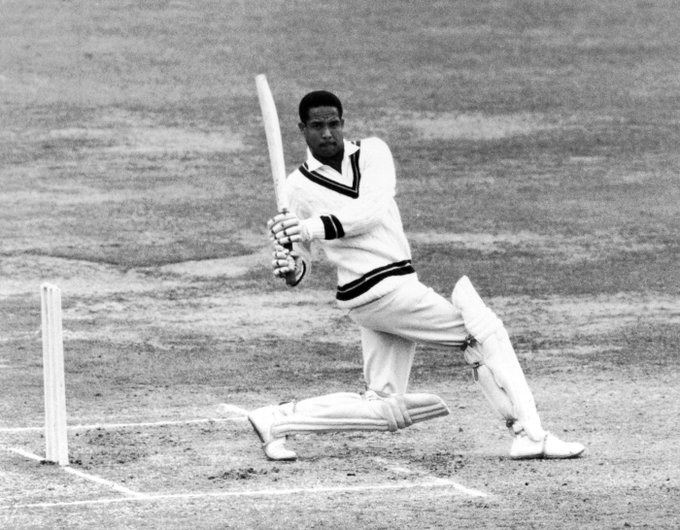
There are certain athletes whom you grow up watching light up stadiums with their epoch-making performances. Over a period of time, those champions become a part of your everyday life. Be it their triumphs or heartbreaks, you feel as if you want to celebrate alongside them or shed a tear in sympathy. Then there are athletes whose heroic deeds are passed down from one generation to another. Garry Sobers’ exploits belong to that category. They have travelled across decades, and his name still evokes reverence. When the words, ‘The legendary Garry Sobers has passed away’, spread across social media platforms, they seemed to unite cricket fans across generations.
Such is the grandeur of Sobers’ career that it would take 10,000 words and more to do justice to his legacy. For now, let us focus on one innings that occupies a special place in cricket’s gilt-edged history books: Sobers’ magnificent 254 for the Rest of the World XI against Australia at the MCG in 1971–72.
The backdrop to that innings is equally fascinating. The fiery young tearaway Dennis Lillee had dismissed Sobers for a duck on a lively pitch in the Perth Test. In the subsequent Test at the MCG, Sobers was once again out for nought to Lillee. Despite the presence of one Graeme Pollock strengthening the Rest of the World batting line-up, they were bundled out for just 185 in the first innings.
At the end of that innings, Sobers walked over to Ian Chappell, the Australian captain, and made his intentions crystal clear:
“I went in to bat in the first innings and Dennis came up with a short-pitched ball. I played a little bit early, and Keith Stackpole picked me up at second slip. That evening I went to the dressing room where Ian was sitting and said to him, ‘You’ve got a boy here called Lillee. Every time I have gone in, all I have got from him is bouncers. I want you to tell him that I can bowl quick too, and I can bowl bouncers. So, watch out for me when he comes in.’”
In reply, when Australia were 285 for 9, it was Lillee’s turn to dance to Sobers’ tune. As it happened, Tony Greig, Sobers’ team-mate, was quick to remind his captain about the promise he had made the previous evening. Sobers later recalled:
“Tony Greig is like an elephant; he doesn’t forget anything. He came to me and said, ‘Why don’t you let him have it?’ I said, ‘Let him have what?’ He said, ‘Let him have the bouncers.’ I ran up and bowled this bouncer, and it whizzed past Dennis. He looked at me and had turned completely pink. I knew by then that I had got him.”
The confrontation did not end there. Sobers was once again at the entrance to Australia’s dressing room, with Ian Chappell standing in front of him. Chappell recalled:
“I’ll tell you something: when Dennis came in, before he reached the room, the bat hit the wall and he said, ‘That little so-and-so, I’ll show him. I haven’t really bowled quick at him yet.’”
The legendary all-rounder had the perfect riposte: “Well, he’s got the ball, I’ve got the bat. I’ve never met anyone who could scare me before, and I don’t think I ever will.”
What followed was an innings written in indelible ink. Sobers walked out to bat with the Rest of the World holding a lead of only around 50 runs. Soon enough, he unfurled a rasping square cut off Lillee. When he reached 75, another debonair cut raced away to the boundary. Lillee responded with a thunderous bouncer, but on that day fire was met with lightning. Sobers hooked it mercilessly. As the commentator exclaimed, “That flew off the bat like lightning and the fielders had no chance.”
Lillee still was not finished. His next weapon was a yorker. Sobers stayed deep in the crease, turned it into a very full delivery and drove it past the hapless Kerry O’Keeffe. After striking 35 boundaries, Sobers was eventually dismissed by Greg Chappell, caught at mid-on. By then, however, he had powered the Rest of the World into a commanding position.

For a moment, let us return to that innings because it also gave rise to one of Ian Chappell’s most famous recollections.
“I head over in his direction to congratulate him. Just the two of us are in a quiet corner, and after I pour him a beer, he has a sip and then says, ‘Prue’s left me.’ Prue being his wife, who lived in Melbourne in those days. I said, ‘Sobie, if that’s the bloody thing that’s annoying you so much, give me her phone number and I’ll tell her to get bloody home straight away.’ You know, he just laughed. And it didn’t make any difference; he came out and belted us again.”
It was a light-hearted conversation that took place at the end of the third day’s play.
Lillee himself was effusive in his praise.
“I remember taking the second new ball and trying to bowl a big inswinging yorker. He leant into it with great power. I went down in my follow-through to try to stop it; by the time I was down, I was looking back and the ball had hit the boundary fence and bounced back. I have never witnessed a shot of such power and grace.”
As it turns out, this epochal innings is merely one gem in a treasure trove full of iconic moments from Sobers’ extraordinary career. Who can forget reading about him bowling 41 overs on the trot in the MCG Test of 1960–61 and claiming a five-wicket haul? During the same tour of Australia, he was dismissed for a duck by Richie Benaud in a practice match. The local press is believed to have labelled him Benaud’s bunny. Unsurprisingly, Sobers responded with a defining century in the Gabba Test.
Millions of words have been written about his record-breaking innings at Kingston and his six sixes off Malcolm Nash. The story goes that almost half of Jamaica poured onto the ground after Sobers surpassed Len Hutton’s record, damaging the pitch in the process. The result was that no play was possible the following day.
The list of anecdotes and achievements associated with Sobers is endless. Such is the aura surrounding him that, even in an imaginary world where the game of cricket no longer exists a hundred years from now, there is every chance that the name Garry Sobers would still echo in certain corners of the world. The boy from Bay Land, St Michael, who grew up playing with worn-out cricket balls at the local Wanderers ground, is immortal. All that mere mortals can do is picture Sobers with his long grip, high backlift and free-flowing swing of the bat, dispatching fours and sixes while also weaving magic with both pace and spin, in his new heavenly abode.
Bibliography
• Wisden Asia Cricket Magazine
• The Chappell Years: Cricket in the 1970s
• Menace – Dennis Lillee
The post Garry Sobers and an innings of incandescent brilliance from the treasure trove appeared first on Sports News Portal | Revsportz.