

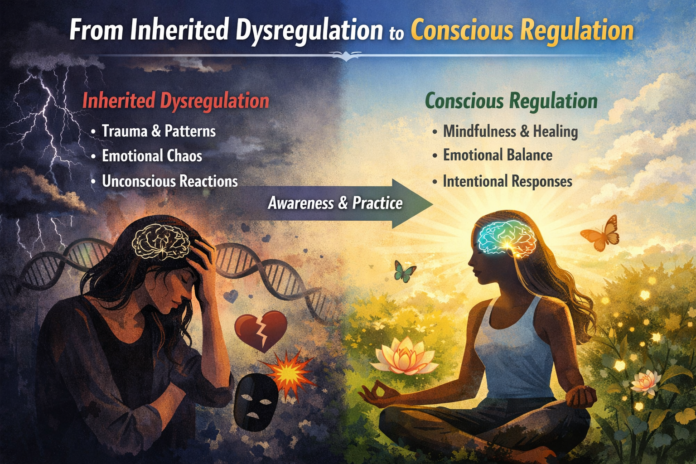
Human beings do not begin life as blank slates. We arrive carrying echoes—of our parents’ nervous systems, their unprocessed grief, their survival strategies, their unspoken fears. Dysregulation is often not chosen; it is inherited, imbibed, and embodied. As young souls, we rarely possess the tools to disentangle ourselves from patriarchal signals, ancestral wounds, or emotional climates that shaped our earliest sense of safety.
To acknowledge this truth is not an act of blame. It is an act of courage.
To err is human but to see the error, to name it without shame, is the first movement toward healing.
When History Becomes Biology
Ancient narratives often mirror modern neuroscience. The story of Sage Visharva—rooted in wisdom, conflict, and divided loyalties—offers a profound metaphor. From a lineage of knowledge emerged Ravana: brilliant, powerful, and yet unrighteous. A convergence of refinement and aggression. A nervous system stretched between order and chaos.
Similarly, Shakuni’s legacy shows how unresolved injustice can transmit itself through generations, shaping jealousy, vengeance, and collapse.
These are not merely mythological tales. They are reflections of how unintegrated experiences become embodied patterns, passed down not just through stories, but through tone of voice, emotional reactivity, and nervous system wiring.
Survival Mode vs. Creative Mode
Many adults today live predominantly in survival mode. Creativity, joy, spontaneity, and rest feel distant—almost indulgent.
Why?
Because chronic stress diverts the body’s intelligence toward protection. When the nervous system is constantly scanning for threat, it cannot access imagination, play, or deep relational presence.
This is not weakness. It is biology responding faithfully to perceived danger.
Neuro-Conscious Insight: Detox Is Alignment, Not Force
True healing does not come from aggression toward the body. It comes from alignment with biological timing.
- Light and dark
- Feeding and fasting
- Action and rest
The liver—our great organ of purification—does not thrive under force. It is exquisitely sensitive to rhythm. A nocturnal worker, it restores balance during late evening and deep sleep.
Poor sleep disrupts this rhythm.
Late eating delays detoxification.
Chronic stress diverts liver energy from cleansing toward survival chemistry.
Health emerges when the body is allowed to keep its own time.
Two Phases of Detoxification
- Phase 1: Transformation—breaking down toxins into intermediate by-products (energy-intensive).
-
Phase 2: Neutralisation and excretion—through bile, stool, and urine.
When rhythm is respected, detox becomes restoration—not exhaustion.
One Intelligence, Many Languages
What neuroscience explains in circuits and hormones, ancient wisdom describes in rhythm and balance.
The liver synchronises:
- Time
- Metabolism
- Endocrine signals
- Emotional processing
- Internal order
Different languages. Same intelligence.
How Dysregulation Is Inherited by Children
Children do not inherit trauma through words alone. They inherit states.
Common patterns include:
- Nervous system responses: hyper-vigilance, anxiety, shutdown
- Emotional climates: stress, anger, fear
- Relational templates: how self and others are experienced
- Limiting beliefs: low self-esteem, abandonment, insecure attachment
- Survival strategies: perfectionism, people-pleasing, withdrawal
This occurs through co-regulation—the constant, unconscious nervous-system dialogue between parent and child.
Neuroplasticity: The Brain Rewires, It Does Not Retire
Change is not only possible—it is inevitable when conditions are right.
The parent is the lighthouse not frantic not reactive. But steady, regulated, and present.
The Path of Repair
- Heal yourself first: identify dysregulation and gently restore balance.
- Be regulated: no fixing, no shaming, no lectures. Calm in the storm.
- Name what happened: link circumstances with emotional responses, without blame.
- Use the body: breathwork, grounding, somatic release, emotional expression.
- Trust timing: allow evolution without comparison or pressure.
The Result
- A regulated parent
- A healing relational pattern
- Timely, appropriate responses
-
Observable change
When regulation becomes consistent, children do not need instruction—they entrain to safety.
A Closing Reflection
Parents often ask, “Will my children heal? ”The deeper question is, “Can I become the regulated presence they can borrow from?”
Healing does not demand perfection. It asks for honesty, rhythm, and patience.
When a lineage shifts from survival to regulation, from rigidity to flexibility, from shame to awareness—the future rewrites itself quietly, gently, and irreversibly.