

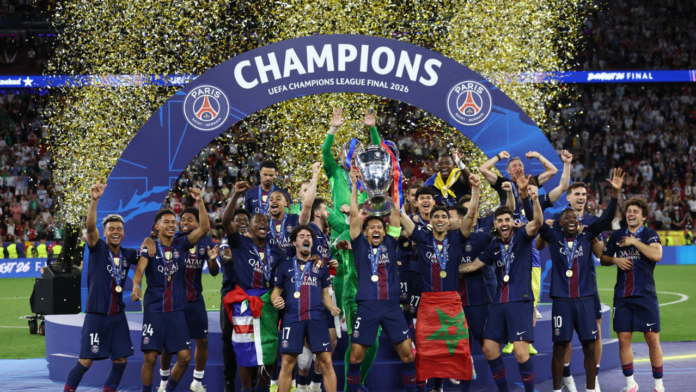
For years, Paris Saint-Germain chased the Champions League through star power.
Zlatan Ibrahimović, Neymar, Lionel Messi, Sergio Ramos and Kylian Mbappé all arrived in Paris carrying enormous expectations. The club won domestic titles regularly, dominated French football and became one of the most recognisable brands in world sport. Yet the one trophy they craved remained out of reach.
The turning point came when PSG stopped asking how to win the Champions League and started asking what kind of football club they wanted to become.
That shift in thinking transformed the club.
Saturday’s dramatic Champions League final victory over Arsenal in Budapest, secured via a penalty shootout after a 1-1 draw, handed PSG a second consecutive European crown. In doing so, they became only the second club in the Champions League era to successfully defend the trophy after Real Madrid’s famous three-peat between 2016 and 2018.
The triumph was not built around a collection of superstars. It was built around a team.
When Luis Enrique arrived in 2023, he inherited a club still carrying the baggage of the “bling-bling” era. Big names often dominated dressing-room conversations, tactical decisions and even club politics. Individual status frequently outweighed collective responsibility.
The Spaniard had little interest in continuing down that road.

PSG’s hierarchy, led by president Nasser Al-Khelaifi and sporting director Luis Campos, backed a different vision – one in which the coach came first, the playing philosophy came next and recruitment followed accordingly.
The departures of Messi, Neymar, Ramos, Marco Verratti and eventually Mbappé were not merely squad changes. They represented a cultural reset.
Enrique made it clear from the beginning that no player would be bigger than the team.
One of the clearest examples came when Ousmane Dembélé arrived late for training ahead of a Champions League fixture. The delay was only a few minutes, but the punishment was immediate. Dembélé was dropped.
The message travelled quickly through the dressing room. Standards would apply equally to everyone. The change was visible not only in discipline but also in the football itself. PSG became a side that attacked collectively, defended collectively and shared responsibility across the pitch.
Enrique often speaks about preferring five players to score 10 goals each rather than one player scoring 50. This season perfectly reflected that philosophy. PSG had 20 different goalscorers across all competitions, making them far less predictable than previous versions of the team.
Without Mbappé, many expected PSG to lose their cutting edge. Instead, they became more balanced.
The numbers tell the story. The club scored significantly more goals in the seasons following Mbappé’s departure than in his final campaign in Paris. Possession remained high, attacking football remained central, but everything operated within a collective structure.
Discipline also became one of the defining characteristics of the side. PSG finished among the teams with the fewest yellow cards in Europe’s major leagues. Players stopped surrounding referees, stopped wasting energy on arguments and focused instead on the game itself.
Just as important was the stability behind the scenes. For much of the previous decade, PSG often reacted emotionally to setbacks. A poor European result frequently triggered transfer speculation and questions about the manager’s future.
That pattern disappeared. When defeats against Arsenal, Bayern Munich and Atlético Madrid sparked criticism during the 2024–25 campaign, PSG resisted the temptation to overhaul the squad. Instead, they remained committed to the project, adding only Khvicha Kvaratskhelia and trusting the existing group.
The faith paid off.
Another important aspect of the transformation has been the club’s renewed connection with French football. Academy graduates have become an increasingly important part of the first-team picture, while French players now account for a significant share of playing time.
The average age of the squad has dropped considerably, creating a younger, hungrier group with room to grow. The results have been extraordinary. Since the start of the 2024–25 season, PSG have collected eight trophies from a possible ten and established themselves as the dominant force in European football.
Their second consecutive Champions League title places them alongside some of the competition’s most celebrated teams. Yet, perhaps the biggest achievement is not the silverware.
For the first time since Qatar Sports Investments took control of the club in 2011, PSG have a clear footballing identity. They know how they want to play, what kind of players they want to sign and what standards they expect.
The era of collecting stars has given way to something far more valuable.
Paris Saint-Germain have finally become a team.
For latest sports updates: Follow RevSportz
The post From Galácticos to a Team: How Luis Enrique Changed PSG appeared first on Sports News Portal | Revsportz.