

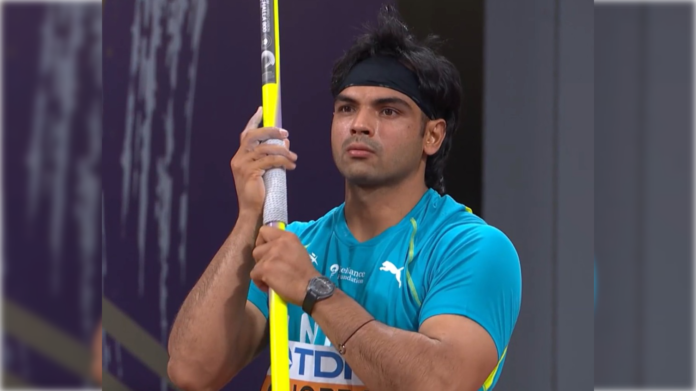
Five years have passed since Neeraj Chopra rewrote Indian sporting history by becoming the country’s first Olympic champion in athletics. Yet, whenever I think back to that unforgettable evening in Tokyo, every moment remains as vivid as if it happened yesterday.
For years, Indian athletes had entered the Olympic Stadium with hope only to leave within minutes, unable to make a final. It had become a familiar and painful pattern, leaving behind the same question: why could a nation of more than a billion people never win an Olympic medal in athletics?
Neeraj, too, entered the stadium early on the day of qualification and left soon afterwards. Only this time, he had an 86.65-metre throw to his name, topping the qualification charts and becoming the first athlete to secure his place in the men’s javelin final. As he walked out, there was an unmistakable swagger in his stride. He was in Tokyo on business – the business of winning an Olympic medal.
On the day of the final, he looked remarkably composed. He exchanged greetings with a few rivals before retreating into his own zone. Watching him from close quarters, one sensed a quiet confidence. His opening throw of 87.03 metres immediately put him in front, but none of us dared get carried away. India had already endured too many near misses in Tokyo, and Johannes Vetter, with seven 90-metre-plus throws that season, remained the overwhelming favourite.
At the end of the opening round, the scoreboard flashed ‘IND’ at the top of the leaderboard. The atmosphere changed instantly. We were no longer merely watching an event; we were living every throw with him.
Then came the moment that changed Indian sporting history.
The instant Neeraj released his second throw, it looked special. The javelin travelled with purpose, soaring through the Tokyo night before landing at 87.58 metres. It wasn’t a national record or an Olympic record, but it didn’t matter. Everyone else was still chasing him.
Coming from a modest farming family in Haryana, Neeraj was making a statement to the world: India could win Olympic gold in athletics.
As Vetter unexpectedly faded out of contention, belief grew stronger. Our WhatsApp group at India Today buzzed incessantly as colleagues urged me to go live. I refused. Superstitious perhaps, but I wasn’t prepared to leave my seat until Neeraj had completed all six throws. In my own make-believe world, I believed I was somehow sending positive energy his way.
When Jakub Vadlejch completed his final attempt, it finally sank in. Neeraj still had one throw remaining, but it no longer mattered. He punched the air, knowing what we all knew.
Neeraj Chopra was Olympic champion.
The press conference that followed produced another unforgettable memory.
When a Norwegian journalist asked why he had taken up a sport with virtually no tradition in India, Neeraj looked towards me and asked whether he could answer in Hindi. The IOC officials agreed, and I was asked to interpret for the international media.
Neeraj smiled and said: “Main bahut mota tha ji. Isi liye ek din gaon mein khelne chala gaya aur wahan bahut saare khel ho rahe the. Javelin bhi tha. Mujhe javelin dekhkar achha laga aur maine use utha liya. Main yeh nahi jaanta tha ki isi javelin mujhe yahan tak le aayega (I was very overweight, so one day I went out to play in my village, where many sports were being played. There was a javelin too. I liked the look of it and picked it up. I never imagined that this very javelin would bring me all the way here).”
As I translated his words, the room fell silent. It was another uniquely Indian story – raw talent discovering itself almost by accident.
He continued: “Uske baad main compete karne laga aur dheere dheere jeetna bhi shuru ho gaya (After that, I started competing and gradually began winning too).”
Listening to him, I couldn’t help wondering how many more Neeraj Chopras might exist across India, waiting only for an opportunity.
His journey, however, wasn’t just about talent. It was about structure.
The Athletics Federation of India, the Sports Ministry and later JSW Sports built an ecosystem around him that allowed him to flourish. Speaking about his coaching journey, Neeraj explained why he had switched from Uwe Hohn to Klaus Bartonietz.
“Unse meri technique match nahi kar rahi thi. Sab theek nahi ho raha tha aur isiliye maine Klaus ko chuna. Wahi mere coach hain ab. Woh mere body ke mutabik meri training plan karte hain (My technique wasn’t matching with his methods. Things weren’t working out, so I chose Klaus. He is my coach now. He plans my training according to what suits my body).”
That, perhaps, was the biggest lesson of all. Elite sport isn’t about finding the most famous coach; it’s about finding the right coach. Preparation isn’t about training the hardest but about training the smartest and peaking at precisely the right moment.
Despite the disruption caused by the pandemic, Neeraj’s team ensured he got quality competition in Sweden before the Games. He reached Tokyo in perfect physical and mental condition. Every aspect of his preparation had been meticulously planned.
His success also highlighted how far Indian sport had evolved. Unlike legends such as Milkha Singh, PT Usha, Gurbachan Singh Randhawa and Anju Bobby George, who relied largely on individual brilliance, Neeraj benefited from an increasingly professional support system built around sports science, recovery and long-term planning.
That is why his gold meant so much more than one extraordinary throw.
It proved that Indian athletes, given the right ecosystem, could consistently compete with and beat the very best in the world.
Looking back five years later, that remains Neeraj Chopra’s greatest legacy. His gold didn’t just end a century-long wait for an Olympic athletics medal. It fundamentally changed the way Indian athletes think. Olympic success in athletics is no longer an impossible dream. Someone has already done it.
As Neeraj stood on the podium, barely 15 feet away from us, we shouted, “Bharat Mata Ki!”
Without missing a beat, he roared back, “Jai (Victory)!”
The IOC officials looked on with amused curiosity, but for those of us fortunate enough to witness history unfold, it was much more than a chant.
It was the sound of belief.
Five years later, that belief still echoes across Indian sport, reminding us that on one unforgettable evening in Tokyo, Neeraj Chopra didn’t simply win a gold medal. He changed the course of Indian athletics forever.
The post Five Years On: The Night Neeraj Chopra Changed Indian Athletics Forever appeared first on Sports News Portal | Revsportz.