

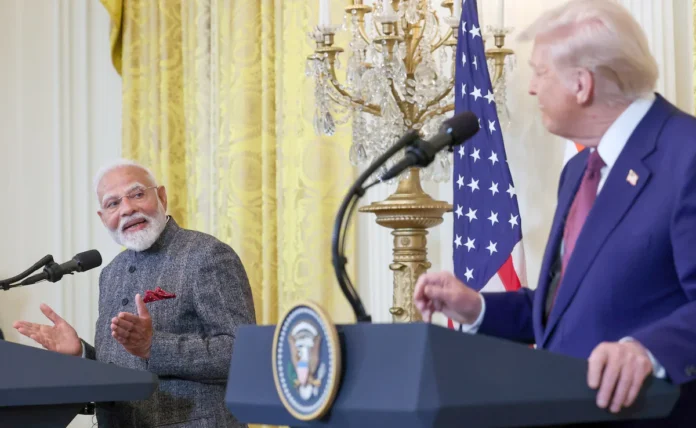
A former senior U.S. official has sparked debate in Washington’s foreign policy circles by asserting that former President Donald Trump “mismanaged” America’s relationship with India — a nation he described as a “major, major counterweight against China.” The remarks highlight a growing consensus among diplomatic observers that Trump’s transactional approach may have undermined long-term strategic gains in one of the 21st century’s most crucial partnerships.
India’s Strategic Value in the Indo-Pacific
India has long been seen by U.S. policymakers as a key partner in balancing China’s expanding influence across Asia. As the world’s largest democracy, a rapidly growing economy, and a regional power with significant military capabilities, India is central to Washington’s Indo-Pacific strategy.
The ex-official emphasized that during a time when Beijing’s assertiveness was rising — from the South China Sea to the Himalayan border — Washington should have strengthened its ties with New Delhi. Instead, he argued, Trump’s unpredictable foreign policy and emphasis on trade deficits created avoidable frictions.
Trade Tensions Overshadowed Strategic Cooperation
Under the Trump administration, Washington frequently clashed with India over tariffs, trade balances, and market access. The U.S. withdrew India’s preferential trade status under the Generalized System of Preferences (GSP) in 2019, a move that angered New Delhi and dampened bilateral trade momentum.
Analysts believe this focus on short-term economic grievances overshadowed the broader strategic imperative of cultivating India as a stabilizing force in the Indo-Pacific region. “India should have been treated as a partner in shaping the regional order, not as a competitor in trade negotiations,” the ex-official reportedly noted.
Missed Opportunities for Deeper Partnership
While the Trump administration did advance defense cooperation — signing key agreements like COMCASA and BECA — critics argue that the overall relationship lacked strategic consistency. Diplomats say Washington could have done more to institutionalize joint initiatives in technology, infrastructure, and supply-chain security, areas where cooperation would have served as a direct counterbalance to China’s influence.
The ex-official suggested that Trump’s personal diplomacy style, which often prioritized spectacle over substance, prevented deeper trust from taking root. “Public displays of friendship, such as the ‘Namaste Trump’ rally in Ahmedabad, were impressive optics,” he said, “but they didn’t translate into coherent policy outcomes.”
The China Factor: A Lost Strategic Window
At a time when China’s Belt and Road Initiative (BRI) was expanding across Asia, the U.S. had an opportunity to work more closely with India on alternative infrastructure and connectivity frameworks. The official lamented that Washington’s inconsistent engagement allowed Beijing to consolidate its economic and political influence in South Asia.
The 2020 border clashes between India and China in Ladakh further underscored India’s strategic role. However, U.S. support during that crisis was largely rhetorical. “That was a moment when Washington could have decisively backed India with diplomatic and defense assurances,” the former official said, “but the administration’s focus was elsewhere.”
Contrast With the Biden Administration
The Biden administration has since taken a more structured approach, revitalizing the Quadrilateral Security Dialogue (Quad) involving India, Japan, Australia, and the United States. The framework aims to promote a free, open, and secure Indo-Pacific.
According to experts, Biden’s approach builds on, but also corrects, Trump’s legacy by institutionalizing collaboration instead of relying on personal rapport. Regular strategic dialogues, defense exercises like Malabar, and initiatives in clean energy and technology have reaffirmed India’s position as a trusted partner in the U.S. strategic calculus.
India’s Perspective
From New Delhi’s standpoint, the Trump era was a mixed bag — marked by strong rhetoric of friendship but limited policy follow-through. India appreciated Trump’s tough stance on China but remained wary of the U.S.’s inward-looking trade policies and reluctance to support multilateral frameworks where India sought a greater voice.
Indian officials have repeatedly emphasized that while they welcome strong ties with Washington, they expect the relationship to be based on mutual respect and long-term strategic alignment rather than short-term political optics.
Conclusion: A Partnership Too Important to Falter
The former U.S. official’s remarks serve as a reminder that the U.S.–India partnership is more than a bilateral relationship — it is a strategic necessity in a rapidly changing world order. As China continues to expand its geopolitical footprint, the U.S. and India remain natural partners in defending democratic values, open markets, and a rules-based international system.
While the Trump years saw both progress and missteps, the enduring strength of the U.S.–India relationship lies in its bipartisan appeal and shared vision for the Indo-Pacific. The challenge now, as many analysts agree, is to ensure that future administrations treat India not just as an ally of convenience but as an indispensable partner in shaping the global balance of power.