

By Subhash Chandra Agrawal
India today stands at a decisive moment in safeguarding public health. With rising lifestyle diseases, growing addiction patterns, and an urgent need to preserve family wellbeing, it is time to revisit the nation’s policies on alcohol, tobacco, cola drinks and unhealthy food habits. Evidence from within India shows that prohibition, when sincerely implemented, can transform households, health outcomes, and even state economies.
Total Prohibition: A Proven Public-Health Intervention from Bihar
After Gujarat, Bihar became the second state to successfully implement total prohibition — and the results, as revealed by the Development Management Institute (DMI), Patna, were remarkable:
Honey consumption increased by 380%
Cheese consumption rose by 200%
Other milk-based products saw 19–29% growth
Entertainment-tax collection grew by 29%
Sales of vehicles — four-wheelers, tractors, two-wheelers, three-wheelers — surged by around 30%
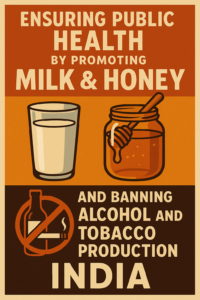
These changes reflect more than altered spending habits. They signal social upliftment — families, especially women and children, benefitted as household income earlier spent on alcohol was redirected toward food, health, education, and productivity.
The nationwide lockdown during COVID-19 unintentionally revealed the same truth: lakhs of habitual drinkers were forced into involuntary abstinence and successfully adapted. This opens the door for a national-level rethink on prohibition.
A Way Forward
India may now consider: A national ban on the manufacture of liquor Eliminating liquor service in government events Temporary allowance for imported liquor only for foreign visitors, with extremely high GST and cess Beer as a transition product, marketed like soft drinks to reduce harmful drinking patterns Just as India became a global leader in Yoga, it can become a model nation advocating for alcohol-free societal growth.
Ban on Manufacture & Sale of Cigarettes and Tobacco Products
Tobacco remains one of the largest preventable killers. While states like Haryana attempted a full ban on gutka, paan masala, and scented tobacco (notification dated 27.09.2021), smuggling from nearby states hindered success. This is why only a Central Government ban can be effective.
India can take inspiration from Bhutan and Ireland, both of which prohibited cigarette sales entirely. Families of smokers, who bear the emotional and financial cost of tobacco-related illnesses, would be the strongest supporters of such a ban. If society relies only on self-regulation for addiction control, then by that logic even helmets and suicide prevention laws should be optional — which is neither practical nor safe.
The revenue loss argument is misleading. The public exchequer spends far more on tobacco-induced diseases than it earns from tobacco taxes. A national ban would lead to net savings in healthcare expenditure and productivity.
Furthermore:
Only FSSAI-certified supari and paan masala without tobacco should be allowed. No-Tobacco Day on 31st May is symbolic unless accompanied by legislative action. Ban Cola Drinks — Revive Traditional Indian Flavoured Beverages
Amitabh Bachchan publicly disclosed at IIM Ahmedabad that he stopped endorsing cola beverages after a child informed him about harmful ingredients in such drinks.
Global cola-makers themselves stopped selling colas in schools worldwide due to rising childhood obesity. Indian parliamentary canteens too do not serve them.
India should therefore:Ban advertising and sale of cola drinks in the country .Encourage traditional Indian alternatives such as rose sherbet, herbal drinks, fruit-based beverages .Support local entrepreneurs and FMCG players to build a Make in India soft-drink revolution .A revival of traditional drinks, manufactured at scale by modern industry, could even challenge the global dominance of multinational cola giants.
Replace White Sugar Cubes with Honey Cubes & Brown Sugar In 2019, the Union Government announced plans to promote honey cubes — a healthier alternative to white sugar cubes — especially to support farmers and tribal communities.
However, implementation remains slow. To improve public health: Production and distribution of honey cubes should be fast-tracked Hotels, clubs and restaurants should be encouraged — even mandated — to offer honey cubes or brown sugar instead of white sugar Large-scale production of brown sugar will narrow the price gap, making it affordable for all Reducing white sugar consumption can significantly reduce the rising incidence of early-age diabetes Promote Organised-Sector Milk Products — Ensure Food Safety
In major cities like Delhi, where Mother Dairy, Amul, Vita, Verka, Sudha, Saras and Nandini have strong market presence, only branded milk should be permitted for sale.
Reasons:
Unorganised khoya and paneer production often leads to widespread adulteration, especially during festive seasons like Diwali . The actual milk available in Delhi cannot logically produce the enormous quantities of khoya sold — indicating rampant spurious production
To safeguard consumers:
Only organised-sector khoya and paneer should be allowed for saleMother Dairy and Amul should consider door-delivery for bulk khoya orders on advance booking
Mother Dairy should reduce fat content in its khoya to improve usability and cost-efficiency, diverting excess fat into ghee and butter production
It is also a moment of pride that Amul ranked 15th among the world’s top 100 most valuable food brands (Brand Finance Food & Drink 2021). Strengthening India’s cooperative dairy ecosystem serves both public health and economic interests.
A Public-Health Blueprint Aligned With National Well-Being
The combined proposals — prohibition, tobacco ban, cola restrictions, healthier sweetening alternatives, and safer milk products — present a holistic roadmap to rebuild India’s public-health environment.
If implemented sincerely:
Families will save more Lifestyle diseases will reduce Crime linked to addiction will decline Indigenous industries (honey, dairy, traditional beverages) will thrive India can lead a global movement toward healthy living, just as it did with Yoga.