

EDIT-POLL REFORMS Click Here
New Delhi: The idea of ‘One Nation, One Election’ (ONOE) is once again at the centre of India’s electoral reform debate, with policymakers examining how the country can move from its current cycle of staggered elections to a system in which Lok Sabha and State Assembly elections are synchronised.
The proposal is not entirely new. India held simultaneous elections to the Lok Sabha and State Assemblies from 1951-52 until 1967, before premature dissolutions of several legislatures disrupted the common electoral cycle.
Why Major Electoral Reforms Are Needed
Implementing simultaneous elections would require substantial constitutional, legal, administrative and logistical changes. The parliamentary committee examining the proposal is currently consulting state governments, political parties, constitutional experts, civil society organisations and other stakeholders to develop a mechanism that can command wider political acceptance.
One of the biggest challenges is dealing with premature dissolution of governments. Under the existing parliamentary system, a government can fall before completing its five-year term. Any ONOE framework would therefore need a clear mechanism for handling a hung House, a vote of no confidence or the collapse of a coalition without permanently disturbing the synchronised electoral cycle.
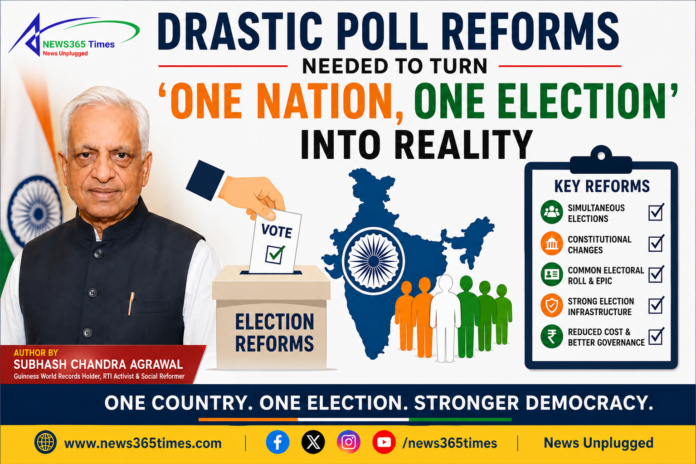
Another important reform concerns electoral rolls and voter identification. The High-Level Committee on Simultaneous Elections had recommended a common electoral roll and common Electoral Photo Identity Cards for elections at different levels of government.
Strengthening the Election Machinery
A nationwide simultaneous election would place enormous demands on the Election Commission and the country’s administrative machinery. The availability of electronic voting machines, voter-verifiable paper audit trail units, security personnel, polling staff and transportation infrastructure would need to be planned well in advance.
In July 2026, the Election Commission was reported to have indicated that it could conduct simultaneous Lok Sabha and Assembly elections with six months’ notice, suggesting that logistical preparedness is being actively assessed.
The parliamentary panel has also been examining whether elections could be synchronised in phases rather than requiring every constituency to vote on a single day. Committee Chairman P.P. Chaudhary has said that ONOE does not necessarily mean voting across the entire country on one day; elections could still be conducted in multiple phases within a common electoral cycle.
Potential Economic and Governance Benefits
Supporters of simultaneous elections argue that frequent polls consume substantial public resources and repeatedly divert government officials, teachers, security personnel and administrative machinery towards election duties.
The Joint Parliamentary Committee has cited estimates suggesting that synchronised elections could generate significant economic benefits by reducing repeated election expenditure and administrative disruption. The committee has also argued that frequent elections can affect governance, education, investment, tourism and industrial activity.
Reducing the frequency of election-related Model Code of Conduct restrictions is another argument advanced by supporters. A more predictable electoral calendar could allow governments to focus on longer-term policymaking and implementation rather than operating under repeated election pressures.
Federalism and Democratic Accountability
However, ONOE also raises important questions about India’s federal structure and democratic accountability. Critics argue that national and state elections serve different political purposes and that synchronising them could increase the influence of national issues over state-level concerns.
There are also questions about what happens when a government loses its majority before the common election cycle ends. Any reform would need constitutional safeguards that preserve the parliamentary principle of government accountability while maintaining electoral synchronisation.
This makes broad political consensus particularly important. The parliamentary committee has repeatedly emphasised the need to evolve a mechanism acceptable to different political parties and stakeholders rather than imposing a purely administrative solution.
The Road Ahead
The government and supporters of ONOE see simultaneous elections as a major electoral reform that could reduce costs, minimise administrative disruption and provide greater continuity in governance. Opponents and constitutional scholars, meanwhile, continue to raise concerns about federalism, accountability and the practical consequences of synchronising elections across a country as diverse as India.
The parliamentary committee is working towards a framework that could potentially make the system operational around the 2029 general elections, although the exact implementation mechanism remains subject to parliamentary consideration and political consensus.
For ‘One Nation, One Election’ to become a genuine reality rather than simply an electoral slogan, India would require deep and carefully designed poll reforms, constitutional safeguards, strong election infrastructure and cooperation among political parties. The success of the proposal will ultimately depend not merely on synchronising polling dates, but on creating a system that preserves India’s federal character while making elections more efficient, predictable and accountable.