

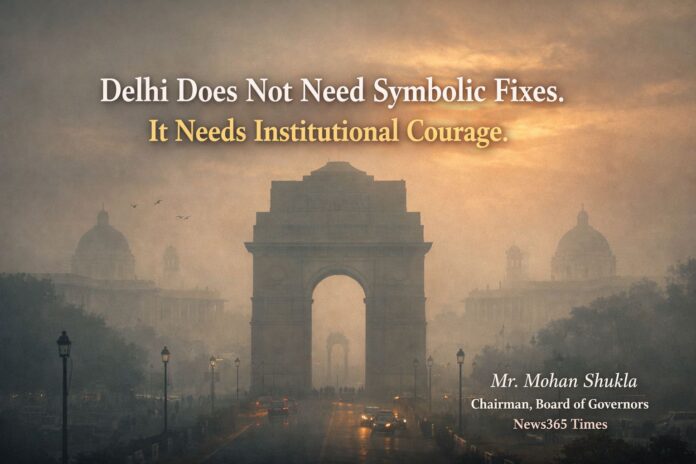
By Mr. Mohan Shukla
Chairman, Board of Governors, News365 Times
I have lived in Delhi for more than 07 decades. I have known this city when mornings were gentle, when trees outnumbered flyovers, and when breathing was never a conscious act. I have also witnessed its transformation into a global capital that is energetic, aspirational — and increasingly breathless.
What troubles me today is not merely the scale of pollution, but our growing acceptance of symbolic fixes as if they were solutions.
Delhi’s air crisis is often described as a seasonal problem. That framing is convenient — and deeply misleading. Pollution does not arrive suddenly every winter; it accumulates patiently through years of fragmented planning, diffused accountability, and short-term decision-making.
DATA CALLOUT | Delhi’s Air: A Structural Decline
- Winter PM2.5 levels routinely exceed safe limits by 8–12 times
- “Severe” air quality days now stretch across months, not weeks
- Pollution peaks have become predictable, repeatable, and normalized
What this tells us: Delhi’s air crisis is structural, not episodic.
The Comfort of Optics
Every year, as air quality deteriorates, we see a familiar pattern: emergency meetings, temporary bans, advisories, and public messaging. These measures are highly visible, politically safe, and administratively convenient. They create an illusion of action without demanding systemic change.
But air pollution is not an optical problem. It is a governance problem.
Symbolism diverts attention from the real questions:
Who plans urban density?
Who enforces construction discipline?
Who ensures industrial compliance beyond paperwork?
Who owns outcomes across state boundaries in a shared airshed?
When these questions remain unanswered, accountability quietly evaporates.
A Governance Failure Disguised as an Environmental Issue
Delhi does not suffer from lack of data or expertise. We have studies, task forces, expert committees, and global comparisons in abundance. What we lack is institutional courage — the willingness to take hard decisions, sustain them beyond political cycles, and enforce them without exception.
Air quality management today is spread across overlapping jurisdictions, each with partial authority and limited accountability. In such a system, responsibility is shared, but ownership is absent. A city cannot clean its air through coordination alone; it requires empowered institutions with measurable targets and enforcement authority.
DATA CALLOUT | Health Impact: The Invisible Emergency
-
- Higher incidence of cardiac and respiratory disease
- Reduced lung capacity in children
- Lower life expectancy for urban populationsLong-term exposure to polluted air is linked to:
- Hospitals report seasonal spikes in respiratory distress, especially among children and the elderly
What this tells us:
Air pollution is not an inconvenience — it is a public health emergency with long-term social and economic costs.
Citizens Are Not the Culprits
A worrying trend in recent years is the subtle shifting of blame toward ordinary citizens — their habits, livelihoods, or daily choices. This narrative is neither fair nor effective.
Citizens did not design unplanned urban sprawl.
Citizens did not delay mass public transport investments.
Citizens did not weaken environmental enforcement.
Yes, public participation matters. But systems shape behaviour far more than advisories ever can. Leadership must begin at the institutional level, not end with moral lectures.
From Seasonal Panic to Structural Reform
If Delhi is to reclaim its right to breathe, three shifts are unavoidable:
First, unified airshed governance.
Air does not recognise administrative boundaries. Delhi and its surrounding regions must be governed as one ecological unit, with a single empowered authority accountable for outcomes.
Second, technology-led enforcement.
Continuous emissions monitoring, automated compliance systems, and transparent public dashboards must replace discretionary, inspection-heavy models that invite inconsistency.
Third, urban design that respects breathing space.
Transport-first planning, disciplined construction practices, green buffers, and ventilation corridors are as critical as emission norms.
A City Still Worth Fighting For
Despite everything, I remain hopeful. I have seen Delhi recover from crises before. What it needs now is not louder debate, but quiet resolve. Not more symbolism, but science-backed execution. Not seasonal outrage, but institutional continuity.
Air pollution is a test of governance maturity. The true measure of leadership will not be in announcements made during smog-filled weeks, but in policies sustained when the skies temporarily clear.
Delhi does not need symbolic fixes.
It needs institutional courage — the courage to plan long-term, enforce fairly, and act decisively.
Only then can this city, which has given so much to generations of its citizens, reclaim its most basic right: the right to breathe.
Editor’s Note:
This column reflects the personal views of the author, drawing on over 07 decades of lived experience in Delhi and his role in public-policy discourse through News365 Times.