

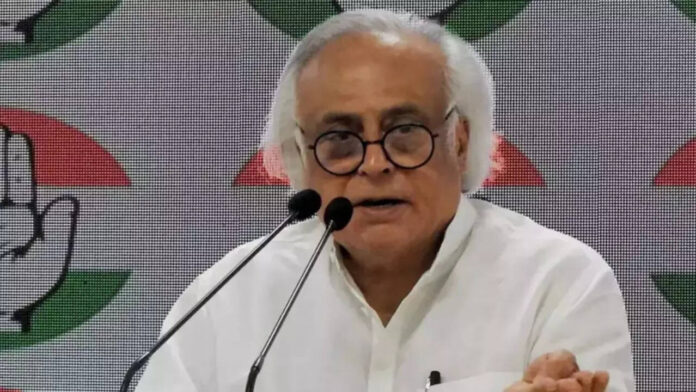
Senior Congress leader and Member of Parliament Jairam Ramesh has raised strong concerns over the sudden withdrawal of a working paper by NITI Aayog that reportedly analyzed Indo-U.S. trade relations. The paper, which was briefly available on the government think tank’s website, was removed without explanation — prompting speculation and criticism over transparency and policy suppression.
A Silent Take-down Sparks Political Noise
Ramesh, known for his sharp interventions on economic and environmental issues, took to social media to highlight the development. In his post, he questioned why a document authored by reputed economists under the aegis of NITI Aayog would be withdrawn unless it contained analysis or conclusions that were “politically inconvenient” to the Modi government.
“Why has NITI Aayog removed its own working paper on Indo-U.S. trade? Was it because it didn’t match the official narrative? This smacks of intellectual dishonesty and political censorship,” Ramesh stated.
What the Paper Reportedly Said
While the full contents of the withdrawn working paper have not been officially disclosed, sources familiar with its content suggest it critically examined trade imbalances between India and the United States, the constraints faced by Indian exporters, and raised questions about India’s current strategy of trade alignment amid growing geopolitical convergence with the U.S.
The paper is also believed to have analyzed the potential fallout of deeper Indo-U.S. digital trade agreements, particularly on data localization and domestic tech sovereignty — areas where the Indian government has maintained a guarded stance.
NITI Aayog Remains Silent
NITI Aayog, the government’s apex policy think tank, has not issued any public clarification regarding the withdrawal. Its website, which previously hosted the document under the “Working Papers” section, no longer lists it.
This lack of transparency has led to broader concerns among academics and policy observers. Critics argue that suppressing policy research undermines the independence of institutions like NITI Aayog and discourages data-driven decision-making.
Opposition Sees Political Motive
The Congress party has seized on the episode to accuse the government of manipulating official narratives and suppressing internal critique. Ramesh called the move “part of a pattern” where institutions are being stifled to prevent any divergence from the government’s preferred storylines, especially in areas like economic policy, foreign relations, and climate strategy.
“First it was environmental clearances, then GDP back series data, and now this. What is this government so afraid of?” Ramesh asked.
Broader Implications for Policy Transparency
This incident adds to growing concerns about the government’s control over institutional autonomy. Analysts say that NITI Aayog, which replaced the Planning Commission with the promise of being a modern, forward-looking, and data-driven body, risks losing its credibility if it is seen to be toeing the government’s line rather than offering candid analysis.
Call for Reinstatement
Several voices from academia and civil society have now joined the call for NITI Aayog to reinstate the withdrawn paper and to reaffirm its commitment to independent research. Former bureaucrats and economists have pointed out that working papers are intended to generate debate — and their removal, especially without explanation, defeats their very purpose.
The withdrawal of the Indo-U.S. trade working paper may seem like a bureaucratic footnote, but it has sparked a broader debate on freedom of research, institutional transparency, and the government’s comfort with critique. Whether NITI Aayog responds or maintains silence, the episode underscores a deeper tension between policy and politics in today’s India.