

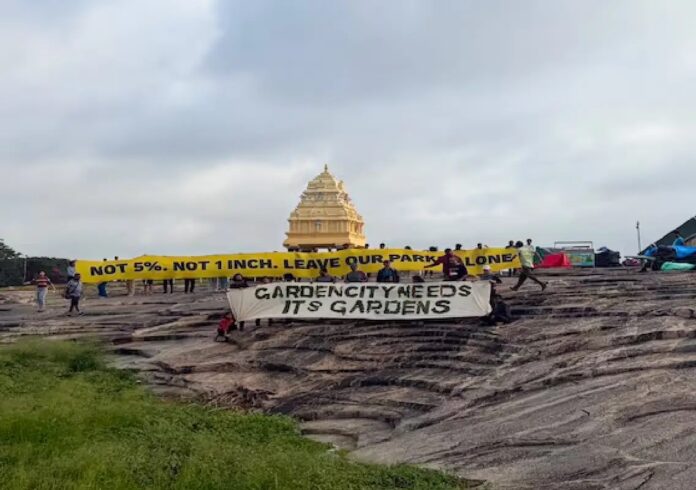
Bengaluru: Karnataka’s recent amendments to two laws have triggered strong concerns among citizen groups and environmental organisations in Bengaluru, particularly over their possible connection with the proposed North-South Twin Tunnel project.
The Karnataka legislature passed amendments to the Bengaluru Metropolitan Land Transport Authority (BMLTA) Act, 2022 and the Karnataka Government Parks (Preservation) Act, 1975 on August 24. The changes have drawn criticism from civic groups, who fear they could weaken safeguards for major urban mobility projects and allow infrastructure projects to use portions of public parks.
The controversy has gained further attention because the proposed tunnel road is planned to pass beneath or near Lalbagh, one of Bengaluru’s most important historic green spaces.
Why the BMLTA amendment is facing criticism
The amendment to the BMLTA Act provides legal continuity to urban transport projects undertaken after the Act came into force in 2022 but before the notification of the BMLTA Rules in 2026.
Under the BMLTA framework, major urban mobility projects within the Urban Mobility Region require approval from the authority. The authority also has a role in projects seeking state financial assistance and certain other forms of government support.
Citizen groups fear the amendment could effectively give statutory backing to projects initiated during the intervening period without subjecting them to the full scrutiny originally envisaged under the BMLTA framework.
They argue that such a provision could have implications beyond the tunnel road, potentially affecting other major projects such as flyovers and elevated corridors.
Parks law amendment raises green-space concerns
The second amendment concerns the Karnataka Government Parks (Preservation) Act. The change permits the State Government, subject to specified conditions, to approve the use or alienation of a portion of government parks and gardens for public infrastructure and public utility projects.
The amendment places a 5 per cent ceiling on the portion of a park or garden that can be used for such purposes. A High Level Committee headed by an officer of at least the rank of Additional Chief Secretary is to examine proposals and make recommendations.
The government has said the provision is intended to facilitate projects serving a public purpose, such as road widening and other infrastructure requirements.
However, environmentalists and citizen groups fear that the provision could weaken longstanding protections for Bengaluru’s remaining green spaces.
Lalbagh at the centre of the debate
Lalbagh has become a particular focus of the controversy because the proposed North-South Twin Tunnel project is expected to pass through the area.
According to concerns cited by environmentalists, the project could require around six acres of Lalbagh temporarily during construction and about one acre permanently. Activists have warned that construction could have implications for the garden’s geological formations, trees and biodiversity.
The government, however, has maintained that the tunnel would pass beneath only a small portion of Lalbagh and that any requirement for park land during construction could be temporary.
The disagreement highlights a wider question facing Bengaluru: how should the city balance its urgent need for transport infrastructure with the protection of its limited public green spaces?
Citizen groups demand alternatives
More than 200 citizens, resident groups, environmental organisations and civil society groups have opposed the parks amendment and called for its withdrawal.
They have sought alternatives that would avoid the use of park land and demanded wider public consultation before decisions affecting Bengaluru’s green spaces are taken.
The groups have also called for comprehensive environmental, social, health and wellbeing assessments of major infrastructure projects.
Their concern is not limited to the present tunnel project. They fear that once the legal provision is available, it could potentially be used for other infrastructure proposals in the future.
Tunnel project adds to the controversy
The amendments have also come under scrutiny in the context of legal challenges to the North-South Twin Tunnel project. Three public interest litigations before the Karnataka High Court have questioned aspects of the project’s compliance with existing laws.
The timing of the legislative changes has therefore attracted additional attention.
The controversy intensified after Adani Group chairman Gautam Adani met Karnataka Chief Minister D K Shivakumar, a day before the legislature passed the amendments. Adani Group has emerged as the lowest bidder for the proposed tunnel road project.
Citizen groups and political opponents have questioned whether the amendments could help remove legal obstacles facing the project. The government has defended the changes as measures aimed at providing legal clarity and facilitating public infrastructure.
Government defends need for infrastructure
Chief Minister D K Shivakumar has maintained that the tunnel project would require only limited intervention in Lalbagh and has argued that Bengaluru needs major infrastructure solutions to address its growing traffic problems.
The government’s position is that carefully regulated use of a small portion of public land for infrastructure can be permitted when there is a clear public interest, subject to environmental and other safeguards.
Opponents, however, argue that Bengaluru’s parks and open spaces are already under pressure and that allowing even limited diversion could establish a precedent for future projects.
The debate therefore goes beyond one tunnel road or one amendment. It raises fundamental questions about how Bengaluru should plan its future, how much weight should be given to citizen participation and environmental protection, and whether major infrastructure decisions should be taken only after alternatives have been thoroughly examined.
A larger question for Bengaluru
Bengaluru urgently needs better transport infrastructure, but the city’s development also depends on protecting its ecological assets and ensuring transparent urban planning.
The latest amendments have brought these competing priorities into sharp focus. While the government sees the changes as necessary to provide legal continuity and enable public infrastructure, citizen groups fear that they could dilute safeguards designed to protect mobility planning and public green spaces.
As legal challenges and public opposition continue, the coming months are likely to determine whether the tunnel project can proceed without significant environmental intervention and whether the amended laws withstand the scrutiny of courts, experts and Bengaluru’s increasingly vocal citizen groups.