

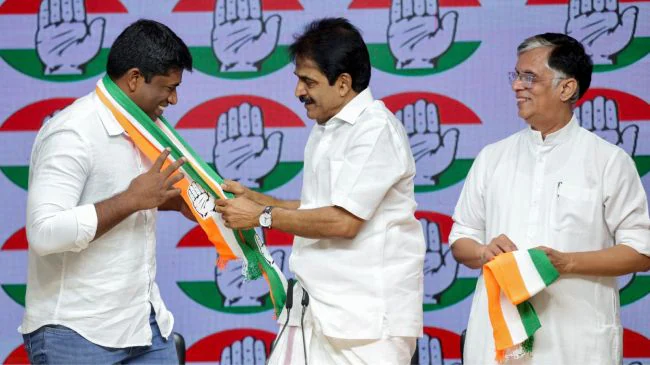
In a significant political development, former IAS officer Kannan Gopinathan has officially joined the Congress party, marking his formal entry into active politics. His decision has once again brought into focus the long-debated issue of bureaucrats joining political parties after serving in the civil services. It also raises important questions about the rules governing political participation of officers belonging to the Indian Administrative Service (IAS), Indian Police Service (IPS), and Indian Forest Service (IFoS).
Background: From Bureaucrat to Political Figure
Kannan Gopinathan, who served as an IAS officer in the 2012 batch from the AGMUT cadre, first came into the limelight for his resignation in 2019. He had stepped down citing concerns over restrictions on civil liberties following the abrogation of Article 370 in Jammu and Kashmir. Since then, Gopinathan has been an active voice in public discourse, often expressing his opinions on governance, democracy, and public accountability. His joining the Congress is seen as a natural extension of his long-standing engagement with political and civic issues.
The Conduct Rules for Serving Officers
Under the All India Services (Conduct) Rules, 1968, serving IAS officers are expressly prohibited from participating in political activity. Rule 5 of these conduct guidelines clearly states that no member of the Service shall be associated with any political party or take part in any political movement or activity.
This rule aims to preserve the neutrality, impartiality, and independence of the civil services — qualities essential for a professional bureaucracy in a democratic framework. Officers are expected to serve the government of the day with loyalty and objectivity, without being influenced by political ideologies or affiliations.
Additionally, these rules bar officers from publicly expressing opinions that could be construed as political in nature or from criticizing government policies in a manner that undermines official neutrality.
Post-Resignation Scenario
Once an officer resigns and their resignation is formally accepted by the competent authority, they cease to be bound by service conduct rules. At that point, the individual becomes a private citizen, free to pursue political, social, or professional activities of their choice, including joining a political party.
In Gopinathan’s case, his resignation from the IAS — though initially met with bureaucratic delay — was eventually processed, and he ceased to be part of the service structure. Thus, his decision to join the Congress now does not violate any existing legal or administrative provision.
Why These Rules Exist
The ban on political activity by serving officers stems from the need to maintain administrative impartiality. Bureaucrats play a vital role in policy implementation, public administration, and maintaining law and order. Their actions directly affect citizens irrespective of political affiliations. Allowing them to take political sides could erode public trust and undermine the integrity of the civil service.
Moreover, India’s Constitution envisages a permanent bureaucracy that serves successive governments with equal professionalism. To achieve this, officers must remain insulated from partisan politics during their tenure.
Precedents and Similar Cases
There have been several instances in the past where former IAS, IPS, and IFS officers joined politics after leaving the service. Prominent examples include Arvind Kejriwal, who resigned from the IRS before founding the Aam Aadmi Party; Shah Faesal, who left the IAS to form his own political outfit; and Yashwant Sinha, who joined politics after serving as a bureaucrat.
Such transitions often reignite debates about the “cooling-off period” — whether officers should be required to wait for a fixed time after resignation before joining politics, to prevent conflicts of interest. While no such rule currently exists, it remains a topic of discussion among policy experts.
Ethical and Institutional Implications
While legally permissible after resignation, the move from bureaucracy to politics raises ethical questions. Critics argue that officers with access to sensitive policy information could exploit it for political advantage. Supporters, however, believe that experienced administrators bring valuable insights and integrity into politics, enhancing governance quality.
In Gopinathan’s case, his outspoken activism and consistent focus on governance issues suggest a transition motivated by ideals rather than ambition. Yet, his entry also underscores the increasingly porous line between administration and politics in modern India.
Conclusion
Kannan Gopinathan’s decision to join the Congress marks a new chapter in his public life — one that transitions from service within the system to seeking change through political participation. His journey also reopens the debate about how India balances bureaucratic neutrality with democratic participation.
The service rules remain clear: while in office, IAS officers must stay away from politics to maintain the integrity of the administrative system. But once outside the bureaucratic framework, their right to political expression is protected — a reflection of India’s democratic values that allow every citizen, including former civil servants, to contribute to the nation’s political discourse.