

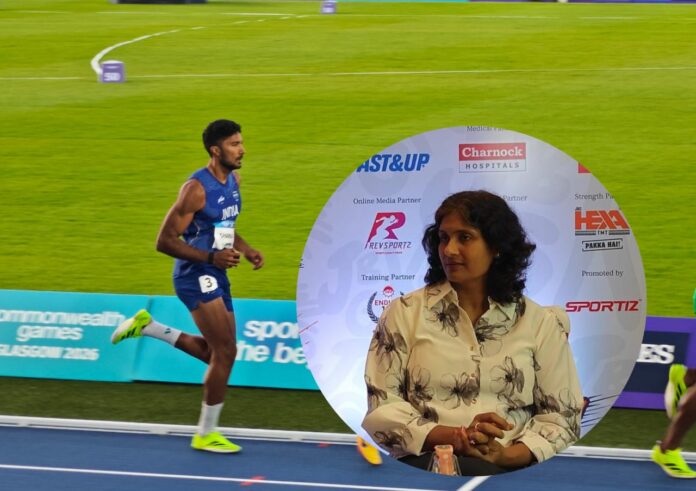
Tejaswin Shankar’s bronze medal in the decathlon at the Glasgow Commonwealth Games was more than just another addition to India’s medal tally. For former Indian heptathlete Soma Biswas, it was a performance that deserved to be celebrated at the very top of the country’s athletics achievements.
Shankar produced a landmark performance, scoring 7976 points to bag India’s first-ever CWG decathlon medal. Doing so after a difficult period in which his participation itself had been in doubt because of a patella tendon injury following his high jump event made the achievement even more special. His ability to return from injury, compete across 10 gruelling events and finish with a bronze medal made the achievement all the more significant.
Biswas, a two-time Asian Games silver medallist in the heptathlon, said she could understand the magnitude of what Shankar had accomplished, even though she has never met him face-to-face.
“I would rate it right at the top,” Biswas said. “I have never met Tejaswin Shankar face-to-face, but as a senior athlete, I can understand what this performance means. As a senior, I would hug him for what he has achieved.”
For Biswas, the achievement is particularly remarkable because of the unique demands of multi-event athletics.
“He has made the difficult look possible,” she said.
“In athletics, the heptathlon and decathlon are among the most demanding events. They are almost ‘man-killing’ events because you have to compete across so many disciplines, and the physical and mental demands are enormous.”
Biswas knows those demands first-hand. A former national-level heptathlete, she competed at a time when Indian athletes were still trying to establish themselves on the international stage.
Those who compete in multi-event disciplines, she explained, have to possess an unusual level of mental resilience. There is little opportunity to dwell on a bad performance because another event is always waiting.
“If something goes wrong in one event, you have to reset your mind immediately and shift your focus to the next event,” she said.
“There are seven events in the heptathlon and 10 in the decathlon. If you perform well in one event, you have to carry that confidence forward. If something goes wrong, you have to recover quickly.”
That ability to reset, Biswas believes, was central to Shankar’s performance.
“He has shown the world that Indians can be champions. We have the quality. We have the ability to compete at the highest level.”
Shankar’s achievement also represents a significant progression for Indian combined-events athletics. With 7666 points, Shankar won the silver medal at the Hangzhou Asian Games and, this time, he has bettered his score in Glasgow.
Earlier this year, Shankar became the first Indian decathlete to breach the 8,000-point mark, securing his personal best of 8057 points at the Senior National Championships in Ranchi.
Biswas recalled her own competitive days, when even reaching 6,000 points in the heptathlon was considered a major milestone.
“When Pramila and I were competing and crossing 6,000 points, people would say that even reaching that level was a big achievement,” she said.
“I remember my coach saying that I had the quality to go beyond 6,000 points, and people, including those in the federation, would laugh. They would say, ‘Let her do it first.’”
But the barrier was eventually broken.
“Around 20 years ago, we broke that 6,000-point barrier. The 8,000-point barrier may have taken longer, but now it has happened. And once a barrier is broken, you realise that it can be broken again.”
Biswas believes Shankar’s performance can have a similar effect on the generation that follows.
“Tejaswin Shankar has shown that it is possible. And I believe athletes coming through the system will be inspired by this performance.”
The former heptathlete also pointed to the broader change in the mindset of Indian athletes. When she was competing, the idea of becoming an Olympic medallist often seemed distant. Today, athletes are increasingly beginning to see themselves as equals to the best in the world.
“When we were competing, we couldn’t even imagine some of these numbers. Things change with time,” she said.
“Earlier, we were told, ‘You have to become an Olympian.’ Nobody was talking about being an Olympic finalist or a medallist. Our physical preparation was different, our infrastructure was different, but more importantly, our mental approach was different.
“We couldn’t see ourselves at that level.”
According to Biswas, that is perhaps the biggest transformation Indian athletics has undergone.
“So what changed? Did our bodies suddenly change? Did the infrastructure suddenly become world-class? No. Our mentality changed.”
She acknowledged that infrastructure has improved significantly over the years, but believes the greater shift has been psychological.
“Our mentality has changed tremendously. Our boys and girls have now learnt to believe that we are at par with the world.”
That belief is evident beyond the decathlon as well. Biswas cited the performances of athletes such as Neeraj Chopra and Avinash Sable as examples of Indians increasingly challenging traditional notions of where the country can excel.
“We started asking: If Kenya can produce Olympic champions, why can’t India? If Ethiopia can win at the highest level, why can’t we?”
The change, she said, is visible in events where India was once not considered a serious medal contender.
“These medals are always special because they show that Indian athletes are breaking into areas where we were not traditionally considered strong.”
“We are beginning to believe that there is no event that is beyond us. That belief itself is a huge change.”
With another major continental competition approaching, Biswas is optimistic about India’s prospects. India won a record 107 medals at the previous Asian Games, and she believes the country can improve on that performance.
“I think the number will increase,” she said.
“Particularly in athletics, I expect a very strong performance. We are already seeing encouraging signs from our junior athletes at the World Championships. The youngsters are showing that the next generation is ready.”
For Biswas, Shankar’s decathlon bronze is therefore about more than one athlete overcoming injury or one medal being added to India’s tally.
It is about breaking a psychological barrier, and showing the athletes who come next that a feat once considered unimaginable can become the new benchmark.
“I believe India can do much bet
ter than the previous medal tally, and athletics will play a major role in that campaign.”
For more exclusive stories, follow RevSportz
The post “As a Senior, I Would Hug Tejaswin”: Soma Biswas Hails Shankar’s Decathlon Bronze appeared first on Sports News Portal | Revsportz.