

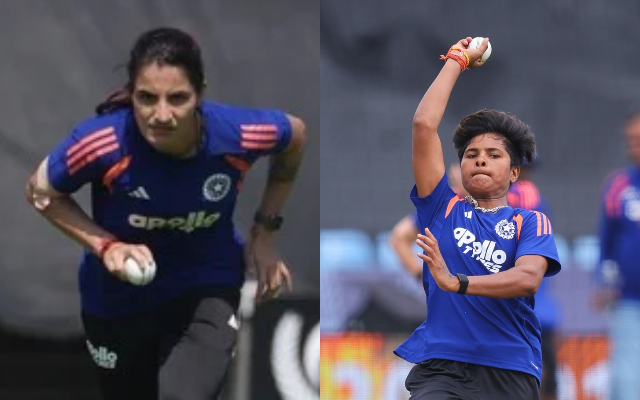
India will take on South Africa on June 21 in the ongoing ICC Women’s T20 World Cup.
With young spinner Shreyanka Patil ruled out of the remainder of the tournament through injury and leg-spinner Prema Rawat drafted in as her replacement, India’s ideal playing XI remains a subject of debate. Two wins from two games have given India the perfect start, but there are still areas that require improvement ahead of key matches against South Africa and Australia. One of the biggest concerns is the inability of the seamers to take wickets consistently in the Powerplay.
Overall, India’s seamers have struggled across the first two matches of the competition, conceding 83 runs in 10 overs and taking just two wickets, with only one of them coming in the Powerplay. In T20 cricket, teams depend heavily on their new-ball bowlers to provide early breakthroughs, but India’s seamers have failed to do so thus far. What makes the numbers more surprising is how different they were during the three-match T20I series against England immediately before the World Cup, when India’s seamers picked up six Powerplay wickets.
The warning signs, however, appeared before the tournament began.
In the warm-up match against West Indies, India failed to take a wicket in the Powerplay. Renuka Singh Thakur returned figures of 0/7 from two overs, while Kranti Gaud conceded 20 runs in her two overs without success.
The second warm-up game against England followed a similar pattern. India conceded 1/39 in the Powerplay, with the lone wicket going to Renuka, who finished with figures of 1/19 from two overs. Kranti again went wicketless, conceding 10 runs from her two overs.

The trend continued in the tournament opener against Pakistan. Although India eventually won comfortably, Pakistan made a strong start in pursuit of 171, reaching 1/52 in the first six overs. Arundhati Reddy (0/21 in two overs) and Kranti (0/14 in one over) bowled three of those six overs, conceding 35 runs without taking a wicket.
Against a relatively weaker Netherlands side, the struggles persisted. The Dutch reached 0/30 after four overs before Nandni Sharma accounted for the only wicket.
It has now become a recurring issue, and a far tougher challenge awaits against South Africa’s dangerous batting line-up.
India’s seamers have lacked discipline, struggled to adjust to the conditions and bowled too many freebies down the leg side. Wides and loose deliveries have allowed opposition batters to get off to flying starts and collect valuable runs at the top of the order.
Ahead of the Proteas clash, both Kranti and Renuka spent considerable time bowling in the nets. Bowling coach Aavishkar Salvi was also involved in lengthy discussions with Renuka and Kranti, often after almost every delivery. He appeared to be discussing possible field placements to Kranti before asking her to bowl according to those plans.
Renuka is yet to feature in the tournament but, with each practice session, her rhythm appears to be returning. Meanwhile, the fact that Arundhati was bowling separately suggested she may not be among the frontrunners for selection. If India are searching for early breakthroughs, they may be tempted to turn to the experience of Renuka.

However, recent performances against South Africa’s batters in the Powerplay have not been particularly encouraging either.
Before travelling to England, India lost 4-1 to South Africa in a five-match T20I series. Across those five games, India managed only two Powerplay wickets, and just one of them came from a seamer, with Kranti striking in the fourth T20I.
The numbers tell the story:
1st T20I – South Africa Powerplay: 53/1 (no wicket by a seamer)
2nd T20I – South Africa Powerplay: 66/0
3rd T20I – South Africa Powerplay: 72/0
4th T20I – South Africa Powerplay: 59/1 (wicket taken by Kranti)
5th T20I – South Africa Powerplay: 49/0
The figures offer little encouragement heading into Sunday’s clash.
Salvi’s lengthy conversations with Renuka and Kranti suggest that the problem has been identified and that work is being done behind the scenes. But the bigger question remains one of execution.
In a World Cup match, under pressure and against quality batters such as Laura Wolvaardt, Sune Luus and company, how effectively can India’s seamers execute their plans and make an impact with the new ball?
For More Exciting Articles: Follow RevSportz
The post Ahead of South Africa Clash, India Seek Answers to Their Powerplay Bowling Woes appeared first on Sports News Portal | Revsportz.