

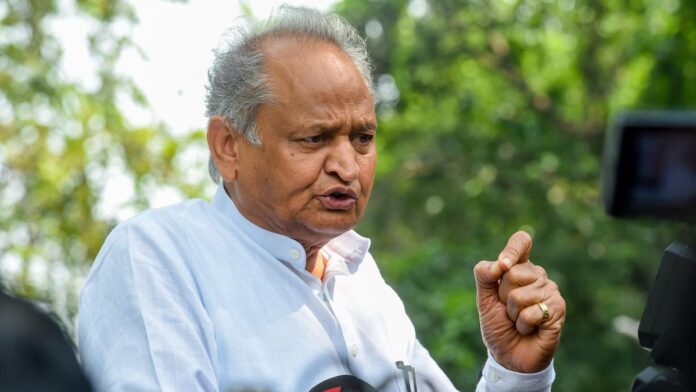
Rajasthan Chief Minister Ashok Gehlot’s recent comments on the ongoing political deadlock in Bihar have triggered a fresh round of political debate. Speaking on the impasse within the INDIA bloc—a coalition of opposition parties vying to challenge the ruling NDA in the state—Gehlot referred to the disputes over seat-sharing and leadership as a “friendly fight.” While the remark was likely intended to convey optimism and a spirit of cooperation, it quickly drew a pointed response from Lok Janshakti Party (LJP) leader Chirag Paswan.
The INDIA bloc, composed of parties such as the Rashtriya Janata Dal (RJD), Congress, and several regional allies, has faced internal friction over candidate allocations and alliance strategies ahead of upcoming elections. Gehlot, known for his conciliatory style, described the disagreements as normal in a coalition, emphasizing that “friendly fights” are part of the democratic process and do not undermine the bloc’s larger objective of providing a united alternative to the NDA.
However, Chirag Paswan, whose party has maintained a fluctuating stance regarding alliances in Bihar, took a subtle dig at Gehlot’s remarks. In statements to the media, Paswan suggested that the “friendly fight” narrative may be oversimplifying serious differences within the INDIA bloc, hinting that personal ambitions and regional calculations are creating deeper challenges than mere friendly banter. Political observers note that Paswan’s comments reflect both his skepticism of the Congress-led narrative and his broader strategy to position the LJP as a decisive player in Bihar politics.
The exchange highlights the intricate dynamics of coalition politics in Bihar. While the INDIA bloc projects unity publicly, behind-the-scenes negotiations remain complex, with regional leaders asserting their influence and negotiating for favorable electoral outcomes. Gehlot’s framing of disagreements as “friendly” may aim to reassure party workers and voters, portraying a sense of stability even amidst internal debates. Conversely, Paswan’s remarks serve to remind the public and coalition partners that these disputes could have tangible electoral consequences.
Political analysts suggest that such public exchanges, though seemingly minor, can influence perceptions among voters, particularly in a state like Bihar where caste equations, party loyalty, and leadership credibility are highly sensitive factors. The India bloc’s ability to manage internal differences while presenting a cohesive electoral front will be crucial in determining its performance in the upcoming polls.
In conclusion, Ashok Gehlot’s “friendly fight” remark underscores the balancing act required in coalition politics, where leadership must maintain unity without ignoring legitimate differences. Chirag Paswan’s pointed response, meanwhile, signals the persistent undercurrents of contestation within the INDIA bloc. As Bihar approaches a high-stakes electoral season, the interplay of collaboration and rivalry among opposition parties will remain a defining feature of the state’s political landscape.