

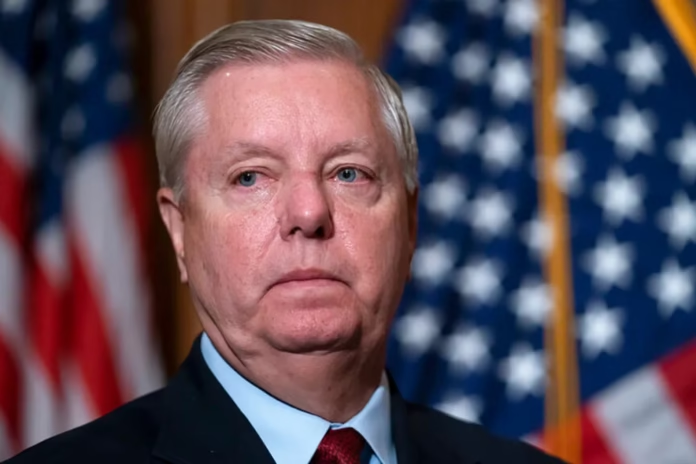
US Senator Lindsey Graham has once again targeted India with a scathing rebuke over its purchase of Russian oil, linking it to the deadly strikes on Kyiv and accusing the nation of bearing the “cost of supporting Putin.” In a public statement, Graham posed the provocative question, “How do you feel right now that your purchases have resulted in innocent civilians, including children, being killed?” following a barrage of Russian missile attacks that killed dozens in the Ukrainian capital. This blunt condemnation has drawn sharp reactions from Indian leadership, who defend their energy security choices, thrusting the India-US relationship into a contentious spotlight and raising questions about the sincerity of global alliances.
Background Reveals Geopolitical Chessboard
The strategic context of Graham’s remarks stems from the ongoing Russia-Ukraine conflict, where India’s decision to buy discounted Russian oil has become a flashpoint in Western sanctions efforts. Graham, a vocal supporter of Ukraine, ties India’s trade—alongside China and Brazil—to funding Putin’s war machine, a narrative echoed by the Trump administration’s recent 50% tariffs on Indian goods. India’s historical reliance on West Asian oil has shifted toward Russia since 2022, prompting US pressure, while Kyiv’s devastation amplifies the moral weight of the accusation. X posts reflect a polarized discourse, with some applauding Graham’s stance and others decrying it as hypocritical given the US’s own energy deals, highlighting the complex interplay of ethics and geopolitics.
Impacts Strain Alliances and Economies
The implications of this rebuke span diplomatic, economic, and social realms. Diplomatically, the statement risks fracturing India-US ties, a key pillar of the Quad alliance, as India asserts its strategic autonomy under Modi’s leadership. Economically, the tariffs and public shaming could disrupt India’s $48.2 billion export market to the US, pushing it toward alternative partners like Russia and China, while affecting global oil markets. Socially, the accusation has stirred nationalist sentiments in India, with some viewing it as an unfair attack on a sovereign choice, though it also exposes domestic debates over energy policy. Operationally, the rhetoric may complicate peace negotiations, challenging the establishment’s narrative of unified Western resolve.
Hurdles Complicate Resolution Path
Significant challenges arise amid this diplomatic spat. Operationally, managing the fallout requires delicate negotiations, with potential missteps risking further sanctions or trade wars. Economically and socially, the tariffs could hit Indian industries hard, leading to job losses and inflaming public opinion, while US consumers may face higher costs for Indian goods. Policy risks include heightened tensions with Russia if India doubles down, and the establishment’s portrayal of Graham’s comments as principled leadership invites skepticism, given the selective targeting of India over other oil buyers like China. The complexity suggests a need for nuanced dialogue, yet political posturing may deepen the divide.
Prospects Offer Chance for Strategic Dialogue
Despite the obstacles, opportunities exist for constructive engagement. Diplomatically, the controversy could prompt a recalibration of India-US relations, fostering a more balanced partnership if both sides address mutual interests. Economically, a resolution might lead to trade concessions, stabilizing markets and encouraging energy diversification in India. Socially, the debate could encourage public discourse on global ethics, strengthening civic engagement if handled inclusively. Policy-wise, it might spur international talks on energy sanctions, potentially shaping a fairer global framework. Whether this episode rebuilds trust or widens rifts depends on diplomatic finesse, but it underscores the stakes of energy geopolitics.
Outcome Hinges on Balancing Principles and Pragmatism
Lindsey Graham’s pointed critique of India over its Russian oil trade, framed against Kyiv’s tragic strikes, has intensified global tensions and tested India-US relations. While the senator’s moral stance aims to pressure India, it risks isolating the US and emboldening Bharat’s independent path. Amid operational challenges and policy risks, opportunities for dialogue offer a path forward, though the establishment’s narrative of righteous intervention warrants critical scrutiny given inconsistent global enforcement. The resolution—whether it forges a new alliance framework or deepens diplomatic divides—rests on the ability of both nations to navigate this contentious geopolitical terrain.