

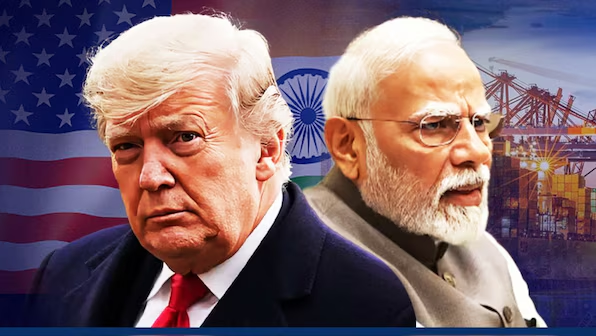
The “America First” policy under Donald Trump has taken a confrontational turn with what critics describe as bullying tactics directed at Bharat, igniting a heated debate over bilateral relations. Recent actions, including the imposition of a 25% tariff on Indian goods, are linked to India’s continued purchase of Russian oil, a move Trump has publicly criticized as disloyalty to US interests. This economic pressure, coupled with threats against leading Indian companies, has drawn sharp reactions from New Delhi, with Prime Minister Narendra Modi emphasizing Bharat’s strategic autonomy. The controversy has thrust the India-US partnership into the spotlight, raising questions about whether Trump’s approach strengthens America or isolates it globally.
Historical Context Fuels Trade and Diplomatic Tensions
The strategic backdrop to this bullying narrative traces to Trump’s second term, where his “America First” doctrine has shifted from non-interventionist promises to aggressive trade policies, echoing his first term’s tariff wars. The latest tariffs, targeting Bharat despite its role as a counterweight to China, contrast with the US’s leniency toward other Russian oil buyers, suggesting selective coercion. Modi’s alignment with a “Bharat First” philosophy, praised during past summits like Howdy Modi, now faces a test, with historical US sanctions on India—like those after the 1998 nuclear tests—adding context to the current standoff. X posts reveal a divided public, with some viewing Trump’s actions as strategic, others as erratic, highlighting the complex interplay of trade and diplomacy.
Implications Challenge Economic and Diplomatic Ties
The implications of this bullying extend across economic, diplomatic, and social spheres. Economically, the tariffs threaten India’s $40 billion trade surplus with the US, potentially disrupting industries like textiles and pharmaceuticals, while pushing Bharat toward alternative markets like Russia and the Middle East. Diplomatically, the move risks alienating a key ally in the Indo-Pacific strategy, with Modi’s refusal to bend under pressure signaling a shift in global alliances. Socially, the public jabs from Trump have stirred nationalist sentiments in India, though they also expose domestic divisions over foreign policy. Operationally, negotiations may strain diplomatic resources, challenging the establishment’s narrative of a robust US-India partnership and inviting skepticism about its durability.
Obstacles Complicate Resolution Efforts
Significant challenges arise amid this escalating tension. Operationally, balancing trade talks with national pride requires deft diplomacy, with potential missteps risking further tariffs or retaliatory measures from India. Economically and socially, the tariffs could hit Indian exporters hard, leading to job losses and inflaming public discontent, while US businesses reliant on Indian goods may face supply chain disruptions. Policy risks include diplomatic fallout if India strengthens ties with Russia or China, and the establishment’s portrayal of Trump’s tactics as principled realism raises doubts, given the selective targeting of Bharat over other nations. The complexity suggests a need for nuanced dialogue, yet political egos may hinder progress.
Opportunities Emerge for Strategic Realignment
Despite the hurdles, opportunities exist for constructive outcomes. Economically, a resolution could lead to a revised trade deal, enhancing market access for both nations and boosting India’s global trade position. Diplomatically, the crisis might foster a more equitable partnership, with India leveraging its strategic value to negotiate from strength. Socially, public discourse could encourage a unified stance on autonomy, strengthening national identity if handled inclusively. Policy-wise, this could spur India to diversify its energy sources and trade partners, potentially reshaping global economic alignments. Whether this episode strengthens bilateral ties or deepens rifts depends on negotiation outcomes, but it underscores the stakes of Trump’s approach.
Outcome Hinges on Navigating Power Dynamics
Trump’s bullying of Bharat under the “America First” banner has placed India-US relations at a crossroads, testing the limits of economic coercion and diplomatic resilience. While the tariffs and public critiques aim to assert US dominance, they risk isolating America and emboldening Bharat’s independent stance. Amid operational challenges and policy risks, opportunities for realignment offer a path forward, though the establishment’s narrative of strategic leadership warrants critical scrutiny given the inconsistent application of pressure. The resolution—whether it forges a new partnership or widens the divide—rests on the ability of both leaders to navigate this high-stakes geopolitical chess game.