

New Delhi | News365 Times
The government has announced a sweeping overhaul of the Goods and Services Tax (GST) regime, reducing the existing four tax slabs (5%, 12%, 18%, 28%) into just two slabs — 5% and 18%.
At first glance, the move is being hailed as a bold simplification step to ease compliance and “benefit the common man.” But a closer look at the fine print reveals a different story.
What Changes on Paper
- Earlier: 4 slabs — 5%, 12%, 18%, 28%
- Now: 2 slabs — 5% and 18%
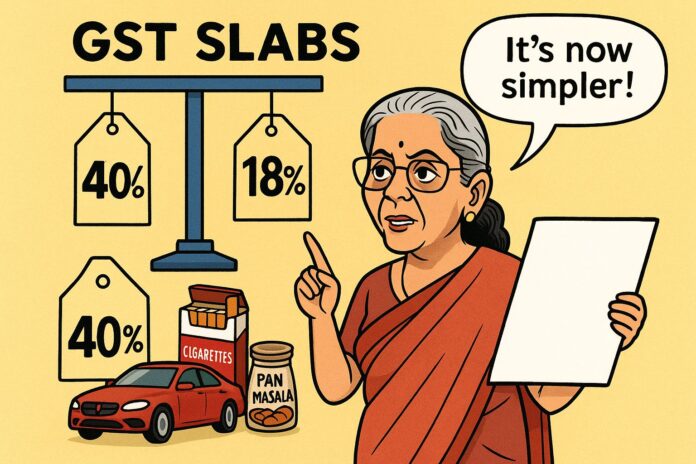
- But actually: There’s a hidden third slab at 40% for certain luxury and “sin goods.”
The Reality Behind the Reform
- 75% of GST revenue already comes from the 18% slab — and that slab remains unchanged. Items under the 12% slab will now shift to 5%, but the impact is limited.
- 90% of items under the 28% slab move down to 18%, offering some relief.
- But the remaining 10% — luxury cars, cigarettes, pan masala, alcohol — will now face a whopping 40% GST rate.
Effectively, India still has three slabs: 5%, 18%, and 40%.
The Hidden Pinch for Households
While industry experts debate simplification, everyday households are in for a surprise:
- Packaged foods like biscuits and ready-to-cook batter have quietly jumped from 5% to 18%.
- Milk-based products, earlier exempt, will now attract 5% GST.
Net result: household expenses will rise. Middle-class families will feel the pinch, not the relief.
The Bottom Line
The reform may look like a rationalisation of the GST system, but in practice it brings steeper taxes on daily essentials and steeper luxury penalties.