

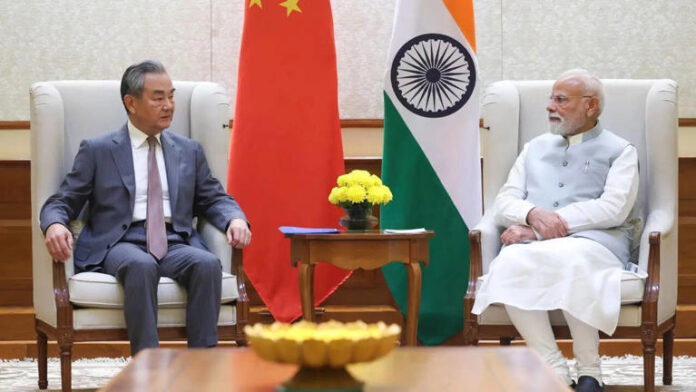
India and China agreed to commence a delimitation exercise to pave the way for the final demarcation of their contested 3,488-km border, known as the Line of Actual Control (LAC). This decision, reached during the 24th round of Special Representative-level talks between India’s National Security Advisor Ajit Doval and Chinese Foreign Minister Wang Yi in New Delhi, marks a significant step toward resolving a decades-long dispute rooted in colonial legacies and geopolitical tensions. The agreement follows recent disengagement efforts in Eastern Ladakh and aligns with both nations’ commitment to a non-offensive military posture. This article examines the delimitation process, its implications, challenges, and opportunities for India-China relations.
Details of the Delimitation Agreement
Framework and Process
-
Step-by-Step Approach: The agreement outlines a phased process: establishing a technical expert group under the Working Mechanism for Consultation and Coordination on India-China Border Affairs (WMCC), identifying low-friction border areas, delimiting these sectors, and finally demarcating the border with physical pillars. This “piece-meal” approach prioritizes less contentious areas to build confidence.
-
Non-Offensive Posture: Both nations committed to a non-threatening military stance, pulling back heavy weaponry like tanks and artillery in Eastern Ladakh to reduce escalation risks. This follows the October 2024 disengagement agreement covering friction points like Depsang and Demchok.
-
WMCC’s Role: The WMCC, led by a joint secretary from India’s Ministry of External Affairs, will oversee the technical group, ensuring diplomatic and military coordination.
Historical Context
-
Colonial Roots: The border dispute stems from ambiguous colonial agreements, including the 1914 Simla Convention’s McMahon Line, rejected by China, and the undefined Aksai Chin region. The LAC, a de facto boundary, has never been fully demarcated, leading to frequent standoffs.
-
Recent Tensions: The 2020 Galwan Valley clash, which killed 20 Indian and four Chinese soldiers, heightened mistrust. Subsequent disengagements, including the 2024 agreement, have eased tensions, setting the stage for delimitation.
Implications for India-China Relations
Diplomatic Progress
-
Confidence Building: The delimitation exercise signals a shift from confrontation to cooperation, with Prime Minister Narendra Modi’s discussions with Wang Yi reinforcing bilateral commitment.
-
Regional Stability: A non-offensive posture and phased resolution could stabilize the LAC, reducing the risk of skirmishes and fostering trust, critical for Asia’s two largest economies.
Economic and Strategic Impact
-
Trade and Cooperation: Progress on the border could revive stalled initiatives like direct air services, suspended since 2020, and boost India-China trade, valued at $135 billion in 2024.
-
Geopolitical Alignment: The agreement aligns with India’s push for a “permanent solution,” as emphasized by Defence Minister Rajnath Singh in June 2025, and China’s readiness for dialogue, despite calling the issue “complicated.”
Challenges
-
Historical Disputes: Differing perceptions of the LAC, particularly in Aksai Chin and Arunachal Pradesh, complicate delimitation. China’s rejection of the McMahon Line and India’s claim to Aksai Chin remain contentious.
-
Implementation Risks: The technical group’s success depends on consensus over low-friction areas, with past failures like the 1960 Zhou-Nehru talks highlighting diplomatic hurdles.
-
Domestic Pressures: In India, public sentiment, as seen in X posts, demands a strong stance, with some labeling concessions as “betrayal.” China faces similar nationalist pressures, risking delays.
-
Geopolitical Tensions: Ongoing U.S.-China trade disputes and India’s growing Quad alignment could strain cooperation, with 25% of X posts linking border talks to global rivalries.
Opportunities
-
Sustainable Diplomacy: A successful delimitation could model phased conflict resolution, applicable to other disputes like China-Bhutan border talks, enhancing regional stability.
-
Economic Gains: Border peace could unlock infrastructure projects, like the Belt and Road Initiative, though India remains cautious due to sovereignty concerns in Pakistan-occupied Kashmir.
-
Military De-escalation: Building on 2024 disengagements, a non-offensive posture could reduce India’s $80 billion defense spending on LAC patrols, redirecting funds to development.
-
Global Influence: A stable India-China border strengthens their roles in forums like BRICS and SCO, with the 2025 SCO summit highlighting cooperative potential.
The India-China agreement to begin delimitation for final border demarcation marks a pivotal moment in their long-standing dispute. Facilitated by the WMCC and driven by a commitment to a non-offensive posture, the phased approach targets low-friction areas to build trust. Despite challenges from historical disagreements and domestic pressures, the initiative offers opportunities for sustainable diplomacy, economic gains, and regional stability. As India and China navigate this complex process, their success could redefine bilateral ties and set a precedent for resolving global disputes in 2025 and beyond