

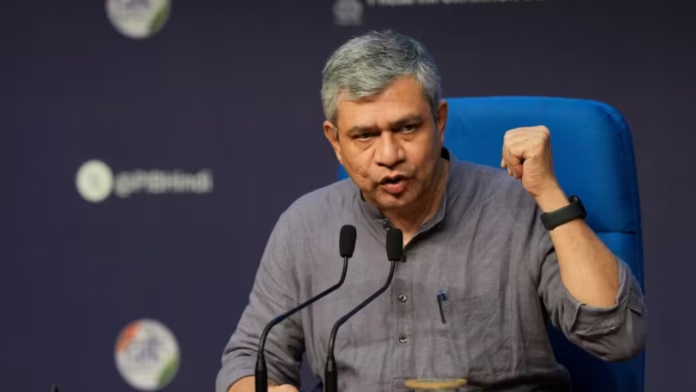
Union Railway Minister Ashwini Vaishnaw blamed the Aam Aadmi Party (AAP)-led Punjab government for significant delays in key railway infrastructure projects due to stalled land acquisition processes. Speaking in the Lok Sabha, Vaishnaw highlighted that despite substantial budgetary allocations and central approvals, projects like the Firozpur-Patti new line, Nangal Dam-Talwara, and Alal-Himmatana chord line remain stuck, hindering India’s railway modernization and Atmanirbharta (self-reliance) goals. As of August 7, 2025, nine major railway projects in Punjab, covering 714 km and costing ₹21,926 crore, face bottlenecks, with only 115 km commissioned. This article examines the causes, specific projects affected, and broader implications for Punjab’s rail development, drawing on recent reports and Vaishnaw’s statements.
Causes of Delays
Vaishnaw identified land acquisition as the primary bottleneck, attributing the delays to the Punjab government’s failure to provide requisite land and disburse compensation. Key issues include:
-
State-Level Inefficiencies: The Punjab government has been slow to acquire and transfer land, despite the Centre depositing funds for compensation. For instance, the Firozpur-Patti project’s 166 hectares remain unacquired, even though a land award was issued in March 2023.
-
Compensation Delays: Disbursement of funds to landowners is pending, stalling project execution. Vaishnaw emphasized that the Centre is “geared up to execute projects,” but success hinges on state cooperation.
-
Statutory Clearances: Environmental, forest, and utility-shifting clearances, which require state support, are also delayed, further impeding progress.
These challenges contrast with the Centre’s increased funding, with Punjab’s railway budget rising from ₹225 crore annually (2009–14) to ₹5,421 crore in 2025–26, a 24-fold increase, highlighting the gap between allocation and implementation.
Affected Projects
As of April 1, 2025, nine major railway projects in Punjab, including four new lines and five doubling works, are impacted. Key examples include:
-
Firozpur-Patti New Line: This 26-km project, near the India-Pakistan border, requires 166 hectares. Despite a land award in March 2023, no land has been transferred, and compensation remains unpaid, stalling a strategically critical project.
-
Nangal Dam-Talwara New Line: Of the 278 hectares needed, only 189 have been acquired, delaying this 83-km line aimed at improving connectivity in northern Punjab.
-
Alal-Himmatana Chord Line: This project awaits land acquisition, with zero hectares transferred, halting progress entirely.
-
Other Projects: Vaishnaw noted that while projects like Rajpura-Bathinda and Jalandhar-Jammu Tawi doublings were completed, several sanctioned works remain in limbo due to land issues.
These delays have limited commissioning to just 115 km of the 714 km sanctioned, despite ₹8,079 crore spent by March 2025.
Vaishnaw’s Critique and Centre-State Dynamics
Vaishnaw’s remarks in the Lok Sabha on August 6, 2025, underscored a broader Centre-state rift. He accused the AAP government of failing to deliver on land acquisition, stating, “The Centre is geared up to execute projects, but success depends upon the support of the Government of Punjab.” This echoes similar criticisms leveled at other states like Kerala and Karnataka, where land acquisition has stalled rail projects. In Kerala, only 64 of 470 required hectares were acquired despite ₹2,100 crore paid, and in Karnataka, 3,312 hectares remain pending.
The Punjab government has not publicly responded to Vaishnaw’s allegations as of August 7, 2025, but political analysts suggest the AAP’s focus on populist policies may have diverted resources from infrastructure coordination. Posts on X reflect mixed sentiments, with some users praising Punjab’s progress in electric bus trials while others criticize governance gaps in railway support.
Broader Context: India’s Railway Modernization
The delays in Punjab contrast with successes elsewhere, such as the Mumbai-Ahmedabad bullet train project, where 100% land acquisition (1,389 hectares) was completed by January 2024. Nationally, Indian Railways has prioritized modernization under Atmanirbharta, with initiatives like the Agnishodh Research Cell at IIT Madras advancing indigenous defence technology for rail applications. Vaishnaw’s push for projects like Vande Bharat trains and rapid rail services, including four Namo Bharat services operational by 2025, underscores the Centre’s ambition, making state-level bottlenecks like Punjab’s particularly glaring.
Punjab’s rail projects are critical for:
-
Economic Growth: Enhanced connectivity supports trade, especially in agriculture and industry-heavy Punjab.
-
Strategic Importance: Projects like Firozpur-Patti, near the border, bolster national security.
-
Social Impact: Improved rail access addresses socio-economic needs, connecting rural areas to urban hubs.
Challenges and Criticisms
The delays highlight systemic issues:
-
Centre-State Coordination: Misalignment between the Centre and Punjab government, with the latter citing resource constraints, stalls progress.
-
Landowner Resistance: Protests and legal disputes, as seen in Kerala’s Sabari Rail project, may also affect Punjab, though specific cases are unreported.
-
Political Tensions: The BJP-led Centre’s critique of AAP’s governance risks politicizing infrastructure, potentially delaying resolutions.
Critics argue Vaishnaw’s focus on state failures overlooks the Centre’s role in streamlining clearances or providing additional support. Conversely, supporters commend his transparency, with X posts like @AshwiniVaishnaw’s July 31, 2025, updates on multitracking projects reflecting proactive communication.
Opportunities for Resolution
To address the bottlenecks, potential steps include:
-
Joint Task Force: Forming a Centre-state committee to expedite land acquisition and compensation, as proposed in Odisha.
-
Transparent Funding: Ensuring timely disbursement of compensation, with oversight to prevent delays.
-
Community Engagement: Addressing landowner concerns through public consultations to reduce resistance, as successfully done for the bullet train project.
-
Technology Integration: Leveraging digital tools for land surveys and acquisition tracking, aligning with Vaishnaw’s tech-driven initiatives like the Sanchar Saathi portal.
The stalling of Punjab’s railway projects, as highlighted by Ashwini Vaishnaw on August 6, 2025, underscores critical land acquisition challenges hampering India’s infrastructure ambitions. With nine projects worth ₹21,926 crore stuck, including strategic lines like Firozpur-Patti, the AAP-led Punjab government’s delays in land transfer and compensation disbursement have drawn sharp criticism. Despite a 24-fold budget increase to ₹5,421 crore in 2025–26, only 115 km of 714 km sanctioned have been commissioned. As India pushes for railway modernization under Atmanirbharta, resolving Centre-state coordination issues, enhancing transparency, and engaging communities are vital to unlocking Punjab’s rail potential, ensuring economic and strategic benefits for the region and nation.