

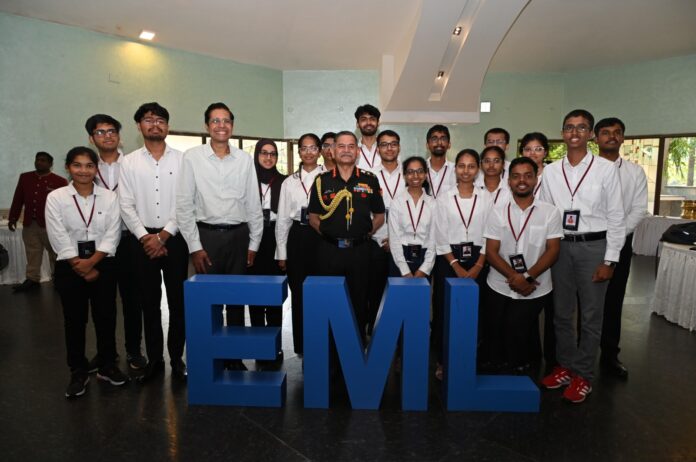
Indian Army, in collaboration with the Indian Institute of Technology (IIT) Madras, inaugurated ‘Agnishodh’, the Indian Army Research Cell (IARC), at the IIT Madras campus in Chennai. The landmark initiative, launched by General Upendra Dwivedi, Chief of the Army Staff (COAS), marks a significant step toward achieving Atmanirbharta (self-reliance) in defence technology. Aligned with the Indian Army’s Five Pillars of Transformation, Agnishodh aims to bridge academic research with operational military applications, fostering innovation in emerging technologies. The inauguration, part of General Dwivedi’s two-day visit to Chennai, underscores India’s commitment to modernizing its armed forces and preparing for future warfare. This article explores the objectives, significance, and broader implications of the Agnishodh Research Cell for India’s defence ecosystem.
Inauguration and Strategic Vision
The Agnishodh Research Cell was formally launched by General Upendra Dwivedi during a ceremony at IIT Madras, attended by military officials, academic leaders, and industry representatives. The initiative is a cornerstone of the Indian Army’s transformation framework, specifically advancing the pillar of Modernisation and Technology Infusion. General Dwivedi emphasized the need for seamless integration of academic excellence with battlefield requirements, stating that Agnishodh would “transform academic excellence into battlefield innovation, powering India’s journey towards Viksit Bharat 2047.”
In his keynote address on the theme “Operation Sindoor – A New Chapter in India’s Fight Against Terrorism,” General Dwivedi highlighted the operation’s unprecedented success. The 88-hour tri-services offensive, executed across the DIME (Diplomatic, Informational, Military, and Economic) spectrum, compelled Pakistan to seek a ceasefire, redefining India’s counter-terrorism doctrine. He underscored the evolving nature of warfare, driven by non-contact strategies, psychological dominance, and technological advancements, asserting that the Indian Armed Forces are prepared for fifth-generation conflicts where “boots must share space with bots.”
Objectives of Agnishodh
The Agnishodh Research Cell is designed to serve as a catalyst for indigenous defence innovation, with the following key objectives:
-
Technology Development: Translate lab-scale research into field-ready defence technologies, focusing on areas such as additive manufacturing, cybersecurity, quantum computing, wireless communication, and unmanned aerial systems (UAS).
-
Upskilling Military Personnel: Build a tech-empowered workforce by training soldiers and officers in emerging domains, enhancing the Army’s operational readiness for modern warfare.
-
Academic-Military Synergy: Foster collaboration between IIT Madras and the Indian Army, leveraging the institute’s research capabilities to address real-time military challenges.
-
Support for Atmanirbharta: Align with national technology missions like INDIAai, Chip-to-Startup, and Project QuILA to promote self-reliance in defence manufacturing.
The research cell will operate within the IIT Madras Research Park, collaborating with entities like the Advanced Manufacturing Technology Development Centre (AMTDC) and Pravartak Technologies Foundation. This ecosystem will facilitate the rapid development and deployment of cutting-edge technologies, ensuring scalability from prototype to battlefield application.
Alignment with National Goals
Agnishodh is a critical component of the Indian Army’s Decade of Transformation and the broader vision of Atmanirbhar Bharat (Self-Reliant India). General Dwivedi highlighted existing partnerships with IIT Delhi, IIT Kanpur, and IISc Bengaluru, noting their contributions to projects like Project SAMBHAV and additive manufacturing collaborations with Army Base Workshops. He praised IIT Madras for its pioneering role in defence research, citing initiatives like Project SAMBHAV as benchmarks for innovation.
The initiative aligns with national technology missions, including INDIAai, Chip-to-Startup, and Project QuILA, with the Military College of Telecommunication Engineering (MCTE) Mhow serving as a strategic partner. These collaborations aim to reduce India’s dependence on foreign defence technologies, particularly in critical areas like semiconductors, AI, and quantum computing, which are vital for modern warfare.
Focus Areas of Research
Agnishodh will prioritize research and development in the following emerging technologies:
-
Additive Manufacturing: Developing 3D-printed components for military equipment, enabling rapid prototyping and cost-effective production.
-
Cybersecurity: Strengthening digital infrastructure to counter cyber threats in modern warfare.
-
Quantum Computing: Exploring quantum technologies for secure communication and advanced data processing.
-
Wireless Communication: Enhancing secure and resilient communication systems for battlefield operations.
-
Unmanned Aerial Systems (UAS): Advancing drone technology for surveillance, reconnaissance, and combat applications.
These focus areas address the evolving nature of warfare, characterized by grey zone conflicts, technological democratization, and non-contact strategies. By upskilling military personnel in these domains, Agnishodh aims to create a future-ready, tech-empowered defence force.
Operation Sindoor: A Case Study in Modern Warfare
During his address, General Dwivedi reflected on Operation Sindoor, a landmark tri-services operation that followed the Pahalgam terror attack, which claimed 26 lives. Described as an “intelligence-driven response,” the operation showcased India’s ability to deliver precise, punitive, and coordinated action across the DIME spectrum, compelling Pakistan to seek a ceasefire within 88 hours. The COAS highlighted its strategic impact, noting that it redefined India’s counter-terrorism doctrine and demonstrated the importance of integrating conventional and modern capabilities.
The success of Operation Sindoor underscores the need for initiatives like Agnishodh, which aim to equip the Indian Army with advanced technologies to address hybrid threats and fifth-generation warfare challenges.
Visit to Officers Training Academy (OTA)
As part of his two-day visit to Chennai, General Dwivedi visited the Officers Training Academy (OTA), where he reviewed infrastructure, modern training methodologies, and initiatives to prepare future military leaders. He commended the instructional staff for fostering excellence and instilling core military values among cadets. Addressing OTA officers, he emphasized the need for integrated responses to grey zone conflicts and the importance of blending traditional combat strength with technological prowess.
Honoring Veterans
General Dwivedi also engaged with military veterans during his visit, acknowledging their enduring contributions to the nation. He felicitated four distinguished ex-servicemen with Veteran Achievers Awards, recognizing their selfless service and commitment to nation-building. This gesture reflects the Indian Army’s respect for its veterans and their role in shaping its legacy.
Challenges and Opportunities
While Agnishodh represents a significant step toward self-reliance, it faces challenges:
-
Technology Transfer: Ensuring seamless integration of lab-scale innovations into operational systems requires robust testing and validation processes.
-
Funding and Scalability: Developing and deploying advanced technologies demands substantial investment and industry partnerships.
-
Geopolitical Sensitivities: Collaborations in sensitive areas like quantum computing and cybersecurity must navigate global supply chain and intellectual property challenges.
-
Skill Gaps: Upskilling military personnel in cutting-edge technologies requires sustained training programs and academic support.
Despite these challenges, Agnishodh offers immense opportunities to position India as a global leader in defence innovation. By leveraging IIT Madras’s research ecosystem and the Army’s operational expertise, the initiative can drive breakthroughs in critical technologies, reduce import dependence, and enhance national security.
Broader Implications
The establishment of Agnishodh aligns with India’s ambition to achieve Viksit Bharat (Developed India) by 2047. By fostering indigenous innovation, the research cell contributes to economic growth, job creation, and technological self-reliance. It also strengthens India’s defence ecosystem, complementing initiatives like the Defence Acquisition Council’s approval of ₹67,000 crore in procurement proposals on August 5, 2025, which prioritize indigenous manufacturing.
The collaboration builds on the Indian Army’s growing network of research partnerships with premier institutions like IIT Delhi, IIT Kanpur, and IISc Bengaluru, creating a robust framework for defence R&D. As global warfare evolves, Agnishodh positions India to address emerging threats with cutting-edge solutions, reinforcing its strategic autonomy.
The inauguration of the Agnishodh Research Cell at IIT Madras by General Upendra Dwivedi on August 4, 2025, marks a transformative milestone in India’s pursuit of Atmanirbharta in defence technology. By fostering collaboration between the Indian Army and IIT Madras, Agnishodh bridges academic innovation with operational needs, advancing the Army’s Modernisation and Technology Infusion pillar. With a focus on emerging technologies like additive manufacturing, cybersecurity, and unmanned aerial systems, the research cell will empower the Armed Forces to tackle fifth-generation warfare challenges. Coupled with the success of Operation Sindoor and ongoing reforms under the Decade of Transformation, Agnishodh positions India as a leader in indigenous defence innovation, driving the nation toward Viksit Bharat 2047. As the Indian Army continues to integrate “boots with bots,” initiatives like Agnishodh will shape a future-ready, tech-empowered military, ensuring India’s security and sovereignty in an evolving global landscape.