

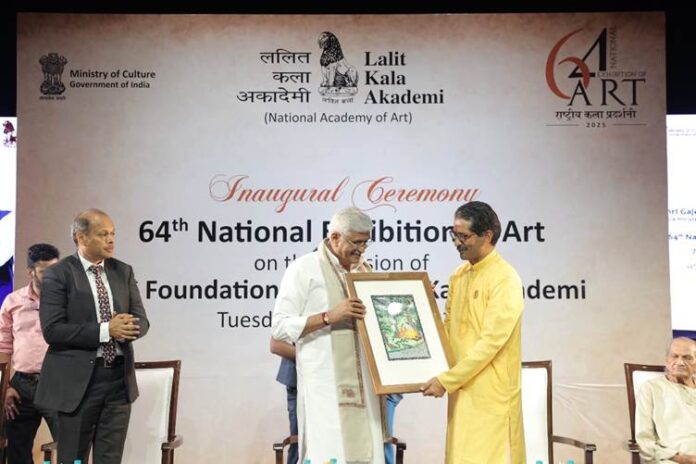
Lalit Kala Akademi, India’s National Academy of Art, inaugurated the 64th National Exhibition of Art (NEA) in New Delhi with a grand ceremony that celebrated India’s vibrant artistic heritage and its evolving contemporary art scene. For the first time in its history, the NEA introduced a groundbreaking initiative allowing award-winning artworks to be available for sale, aligning with the Government of India’s National Mission on Cultural Mapping and reinforcing a commitment to supporting artists’ livelihoods. The event, graced by Union Minister for Culture and Tourism Shri Gajendra Singh Shekhawat, showcased 283 diverse artworks and honored both emerging and veteran artists, marking a pivotal moment in India’s cultural landscape. This article explores the significance of the 64th NEA, its innovative features, and its broader impact on India’s creative economy.
A Historic Inauguration
The 64th NEA was formally launched at the Lalit Kala Akademi Galleries, Rabindra Bhavan, through a ceremonial ribbon-cutting and lamp-lighting led by Shri Gajendra Singh Shekhawat, Union Minister for Culture and Tourism. The event was attended by key dignitaries, including Shri Vivek Aggarwal, Secretary, Ministry of Culture; Ms. Amita Prasad Sarbhai, Additional Secretary, Ministry of Culture; Shri Nand Lal Thakur, Vice Chairman, Lalit Kala Akademi; and Shri Rajeev Kumar, Secretary, Lalit Kala Akademi. The ceremony highlighted the Akademi’s role as a steward of India’s visual arts, fostering a platform that bridges traditional, folk, tribal, and contemporary expressions.
In a landmark move, the Akademi announced that award-winning artworks at this year’s exhibition would be available for purchase, a first in the NEA’s 64-year history. This initiative aims to empower artists financially, promote art acquisition among collectors and institutions, and strengthen India’s creative economy. The decision aligns with the National Mission on Cultural Mapping, launched by the Ministry of Culture to identify, document, and support artistic talent across the country, ensuring sustainable livelihoods for creators.
Keynote Addresses: A Vision for Art and Empowerment
Shri Gajendra Singh Shekhawat, in his keynote address, emphasized the NEA’s role as a vibrant cultural platform. “The exhibition is not just a display of artworks, but a vibrant cultural platform showcasing the talent of emerging and established artists from across the country,” he stated. He highlighted the diversity of the exhibited works, which span contemporary, traditional, folk, and tribal art, reflecting India’s rich artistic heritage.
The Minister praised the Akademi’s decision to allow the sale of artworks, noting, “This forward-looking move promotes self-reliance among artists and strengthens our creative economy. In today’s time, where art, culture, and economic development are increasingly interlinked, such initiatives are both timely and visionary.” He underscored the transformative potential of art, stating, “Art is no longer confined to galleries and museums; it is a medium of social transformation. From education and tourism to employment and inclusion, the role of art is expanding rapidly.” He reaffirmed the government’s commitment to empowering artists and integrating their work into sustainable cultural policies.
Shri Vivek Aggarwal, Secretary, Ministry of Culture, lauded the exhibition’s diversity, stating, “The 64th National Exhibition of Art showcases a rich collection of exceptional artworks from across the country, created in diverse mediums. This not only reflects the vastness and diversity of Indian art but also provides a meaningful platform for creative dialogue among artists.” He commended the Akademi for fostering collaboration between emerging and established artists.
Ms. Amita Prasad Sarbhai, Additional Secretary, Ministry of Culture, remarked, “This prestigious exhibition stands as a testament to the vibrant creative spirit of our nation and reflects the Akademi’s steadfast dedication to fostering artistic innovation and excellence.” She highlighted the exhibition’s role in weaving together India’s cultural traditions with its evolving artistic narrative.
The 64th NEA: A Showcase of Artistic Excellence
The 64th NEA features a meticulously curated selection of 283 artworks, chosen from over 5,900 submissions through a rigorous two-tier jury process. The exhibition showcases a wide range of mediums, including painting, sculpture, graphics, installation, photography, and mixed media, reflecting the depth and diversity of Indian artistic expression. The artworks represent artists from across the country, encompassing urban, rural, and tribal perspectives, and highlight both contemporary trends and traditional techniques.
The exhibition, open to the public from August 6 to September 15, 2025, daily between 11:00 AM and 7:00 PM, offers visitors a unique opportunity to engage with India’s artistic heritage and acquire award-winning pieces. The decision to allow sales is expected to attract art collectors, galleries, and institutions, creating a sustainable market for artists and fostering a culture of art patronage in India.
Honoring Artistic Contributions
The inauguration ceremony included the felicitation of 20 Lalit Kala Akademi Awardees, recognized for their innovation and excellence in the visual arts. These awards celebrate the contributions of emerging and mid-career artists, providing them with a platform to gain national recognition. In addition, three veteran artists—Shri Krishen Khanna, Shri Ram V. Sutar, and Smt. Ira Chaudhari—were honored for their lifetime achievements. Their work, spanning decades, has significantly shaped India’s artistic and cultural landscape, with contributions ranging from monumental sculptures to evocative paintings.
Publications Launched
Two significant publications were unveiled during the ceremony, underscoring the Akademi’s commitment to documenting and preserving India’s artistic legacy:
-
64th NEA Exhibition Catalogue: This comprehensive catalogue documents the featured artworks and artists, serving as a valuable resource for scholars, collectors, and art enthusiasts. It captures the diversity and creativity of the exhibition, providing insights into the artists’ inspirations and techniques.
-
“Printmaker for All Seasons”: A special book celebrating the life and legacy of Padma Shri Shyam Sharma, a renowned printmaker whose work has left an indelible mark on Indian art. The publication highlights Sharma’s contributions to printmaking and his influence on contemporary artists.
These publications reinforce the Akademi’s role in promoting art scholarship and ensuring that India’s artistic heritage is accessible to future generations.
Lalit Kala Akademi: A Pillar of Indian Art
Established on August 5, 1954, by the Government of India as an autonomous body, the Lalit Kala Akademi was granted statutory authority in 1957 under the Societies Registration Act, 1860. As India’s National Academy of Art, it has played a pivotal role in promoting visual arts, fostering creativity, and shaping cultural sensibilities across the nation. The Akademi’s mission is to establish, preserve, and document visual art of the highest order, reflecting the vitality and complexity of India’s ancient, modern, and contemporary art traditions.
The Akademi’s activities span the entire Indian subcontinent, weaving together diverse cultures and artistic expressions. It supports traditional art forms while embracing contemporary global trends, creating a platform for dialogue between India’s creative genius and international art movements. Through exhibitions, workshops, residencies, and publications, the Akademi nurtures artists, promotes cultural exchange, and enhances public engagement with the visual arts.
Significance of the Sale of Artworks
The decision to allow the sale of award-winning artworks is a transformative step for the NEA and Indian art. Historically, the exhibition focused on showcasing talent without a commercial component, limiting artists’ ability to monetize their work directly through the platform. By introducing sales, the Akademi addresses a critical need for financial empowerment, enabling artists to sustain their practice and invest in further innovation.
This initiative aligns with global trends, where art fairs and biennales like Art Basel and the Venice Biennale combine exhibition with commerce, creating vibrant markets for artists. In India, where the art market is projected to reach $2.5 billion by 2027, according to a 2024 Deloitte report, the NEA’s move could stimulate growth, attract new collectors, and position Indian artists on the global stage. It also supports the government’s vision of integrating art with economic development, as outlined in the National Mission on Cultural Mapping, which aims to create sustainable opportunities for over 2 million artists and artisans identified in its database.
Challenges and Opportunities
While the 64th NEA’s initiatives are visionary, they face challenges:
-
Market Accessibility: Ensuring that artworks are priced affordably for a broad audience while fairly compensating artists requires careful curation and marketing.
-
Digital Integration: Leveraging digital platforms to promote sales and reach global collectors could enhance the initiative’s impact but requires investment in technology.
-
Cultural Awareness: Encouraging art acquisition among India’s middle class, where art is often seen as a luxury, demands public education and outreach.
-
Logistical Support: Managing sales, authentication, and logistics for artworks poses operational challenges for the Akademi, which must balance its cultural and commercial roles.
Despite these challenges, the NEA presents significant opportunities to strengthen India’s creative economy, foster social inclusion through art, and elevate Indian artists’ global visibility.
Broader Impact on India’s Cultural Landscape
The 64th NEA reinforces India’s commitment to cultural preservation and innovation, aligning with the government’s broader cultural policy. By empowering artists through sales, the Akademi contributes to economic development, job creation, and tourism, as art becomes a driver of social and economic transformation. The exhibition’s emphasis on diversity—spanning urban, rural, tribal, and folk art—reflects India’s pluralistic identity, fostering unity through creative expression.
The NEA also complements other cultural initiatives, such as the Ministry of Culture’s efforts to digitize India’s heritage and promote cultural tourism. By showcasing 283 artworks to the public until September 15, 2025, the exhibition invites widespread engagement, democratizing access to art and inspiring future generations of creators.
The 64th National Exhibition of Art, inaugurated by the Lalit Kala Akademi on August 5, 2025, marks a historic shift toward artist empowerment with the unprecedented decision to allow the sale of award-winning artworks. This initiative, aligned with the National Mission on Cultural Mapping, underscores India’s commitment to supporting artistic livelihoods and strengthening its creative economy. Featuring 283 diverse artworks, honoring 20 awardees, and celebrating veteran artists like Shri Krishen Khanna, the NEA reflects the vibrancy and depth of Indian art. As the exhibition opens to the public until September 15, 2025, it offers a rare opportunity to engage with India’s cultural heritage and invest in its artistic future. Under the leadership of the Lalit Kala Akademi, the 64th NEA sets a bold precedent for integrating art, culture, and economic development, positioning India as a global leader in the visual arts.