

The human mind is a vibrant theatre where thoughts unfold as both creators and disruptors of our reality. The introspective question, “Have you watched your thoughts?” invites us to pause and observe the intricate dance of cognition. By stepping into a state of mindful awareness—a void where thoughts are stripped of their immediate power—we can transform mental chaos into clarity. This article explores the process of observing thoughts, dissecting their anatomy, and calibrating emotional responses to foster confidence, performance, and inner harmony. Through this journey, we become both the engineer and the experiment, crafting a blueprint for cognitive behavior that invites less trouble and more intentionality.
The Theatre of the Mind: Observing Thoughts
The journey to clarity begins with a deliberate act of observation. In the silent theatre of the mind, we step outside the active arena of thinking into an empty state—a void where the mind, both an old friend and a fierce challenger, resides. This act of pausing allows us to witness thoughts as they attempt to take shape, forming their own dramas of desire, fear, or expectation. By resisting their immediate formation, we dismantle their narrative power, reducing them to nothingness.
This process is akin to an umpire halting a play before the field is ready. By refusing to let the mental stage show begin until the inner ground is prepared, we create a space of heightened awareness. In this conscious field, our senses become alert, and a profound connection emerges between senses and consciousness—a cipher represented by the letters “sc.” This bridge channels raw sensory input into deliberate awareness, unlocking a wave of confidence and performance that transforms how we engage with the world.

The Anatomy of a Thought
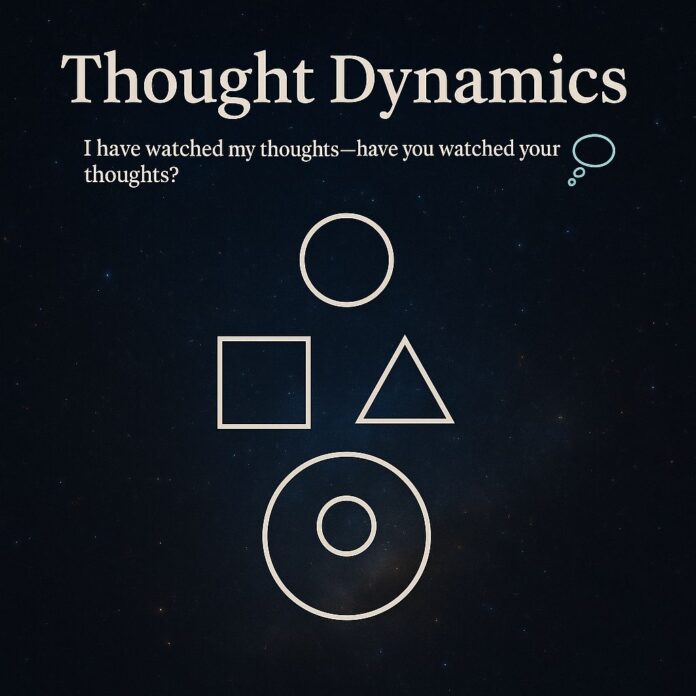
Through mindful observation, thoughts reveal a structured anatomy, each component representing a stage in their formation and impact on our psyche. This framework, derived from introspective analysis, provides a roadmap for understanding and managing cognitive processes:
-
The Core (Perfect Circle): At the heart of every thought lies a perfect circle, symbolizing emptiness—a still point of pure potential. This is the origin of thought, a neutral space free from preconceptions, where infinite possibilities reside before taking form.
-
The Square (Activation): As a thought gains structure, it transitions into a square, representing activation. This stage embodies the potential energy that arises when a thought is given form, moving from abstract possibility to a structured concept ready for action.
-
The Triangle (Insertion): The thought then pierces awareness as a triangle, denoting insertion. This sharp, directed stage is where a thought demands attention, entering our consciousness with purpose and clarity, often triggering emotional or behavioral responses.
-
The Peripheral Circle (Everythingness to Oneness): Finally, the thought integrates into a peripheral circle, symbolizing the journey from everythingness—scattered energies and chaotic inputs—to oneness, where disparate thoughts harmonize into a unified, purposeful whole.
This anatomy illustrates how thoughts evolve from potential to action, shaping our Cognitive Behavior (CB). By understanding these stages, we gain the power to guide thoughts deliberately, preventing chaos from dominating our mental landscape.
The Signal and Response Relationship
A critical insight from observing thoughts is the Signal and Response Relationship, where thoughts act as signals triggering emotional and behavioral responses. A key discovery is the role of attachment—often mistaken for love—as a sticky force that binds us to outcomes, hindering clarity and performance. Attachment to self, others, or results creates emotional turbulence, clouding judgment and amplifying reactivity.
To counter this, we must calibrate emotional responses, modulating how attachment influences our actions. This process involves:
-
Recognizing Attachment: Identifying thoughts rooted in attachment, such as fear of failure, need for approval, or fixation on outcomes. These thoughts often manifest as anxiety, doubt, or overthinking.
-
Modulating Responses: Using mindfulness to detach from outcomes, we can adjust the intensity of emotional reactions, prioritizing clarity over impulsivity. This involves pausing to assess a thought’s validity before responding.
-
Building Confidence: By channeling focused responses into purposeful actions, we enhance performance, transforming chaotic thoughts into productive outcomes.
This calibration becomes the blueprint for an evolving Cognitive Behavior (CB), a framework that reduces emotional turbulence and fosters intentional decision-making. By mastering this relationship, we invite less trouble into our lives, creating a cycle of clarity and resilience.
Engineering Clarity: The Self as Engineer and Experiment
Clarity is not a fleeting accident; it is a deliberate act of psychological engineering. By observing thoughts, dissecting their anatomy, and calibrating responses, we assume dual roles as both the engineer and the experiment. This process yields profound outcomes:
-
Presence and Purity: The conscious field becomes a space of love, aroma, and incense—symbols of purity, presence, and grounded awareness. This state transcends mere silence, fostering a deep connection with the self.
-
Performance Enhancement: Focused responses improve decision-making, enabling us to act with confidence and precision, much like a well-tuned system.
-
Inner Harmony: Integrating thoughts from chaos to oneness creates a unified mental state, where scattered energies align into a harmonious whole.
This engineering process empowers us to shape our mental landscape with intention, transforming chaos into clarity and reactivity into purpose.
Challenges in Achieving Mental Clarity
The path to clarity is fraught with obstacles, requiring discipline and persistence:
-
Mental Noise: Habitual thoughts, driven by ingrained patterns or emotional triggers, create chaos that resists the void of observation. Breaking these patterns demands consistent mindfulness practice.
-
Over-Identification with Attachment: Mistaking attachment for love distorts responses, leading to reactive behaviors. For example, clinging to outcomes can amplify stress, reducing performance.
-
Lack of Discipline: Sustaining mindful observation requires daily commitment, akin to training a muscle. Without consistency, the mind reverts to chaos.
-
External Pressures: Societal expectations, work stress, or personal obligations can disrupt inner focus, making it harder to maintain a conscious field.
Opportunities for Cognitive Transformation
The process of thought dynamics offers transformative opportunities:
-
Mindfulness Practices: Techniques like Vipassana meditation or journaling enhance our ability to observe thoughts and create a void, fostering clarity. Regular practice, even 10 minutes daily, can rewire cognitive patterns.
-
Cognitive Behavioral Tools: Methods from Cognitive Behavioral Therapy (CBT), such as thought reframing or exposure exercises, help calibrate emotional responses, reducing attachment’s grip.
-
Emotional Resilience: By modulating reactions, we build confidence and adaptability, enabling us to navigate challenges with poise.
-
Technological Support: Emerging mental health apps using AI, such as mood trackers or guided meditation tools, can support thought observation, providing real-time feedback.
-
Community Engagement: Sharing mindfulness practices through workshops or support groups fosters collective clarity, amplifying individual efforts.
Future Outlook
As mental health awareness grows globally, with 15% of Indian adults needing support (per NIMHANS, 2022), structured thought dynamics can revolutionize personal and societal well-being. By 2030, widespread adoption of mindfulness and CBT could reduce stress-related disorders, enhancing productivity and resilience. This aligns with global trends, where mindfulness programs in workplaces have increased employee performance by 12–15%, per studies from Harvard Business Review. Individuals who master thought dynamics will not only invite less trouble but also contribute to a more conscious, harmonious society.