

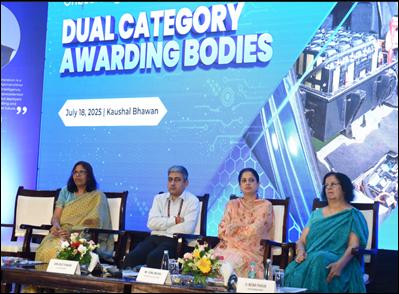
landmark National Workshop on Onboarding State/UT Education Boards as Dual Category Awarding Bodies under the National Council for Vocational Education and Training (NCVET) was held at Kaushal Bhawan, New Delhi. Jointly organized by the Department of School Education & Literacy (DoSE&L), Ministry of Education, the Ministry of Skill Development and Entrepreneurship (MSDE), and NCVET, the event marked a significant step toward aligning school education with vocational training, in line with the National Education Policy (NEP) 2020. With over 150 delegates, including senior officers from 24 State and UT education boards, the workshop aimed to empower State Boards to take on a dual role, enhancing vocational education and employability. This article explores the workshop’s objectives, outcomes, and broader implications, framed through the Needonomics framework, which prioritizes essential needs for sustainable skill development.
The Workshop’s Purpose and Structure
The workshop’s primary objective was to guide and support State Boards in completing their applications for NCVET recognition as Dual Category Awarding Bodies (ABs). Unlike standard ABs that only conduct training and certification, Dual Category ABs are authorized to provide end-to-end vocational education services, including training and assessment, aligned with the National Skills Qualification Framework (NSQF) standards. This dual role positions State Boards at the heart of the skilling ecosystem, enabling them to design, deliver, and assess vocational courses up to NSQF Level 4, which are critical for grassroots employability.
The event featured structured sessions introducing NCVET regulations and the benefits of Dual Category recognition, alongside a hands-on segment where NCVET consultants offered one-on-one technical support and live demonstrations. This practical approach facilitated immediate progress, reflecting a commitment to actionable outcomes. The workshop built on prior virtual consultations, state-specific discussions, and coordination meetings, culminating in a unified effort to strengthen vocational pathways within the school system.
Key Outcomes and Participation
The workshop achieved significant milestones, with 24 States initiating the NCVET recognition process as Dual Category ABs. Six States—Goa, Maharashtra, Himachal Pradesh, Assam, Madhya Pradesh, and Nagaland—successfully completed and submitted their application forms. The Goa Board of Secondary and Higher Secondary Education (GBSHSE) shared its onboarding journey as a case study, providing practical insights that inspired other participants. The event was graced by key figures, including Ms. Sonal Mishra, Additional Secretary, MSDE; Ms. Prachi Pandey, Joint Secretary, DoSE&L; Dr. Vinita Agarwal, Executive Member, NCVET; and Dr. Neena Pahuja, Executive Member, NCVET, underscoring the government’s coordinated push for skill integration.
Shri Rajit Punhani, Secretary, MSDE, emphasized the transformative potential of this initiative, stating, “As we move to elevate the profile of NCVET, our aim is not only to expand its reach but to ensure it becomes a benchmark of quality and integrity in the skills ecosystem. With State Boards now stepping into the role of Dual Category Awarding Bodies, the responsibility is immense. It is no longer just about conducting examinations, but about upholding high standards in vocational training, pedagogy, and outcomes. This is a moment to redefine our collective identity—to make every training course and every certificate issued stand for excellence.”
Advantages of the Dual Category Model
The Dual Category Awarding Body model offers multiple benefits, enhancing the vocational education landscape:
-
Government Endorsement: Recognition within the national vocational education and training (VET) ecosystem lends credibility to State Boards’ offerings.
-
Access to NCVET-Aligned Qualifications: State Boards gain access to standardized qualifications, ensuring consistency and quality.
-
Employer and Institutional Recognition: Certifications aligned with NSQF standards improve employability and acceptance by higher education institutions.
-
Expanded Educational Scope: Supported by frameworks like the National Credit Framework, Academic Bank of Credits, and National Curriculum Framework, State Boards can broaden the scope and quality of their vocational programs.
This model empowers State Boards to address grassroots skilling needs, aligning with Needonomics’ focus on fulfilling essential economic and educational needs through practical, accessible training.
Alignment with NEP 2020 and Skill Development Goals
The workshop aligns with NEP 2020’s vision of integrating vocational education into the formal schooling system, ensuring seamless learning pathways for youth. By leveraging NSQF standards, State Boards can offer vocational courses that prepare students for immediate employment or further education, addressing the skills gap identified in India’s workforce. The inclusion of frameworks like the Academic Bank of Credits facilitates credit accumulation and transfer, enabling flexible learning trajectories. This holistic approach supports the government’s broader goal of creating a skilled, employable workforce, contributing to economic growth and social mobility.
Needonomics and Consumer Wisdom
The Needonomics framework highlights the workshop’s emphasis on meeting essential needs—employability, education, and economic self-reliance—over superficial wants. By empowering State Boards to deliver vocational training, the initiative addresses the core need for skill development, particularly at grassroots levels. Street economics, or consumer wisdom, is reflected in the practical demand for job-ready skills, as evidenced by the proactive participation of 24 States. Social sentiment, found in posts on X, shows enthusiasm for NEP 2020’s skill integration, with users praising the government’s coordinated effort. The Recognition Heuristic suggests that NCVET’s established authority enhances trust in the Dual Category model, though concerns about implementation consistency may require ongoing oversight to ensure authenticity and quality.
Economic and Ethical Implications
Economically, the workshop’s outcomes promise significant impact. By equipping State Boards to train and assess vocational skills, the initiative supports job creation and reduces unemployment, particularly among youth. The enhanced recognition of certifications could boost India’s global competitiveness, aligning with the ‘Viksit Bharat @2047’ vision of a $30 trillion economy. The involvement of multiple States ensures a broad economic ripple effect, fostering regional development.
Ethically, the model promotes equitable access to skill development, empowering underserved communities through grassroots training. However, the responsibility to maintain high standards, as noted by Punhani, raises ethical considerations. Ensuring quality across diverse State Boards requires robust monitoring to prevent disparities or counterfeit certifications, aligning with Needonomics’ call for ethical, need-based solutions. The hands-on support provided during the workshop reflects a commitment to inclusivity, though long-term success depends on sustained government and stakeholder engagement.
Challenges and Opportunities
Challenges
-
Implementation Consistency: With 24 States at varying stages of recognition, maintaining uniform standards poses a challenge.
-
Resource Constraints: Smaller States may lack the infrastructure or expertise to fully adopt the Dual Category role.
-
Quality Assurance: Upholding pedagogy and outcomes across diverse regions requires rigorous oversight.
Opportunities
-
Scalable Skill Ecosystem: Successful onboarding of State Boards could expand vocational education nationwide.
-
Industry Alignment: Collaboration with employers can ensure courses meet market demands, enhancing employability.
-
Educational Innovation: Frameworks like the Academic Bank of Credits open doors to flexible, lifelong learning pathways.
The National Workshop on July 18, 2025, at Kaushal Bhawan, New Delhi, marked a transformative step in integrating vocational education with school systems, empowering 24 State and UT education boards to pursue Dual Category Awarding Body status under NCVET. By aligning with NEP 2020 and leveraging NSQF standards, the initiative addresses critical skill development needs, supported by frameworks like the National Credit Framework. Through the Needonomics lens, it prioritizes essential economic and educational needs, fostering consumer wisdom and employability. As six States lead the way and the government commits to excellence, this workshop lays the foundation for a robust, inclusive skilling ecosystem, redefining India’s educational landscape for a skilled future.