

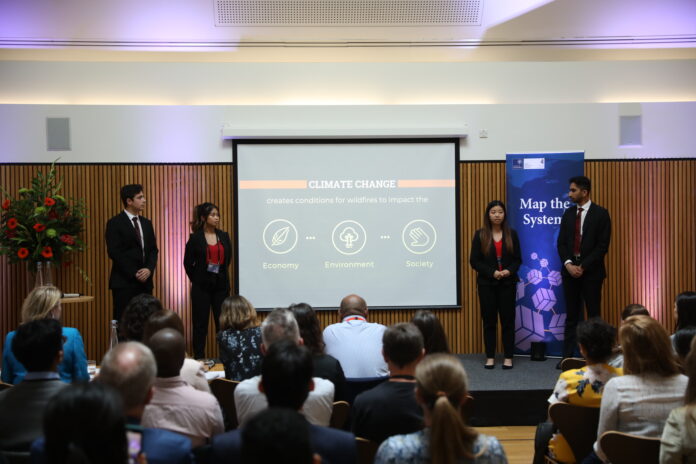
In a groundbreaking achievement, the Goa Institute of Management (GIM) has become the first Indian business school to qualify for the global finals of the prestigious Map the System competition, organized by the Skoll Centre for Social Entrepreneurship at the University of Oxford. Held from July 3 to 6, 2025, at Oxford’s Saïd Business School, the finals saw GIM’s team of second-year Post Graduate Diploma in Management (PGDM) students—Aryan Rajpal, Shubham Das, Dhruv Bhagat, Aditi Naringe, and Yash Kabra—stand out among over 1,750 global participants from 50 institutions across 17 countries. Their project, Mapping Access to Justice in India, earned global acclaim for its deep dive into systemic challenges within India’s legal framework, marking a significant milestone for Indian higher education on the world stage.
A Landmark Achievement for Indian Education
The Map the System competition challenges participants to use systems thinking to analyze complex social or environmental issues, moving beyond surface-level problems to uncover structural and systemic gaps. GIM’s team, mentored by Professors Pravat Surya Kar, Andy Silveria, and Karman Khanna, secured a place among the top 10% of global participants, a testament to their rigorous research and innovative approach. Their project focused on structural deficiencies in India’s justice delivery system, exploring issues such as inadequate infrastructure, outdated processes, and lack of institutional accountability, which contribute to delays and inaccessibility in the legal system.
The team employed advanced analytical tools, including Iceberg and causal loop diagrams, to present a layered understanding of these challenges. Their presentation at the Oxford finals, delivered before a distinguished panel of academics, policymakers, and social impact experts, showcased not only their analytical prowess but also their ability to propose actionable insights for reform. The event also provided opportunities for workshops, speaker sessions, and networking with global teams, enriching the students’ experience and amplifying their global exposure.
Professor Ajit Parulekar, Director of GIM, hailed the achievement as a reflection of the institute’s commitment to fostering systems thinking and problem-based learning. “This milestone embodies the spirit of innovation and social responsibility we strive to instill in our students,” he said, noting that the team’s work aligns with GIM’s mission to create ethical and transformative leaders. The students themselves described the experience as a “turning point” in their academic journey, emphasizing how the competition deepened their understanding of complex systems behind everyday challenges.
Aligning with NEP 2020 and Viksit Bharat
This historic achievement resonates with the transformative vision of the National Education Policy (NEP) 2020, which emphasizes multidisciplinary education, innovation, and global engagement. GIM’s success at Oxford reflects NEP 2020’s call for Indian institutions to compete on global platforms while addressing local challenges. The project’s focus on access to justice aligns with India’s broader developmental goals under Viksit Bharat 2047, particularly in promoting equity, accountability, and systemic reform. By tackling a pressing social issue, GIM’s team has demonstrated how Indian business schools can contribute to nation-building while gaining international recognition.
GIM’s participation also underscores the institute’s alignment with NEP 2020’s emphasis on research and innovation. The Map the System project required students to conduct in-depth research and create presentations with mentorship support, mirroring the policy’s push for experiential and problem-based learning. This achievement further highlights GIM’s role in nurturing agile leaders equipped to address complex global and societal challenges, a key pillar of NEP 2020’s vision for higher education.
GIM: A Beacon of Excellence in Management Education
Established in 1993 by Romuald D’Souza, a Jesuit priest and former director of XLRI Jamshedpur and XIMB Bhubaneswar, GIM has grown into one of India’s premier business schools. Located in the scenic Sahyadri hills of Sanquelim, Goa, the institute’s 50-acre eco-friendly campus fosters a holistic learning environment with state-of-the-art facilities, including 24/7 Wi-Fi, a resource-rich library with over 7,175 titles, and vibrant student clubs. GIM offers a range of AICTE-approved and NBA-accredited PGDM programs, including specializations in General Management, Healthcare Management, Big Data Analytics, and Banking, Insurance, and Financial Services, as well as a doctoral Fellow Programme in Management (FPM).
GIM’s commitment to global engagement is evident in its international accreditations from SAQS, AMBA, and the Business Graduates Association (BGA), as well as memberships in prestigious bodies like AACSB, EFMD, and the UN Global Compact Network India. The institute’s international exchange programs with institutions such as the University of Antwerp (Belgium), Nova SBE (Portugal), and Warsaw University of Technology Business School (Poland) provide students with global learning opportunities. The Atal Incubation Centre at GIM, inaugurated in 2021, has supported over 22 startups, reinforcing the institute’s focus on innovation and entrepreneurship.
GIM’s emphasis on responsible management and sustainability has earned it global recognition, including a “Highly Commended – Sustainability Institute of the Year” award at the International Green Gown Awards 2022 and a Level 5 rating in the Positive Impact Rating in 2021 and 2023. These accolades reflect GIM’s dedication to integrating technology-driven management, social sensitivity, and ethical leadership into its curriculum, aligning with the UN Sustainable Development Goals (SDGs).
A Milestone for Indian B-Schools
GIM’s qualification for the Map the System finals marks a significant moment for Indian business schools, showcasing their growing influence in global academic and social innovation spaces. The team’s project not only highlighted critical issues in India’s legal system but also positioned GIM as a pioneer in solution-oriented education. By competing alongside top global institutions, GIM has elevated India’s visibility in systems thinking and social entrepreneurship, paving the way for other Indian B-schools to follow suit.
The achievement also reflects GIM’s robust academic ecosystem, which encourages students to tackle real-world challenges through research and collaboration. With a faculty-student ratio among the best in India and a pedagogy that blends case studies, field trips, and real-time assignments, GIM equips students with the analytical and leadership skills needed to excel in competitive global platforms. The institute’s 100% placement record, with top recruiters like Microsoft, Amazon, and Bain & Co., and an average salary of INR 15.6 LPA in 2024, further underscores its industry relevance and academic rigor.
Looking Ahead
The success of GIM’s team at Oxford’s Map the System finals is a testament to the institute’s commitment to fostering innovative, socially responsible leaders. It also highlights the potential of Indian business schools to lead in global academic competitions and contribute to solving pressing societal challenges. As GIM continues to align its programs with NEP 2020 and Viksit Bharat 2047, this milestone serves as a beacon for other institutions, demonstrating how Indian education can blend global competitiveness with local impact.
By addressing systemic issues like access to justice, GIM’s students have not only made history but also set a precedent for future generations of Indian scholars to engage with global platforms. This achievement is a step toward realizing India’s vision of becoming a global knowledge superpower, with institutions like GIM leading the charge in creating a more equitable and innovative future.