

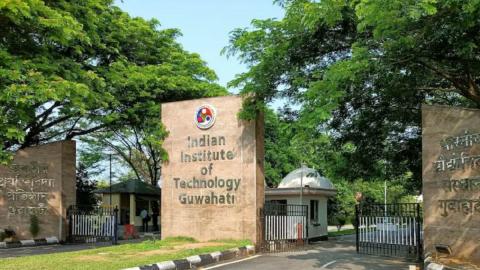
Guwahati: In a groundbreaking innovation towards addressing water pollution, scientists at the Indian Institute of Technology Guwahati (IIT-G) have developed an economically priced and eco-friendly technique to eliminate harmful pollutants from industrial waste water. The innovation includes treating wastewater using biochar from fruit waste such as pineapple crowns and mosambi (sweet lime) fibers to effectively take up toxic nitroaromatic chemicals that are most prevalent in waste water from industries such as dyes, pharma, and pesticides.
Headed by Dr. Gopal Das, an associate professor in the Department of Chemistry at IIT Guwahati, the researchers have shown that biochar, which is produced by a process known as pyrolysis, can be utilized as a potent material to remove pollutants from wastewater. Pyrolysis is the process of heating organic waste materials, for instance, fruit waste, in the absence of oxygen and transforming them into a carbon-based material called biochar.
The biochar derived from pineapple crowns and mosambi fibers—labeled **ACBC (Ananas Comosus Biochar)** and **MFBC (Citrus Limetta Biochar)**, respectively—has demonstrated exceptional performance in adsorbing 4-nitrophenol, a ubiquitous and toxic nitroaromatic compound present in industrial wastewater. This group of chemicals is well known for its environmental persistence and for its potential to induce cancer, genetic mutations, and other health hazards.
The study, which was published in the highly acclaimed journal *Chemical Engineering Science* recently, reported that ACBC had a 99% removal efficiency of 4-nitrophenol, while MFBC had removed close to 97%. The reason why this technique differs from conventional wastewater treatment technologies is not just because it is efficient but also because it is fast. The biochar had achieved equilibrium in a mere five minutes, far surpassing conventional methods that are normally slower and involve costly catalysts and sophisticated equipment.
“Due to this quick adsorption mechanism combined with efficient removal, the technology is particularly suited for large-scale industrial application,” Dr. Das explained. He added that the biochars are reusable multiple times without decreasing their efficacy, thus making it economically and environmentally friendly.
The implications of this discovery reach beyond industrial water pollution treatment. The biochar technology, according to Dr. Das, can be scaled down for rural communities where clean water is a problem. The technology can also be implemented for larger-scale environmental cleansing, converting waste products into useful products for purifying polluted water.
The group of researchers, led by Dr. Deepmoni Deka and Neha Gautam, is now working toward planning lab-scale testing and field trials for further fine-tuning the technology. They hope to test the efficacy and scalability of the system before proceeding toward commercial-scale production. The researchers are actively looking for collaborations with stakeholders in the industry in order to commercialize this potentially game-changing technology and tackle the increasing global concern of water pollution.
By transforming fruit waste into a solution for environmental conservation, IIT Guwahati research not only solves the burning problem of water pollution but also encourages a circular economy strategy for waste management, which is a major leap towards environmentally friendly industrial practice.
With this research ongoing, there is promise for cheaper and greener industrial pollution solution strategies, which can revolutionize wastewater treatment all over the world.
The post IIT Guwahati Develops Fruit Waste Purifiers for Industrial Wastewater appeared first on Global Governance News- Asia's First Bilingual News portal for Global News and Updates.