

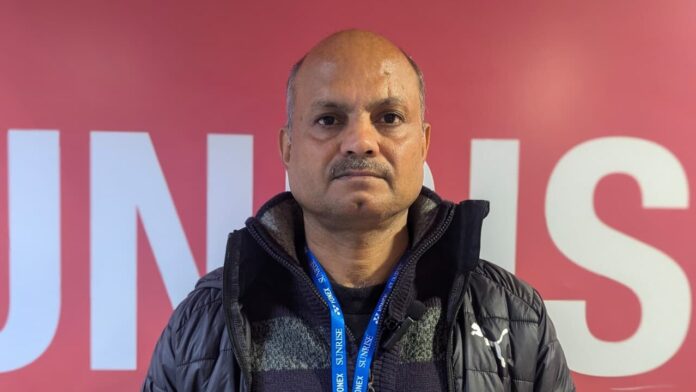
Sanjay Mishra, Honorary General Secretary of the Badminton Association of India (BAI) and former chief coach of the Indian junior badminton team, spoke candidly to RevSportz about India’s successful hosting of the World Championships, the lessons from the India Open and the road ahead for Indian badminton.
Boria: Now that the World Championships are over, are you finally breathing easy? Have you celebrated?
Sanjay Mishra: Yes, of course. It has been conducted very successfully. Actually, not only me but my whole team, the Sports Ministry, everyone is happy. Our president and the Sports Minister are also very happy.
After the India Open, our team, the Sports Ministry and SAI all put in a lot of effort, and we got a good result. So we are very happy.
As you saw, the tournament finished and the very next day there was so much rain. So it almost felt like luck was also with us and God was also with us.
If you look at the programmes that Prime Minister Narendra Modi is running for Khelo India, the various programmes being introduced by the Sports Minister to encourage sport, the Khelo India initiatives and the way our president is encouraging badminton, keeping all these things in mind, our team worked very hard.
There was some negativity during the India Open, and a lot of work was done to address that over the last five or six months. When the result is good, everything starts looking good and perhaps some of the earlier shortcomings also get overlooked.
Boria: You are saying a lot of work was done, and we can see that. Money was spent, work was done and that is why you were able to conduct such a tournament. But tell us what actually happened backstage after the negativity during the India Open. What meetings took place and how did you go about fixing everything?
Sanjay Mishra: Immediately after the India Open, I think the following week, after about a week, the DG called a meeting. He specifically said that this was a challenge for us.
He said that we would conduct the World Championships in the same stadium and show everyone that we could conduct a world-class event in this stadium.
The Sports Ministry took it very seriously. SAI took it very seriously. Our president also took it very seriously. We formed a team.
I think roughly 600 to 700 people became involved in the entire process. After that, the work started.
I think the BWF also took it very seriously. Every month, the BWF team would visit and see how much work had been completed and what work remained. Whatever things they felt needed to be done, they would give us a list.
We would share that with SAI and the Ministry, and then work would be done on those points.
What you saw during these seven days of the tournament was actually the result of a very long process before the tournament — the meetings, the planning and everything that was done.
It is a long story. I am very thankful to the Sports Ministry, SAI, the Sports Minister, our president and everyone involved because they took these things very seriously. Because of that, we were able to successfully complete the tournament.
One thing I would say is that the negativity that continued for almost a month after the India Open was talked about a lot. So if there is something good that has happened, appreciation should also happen in the same way.
Boria: When you were facing criticism after the India Open, how did you accept it? It is not easy for people in positions of power — politicians, bureaucrats or administrators — to accept that something went wrong and then say, “We will improve it.”
Sanjay Mishra: Exactly. As you said, whatever negative feedback came, we took it positively.
If there was something negative and we could correct it, we decided that we would do it.
And I think whatever happened during the India Open actually happened because we conducted the India Open at IG Stadium as a test event. It is a very large stadium, so we wanted to understand what kind of things could create difficulties for us.
We used it as a test event, and I think that turned out to be very good.
Whatever negative feedback came at that time, whether it came through the media or from anyone who told us that work needed to be done in a particular area or that something was not right, we noted everything down.
There were many meetings with the DG. It was not one or two meetings. I think there were perhaps around 200 meetings.
In every meeting, we discussed what work had already been completed, what work still needed to be done and what the problems were.
The Ministry and SAI took all those problems very seriously and worked on them.
And that is the result you saw — we were able to conduct the World Championships so successfully.
Boira: A lot of money has been spent on the facility. BAI has spent around ₹20 crore, and there has also been expenditure by the Ministry. The facility has been upgraded beautifully. What is the plan now? If the stadium is not used, we all know it can become a white elephant again. What is BAI’s plan regarding international events and making use of this facility?
Sanjay Mishra: The renovation of the IG Stadium has been done very well.
As far as the future is concerned, regarding how SAI or the Ministry plans to use the stadium, I don’t have proper information about that.
But I definitely have one suggestion and one request: it would perhaps be better if the stadium were given only for sporting activities.
There must have been some difficulties earlier and, if the Ministry or SAI is taking a particular decision, there must be a reason and some thought behind it.
I don’t have the exact information about that.
But if the stadium is used for sporting activities, then perhaps the renovation that has been done can be utilised for many years and different sports can benefit from it.
Boria: India has said it wants to host the Thomas Cup and Uber Cup. How confident are you? What is the way forward?
Sanjay Mishra: We have bid for it. The way we successfully conducted this tournament, and the fact that the BWF President, Secretary, Deputy President and other officials were here, and the way they appreciated the tournament and everything that was done, makes us a little positive.
Looking at the way we conducted the World Championships, I think perhaps our chances of getting the Thomas and Uber Cup have increased.
Boria: If India gets the Thomas and Uber Cup, will you conduct it in Delhi itself?
Sanjay Mishra: Yes, in Delhi itself. Our plan is to conduct it at the same IG Stadium if we get the event.
Boria: The players, especially Gayatri and Trisha, spoke about the crowd. Gopi also mentioned the 7,000–8,000 people who came to watch. Delhi really showed up. How proud were you of the crowd?
Sanjay Mishra: Exactly. I understand when our players are playing and there is a crowd supporting them. But in the final, there was no Indian player playing. Even after that, if the stadium was packed, it means that the popularity of badminton is growing and that there are a lot of sports lovers.
For us and for everyone involved in sport, having a packed stadium for an event in which no Indian player is playing is a very big thing. It is also a matter of great happiness.
I think all the badminton lovers must especially be very happy, and as BAI, we are also very happy.
Boria: Looking ahead, how do you see India’s prospects at the Asian Games? And if we look at the 2028 Olympic cycle, how is BAI thinking about the short-term Asian Games target and the longer-term Olympic target?
Sanjay Mishra: If you look at the World Championships, frankly speaking, Gayatri and Trisha performed extraordinarily. But if you really ask me, perhaps nobody expected this kind of performance from Trisha Jolly. That is absolutely true because over the last eight to ten months, because of injury or whatever the reasons were, her performance had not been at that level.
But she is, of course, a player who is capable of being among the top four in the world. She has that ability. But for the last eight to ten months, she had not been able to perform at that level.
As far as the other players are concerned, I was a little disappointed with Lakshya’s performance, and he must also have been disappointed. But Lakshya is the kind of player who can lose in the first round of one tournament and then, seven or ten days later, win a very big tournament. He has the quality to beat any player in the world.
Ayush has already proved that. He beat the world No. 1 in the first round and showed that he can beat anyone.
As far as Satwik and Chirag are concerned, nobody has any doubt about their performance and ability.
My feeling is that perhaps there was some extra pressure at the World Championships because they were playing at home in front of the home crowd. Whatever the reason was, I cannot say for sure.
But at the Asian Games, of course, our players performed well last time as well. The team won a medal and there were other medals too.
So I believe that India will perform well again at the Asian Games, and perhaps we can win more medals than last time.
As far as the 2028 Olympics are concerned, Sindhu is playing well right now. She has been performing well for the last three or four months.
Ayush, Lakshya and all these players have the ability to beat any player in the world at any time.
So I am quite positive that our performance at the Asian Games will be very good — both in the team championship and individual championship.
As far as the juniors are concerned, our juniors have started performing as well.
We have recently won back-to-back B300 events. In boys’ singles and boys’ doubles, we have been getting results. The Hariharan-Arjun pair has also performed very well in some tournaments.
I hope this pair will also produce results. There are some good juniors coming through, and I think that in the next two to three years, you will see a group of juniors who will perform well.
Boria: How do you see the new 15-point scoring system? Badminton could change significantly after this. Gopi believes it could be good for Indian players. Do you agree?
Sanjay Mishra: Whenever there is a major change, initially there is a lot of discussion about it.
But players are such that they adapt to things very quickly.
Training will start according to the new system. Their game practice will be done according to the new system, and their planning will also happen accordingly.
As far as Indian players are concerned, as you said, Gopi believes this, and I also feel that this could benefit us. Perhaps we will get even better and bigger results.
If we look at the world level, when the earlier system changed to the service-change system, it was initially criticised. People said it was wrong. But similarly, when the present scoring system came in, it was also initially criticised.
After that, however, we saw that it worked very well. There have been very good matches and everything has been going well.
So I feel that the 15-point system may initially cause some difficulty for some players, but as far as Indian players are concerned, I believe that this system can benefit them and they can perform better.
Also, in domestic badminton, we have already started the 15-point system from July, so our players are already getting ready for it.
Boria: What is your understanding of Satwik-Chirag’s situation, particularly Satwik’s shoulder issue? Can it be managed until the Olympics?
Sanjay Mishra: Injuries are part of the game. Satwik is a hard hitter. I had also spoken to my physio about it, and they said that it is not a major issue or something that has caused a very big or very long-term problem. It is manageable.
I feel that this pair is capable of giving our country major achievements for at least the next three years. I feel that they can manage it at least until the Olympics.
Because if they go for surgery now, then perhaps one year could be lost — six months for the surgery and recovery, and then time to come back into the group. I don’t see them doing that immediately because there is Olympic qualification and then the Olympics.
So I also hope that they can manage it.
Given the kind of ability, potential and talent they have, they will give everything to win that one medal which is still missing — the Olympic medal.
They will put their heart and soul into trying to win it in 2028.
Boria: If you close your eyes today and think about the Delhi World Championships, what is the one moment you will always remember? The crowd’s chant, the Gayatri-Trisha medal, or something else?
Sanjay Mishra: Both, actually. Successfully conducting the tournament is one part of it. But getting a medal — as they say, it was “sone pe suhaga” — that was the kind of moment it was.
So we are enjoying both things equally: successfully conducting the tournament and getting a medal.
Yes, we were perhaps expecting more medals. But at least Trisha Jolly and Gayatri did not leave us empty-handed. So we are very thankful to them and we are very happy.
Boria: Finally, how do you look back at the entire World Championships experience?
Sanjay Mishra: Successfully conducting the tournament was a major achievement for us, especially after everything that happened during the India Open.
The fact that the event was conducted successfully and that India also won a medal made the experience even more special.
We were expecting more medals, but at least Trisha Jolly and Gayatri ensured that we did not return empty-handed.
We are very thankful to them and very happy with what we achieved.
(Transcribed by Shourjyani Chatterjee)
Follow REVSPORTZ for more articles.
The post Sanjay Mishra: “We Took the India Open Criticism Positively” — BAI General Secretary on World Championships Turnaround, Thomas-Uber Cup Bid & 2028 Olympics appeared first on Sports News Portal | Revsportz.