

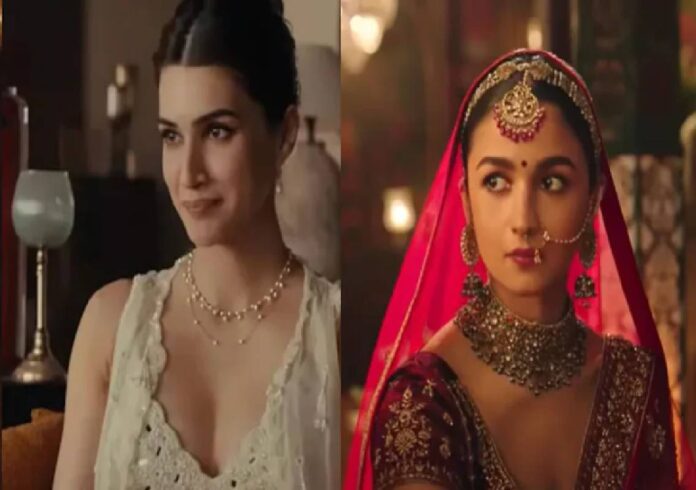
Mumbai: Kriti Sanon’s latest Raksha Bandhan advertisement has sparked a debate over the portrayal of Indian traditions in modern advertising. The jewellery campaign, which features Sanon celebrating Raksha Bandhan with her brother and tying a rakhi to her pet dog, has drawn criticism from some social media users over her outfit and the way the festival has been presented.
The controversy has also brought back a familiar debate in the advertising industry: how far can brands reinterpret traditional festivals and cultural customs while still retaining their emotional and cultural significance?
Kriti’s campaign is not the first festive or bridal advertisement to face such questions. Over the years, several Indian brands have found themselves at the centre of similar controversies after campaigns attempted to challenge conventional ideas around weddings, festivals, religion, gender or social customs.
Kriti Sanon’s Raksha Bandhan campaign
Kriti Sanon’s advertisement for jewellery brand GIVA presents Raksha Bandhan through a contemporary lens.
In the campaign, Sanon is seen celebrating the festival with her brother while wearing an ivory bralette-style blouse paired with a cape and draped skirt. Another part of the campaign shows her tying a rakhi to her pet dog, highlighting the idea that pets can also be considered family.
While some viewers appreciated the modern interpretation, others questioned whether the styling and presentation were appropriate for a traditional festival. Critics particularly focused on Sanon’s outfit and the decision to include the dog in the rakhi ritual.
The campaign subsequently became a subject of widespread discussion on social media.
Kangana Ranaut criticises the advertisement
The controversy intensified after actor Kangana Ranaut criticised the campaign.
Ranaut questioned Sanon’s choice of clothing for an advertisement centred on Raksha Bandhan and argued that the outfit was inappropriate for a traditional festival. Her comments added a celebrity voice to the criticism that had already been circulating online.
The criticism was not limited to the clothing. Some users also objected to the portrayal of the pet dog as part of the rakhi celebration.
At the same time, others defended the advertisement as an example of changing family structures and modern interpretations of festivals.
Kriti responds to the debate
Kriti Sanon later addressed the controversy, arguing that culture and tradition are not determined by a woman’s clothing.
The actor emphasised the emotional meaning of Raksha Bandhan and pointed out that her pet is also considered part of her family. Her response shifted the conversation towards the larger question of whether traditional festivals can be represented differently in contemporary advertising.
The debate therefore moved beyond the advertisement itself and into a broader discussion about women’s clothing, cultural identity and the freedom to reinterpret traditions.
Why festive advertisements often face backlash
Festivals offer brands a powerful opportunity to connect products with emotion, family and cultural identity.
However, this also makes festive campaigns particularly sensitive.
An advertisement for jewellery, clothing, food or consumer products may attempt to present a festival in a fresh way, but audiences can interpret the same creative decision as an unnecessary departure from tradition.
This tension between cultural familiarity and modern storytelling has resulted in several advertising controversies over the years.
Tanishq’s interfaith wedding advertisement
One of the most prominent examples was a Tanishq advertisement released in 2020.
The campaign showed a Muslim mother-in-law organising a traditional Hindu baby shower ceremony for her Hindu daughter-in-law.
The advertisement was intended to highlight an interfaith family celebrating each other’s traditions. However, it faced intense criticism online from sections of the audience, with the debate becoming entangled in wider discussions around religious identity and representation.
Tanishq eventually removed the advertisement, citing concerns over the safety of its employees and partners.
The campaign remains one of the most widely discussed examples of the difficulties brands can face when advertising intersects with religion and social issues.
Manyavar’s ‘Kanyamaan’ campaign
Another campaign that generated considerable discussion was Manyavar’s ‘Kanyamaan’ advertisement featuring Alia Bhatt.
The campaign challenged the traditional concept of kanyadaan, a wedding ritual in which the bride is symbolically ‘given away’ by her family.
Instead, the advertisement presented the idea of kanyamaan, suggesting that a daughter should be treated with respect rather than viewed as someone being handed over.
While the campaign received praise for questioning a traditional concept, it also attracted criticism from sections of the audience who felt that the advertisement was unnecessarily challenging established wedding customs.
The debate highlighted how even campaigns designed around social messaging can produce sharply divided responses.
Sabyasachi’s jewellery campaign
Luxury designer Sabyasachi Mukherjee also faced criticism over a jewellery campaign that featured an intimate portrayal of a bride and groom.
The campaign, released for his jewellery collection, generated controversy over the visual representation of Indian brides and relationships.
Critics questioned whether certain imagery was appropriate for a bridal campaign, while others argued that the designer was simply presenting a contemporary interpretation of Indian wedding culture.
The discussion again demonstrated how bridal advertising can quickly become a debate about cultural expectations.
FabIndia’s ‘Jashn-e-Riwaaz’ campaign
Another major controversy involved FabIndia’s ‘Jashn-e-Riwaaz’ campaign in 2021.
The brand released advertisements featuring models dressed in traditional Indian clothing and jewellery ahead of Diwali.
The campaign title, however, prompted criticism from some sections of social media users who objected to the use of the phrase Jashn-e-Riwaaz for a Diwali campaign.
The controversy became politically charged, with critics arguing that the brand had unnecessarily altered the cultural identity associated with the festival.
FabIndia subsequently changed the campaign’s name.
The incident showed how even the language used in a festive campaign can become controversial when audiences believe it does not sufficiently reflect the identity of the festival being celebrated.
Dabur’s Karwa Chauth advertisement
Dabur also faced criticism for a Karwa Chauth advertisement featuring a same-sex couple.
The campaign attempted to present a more inclusive interpretation of the traditional festival by showing two women participating in the ritual.
While many viewers praised the representation, others criticised the advertisement for changing the traditional understanding of Karwa Chauth.
The controversy ultimately resulted in the advertisement being withdrawn.
The campaign nevertheless became part of a larger conversation around LGBTQ+ representation in mainstream advertising and whether brands should use traditional festivals to communicate contemporary social messages.
Manyavar’s bridal campaigns and changing traditions
Manyavar has repeatedly used wedding campaigns to question established ideas around marriage and gender roles.
Its advertisements have often focused on themes such as women’s independence, changing family structures and the emotional aspects of marriage.
Such campaigns have generally received a combination of praise and criticism, illustrating the challenge brands face when attempting to make traditional wedding narratives more progressive.
The response depends heavily on how audiences interpret the balance between social messaging and cultural representation.
Why brands continue to challenge conventions
Despite the risks, brands continue to experiment with traditional festivals and wedding customs because these occasions carry strong emotional associations.
A campaign that generates discussion can receive significantly more attention than a conventional advertisement.
However, controversy can also become a liability.
When audiences feel that a brand has trivialised a cultural ritual or used a sensitive tradition merely to sell a product, criticism can quickly spread across social media.
This makes cultural sensitivity an increasingly important part of advertising strategy.
Social media has changed the advertising landscape
Earlier, controversial advertisements were largely discussed through television, newspapers and industry publications.
Social media has dramatically changed that dynamic.
A campaign can now generate thousands of reactions within hours, with users dissecting everything from clothing and dialogue to religious references and representation.
Celebrity involvement can make the discussion even larger.
Kriti Sanon’s campaign is a recent example, with criticism of her outfit and the inclusion of her pet becoming separate strands of the wider online debate.
The culture versus modernity debate
At the heart of many such controversies is a question with no universally accepted answer: how should traditional Indian festivals be represented in modern advertising?
Some audiences prefer campaigns that closely follow familiar rituals, clothing and visual imagery.
Others believe traditions can evolve and that advertisements should reflect changing lifestyles and family structures.
Both perspectives can coexist, but brands have to decide how far they want to push a reinterpretation.
Controversy can also increase visibility
There is another side to such campaigns.
Controversy can dramatically increase an advertisement’s visibility.
A campaign that might otherwise receive limited attention can become a national talking point after criticism from celebrities or social media users.
For brands, however, increased visibility does not always translate into positive brand perception.
The challenge is to create conversations without alienating the audience the campaign is intended to reach.
Kriti’s campaign joins a long list
Kriti Sanon’s Raksha Bandhan advertisement has therefore entered an already long list of campaigns that have generated debate over tradition and modernity.
From interfaith relationships and wedding customs to LGBTQ+ representation and festive rituals, advertisers have repeatedly tested the boundaries of cultural storytelling.
The reactions have varied widely, but each controversy has contributed to a larger discussion about how Indian identity is represented in commercial campaigns.
Conclusion
Kriti Sanon’s Raksha Bandhan advertisement is the latest example of a festive campaign triggering a debate over tradition, modernity and cultural representation. The GIVA campaign features Sanon celebrating Raksha Bandhan with her brother and tying a rakhi to her pet dog, while her contemporary outfit has also drawn criticism.
The controversy follows several other Indian advertising campaigns that faced backlash for reinterpreting cultural customs, including Tanishq’s interfaith baby-shower advertisement, FabIndia’s Diwali campaign and Dabur’s Karwa Chauth advertisement.
Such controversies underline the difficult balance brands must maintain between creative freedom and cultural sensitivity. As audiences and family structures evolve, advertisers are likely to continue experimenting with traditional narratives — but the reactions to these campaigns show that the line between modern representation and cultural offence remains highly contested.