

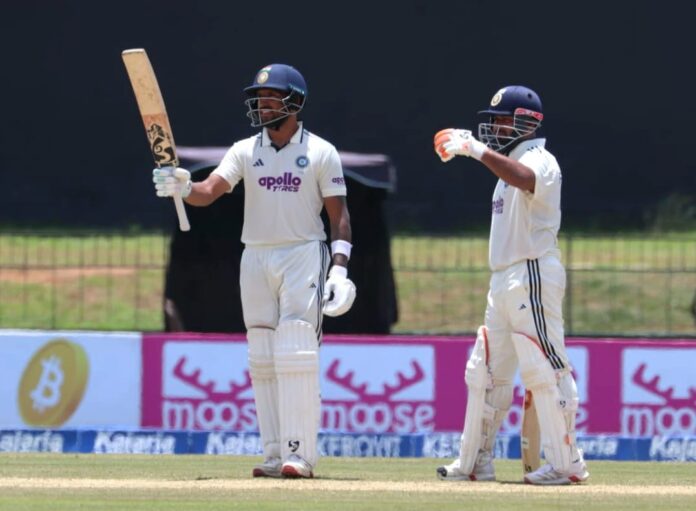
When does a team move from transition to stability? For India, the batting transition was always going to take time, as it was never easy to find replacements for stalwarts such as Virat Kohli, Rohit Sharma, Cheteshwar Pujara and Ajinkya Rahane. For ‘new’ India, the new cycle began in England last year. Head coach Gautam Gambhir is right when he says the home Test series whitewash against New Zealand in 2024 shouldn’t be connected with the current squad, for that side was still carrying the heavy remnants of the past.
Once Shubman Gill decided to drop down to No. 4 to make up for a Kohli-sized void, two batting positions became very important — Nos. 3 and 6. The heavy rotation at No. 3 was down to the fact that there was no seamless transition, as there had been from Rahul Dravid to Pujara. Before the start of this season, the team management decided to give Sai Sudharsan a long rope despite his forgettable innings against South Africa in Guwahati last winter. But the left-hand batter was ruled out of the Sri Lanka series and another new No. 3 had to be tried. Devdutt Padikkal said carpe diem. With back-to-back hundreds, he has all but owned the spot for the time being.
So, what will happen when Sai returns to the fold? Very likely, he will bat at No. 5, followed by Rishabh Pant at No. 6 and Ravindra Jadeja at No. 7. Where does that leave Dhruv Jurel, who dug in his heels at the SSC, scored his second Test hundred and took the tourists to a winning position? Jurel scored a half-century in the first Test in Galle as well.
India’s next Test assignment is against New Zealand in November and, assuming everyone is fit, it would be a contest between Washington Sundar and Nitish Kumar Reddy for the No. 8 position. Conditions will determine the selection. It’s very likely that, notwithstanding his batting form in the ongoing series, Jurel will have to sit out. But therein lies the positive — India’s batting is finally taking shape, with transition veering towards stability. Having quality back-ups such as Jurel adds serious depth to a squad, and the series against Sri Lanka is witnessing the rebirth of Indian batting.
That it is a series against Sri Lanka is a flawed argument. You can only play what is in front of you. In this Test, as in Galle, Indian batsmen had to toil hard for their runs. The cricket in the first session on Day 2 here was attritional. India prevailed because they showed resolve.
Also, a batting unit is judged in proper Test-match conditions. Lottery pitches make batting a game of Russian roulette, which is applicable to every team in the world. For context, turn to the series between Australia and Bangladesh.
The way young Indian batsmen, Padikkal and Jurel in particular, have batted in both Tests dismisses the lousy perception that the current crop of players no longer care for Test cricket. The effort that Jurel, in particular, has put in after that forgettable outing in Guwahati to improve as a Test batsman has been heartening. It wouldn’t have happened if they were indifferent towards the purest format of the game.
“To play Test cricket for India, it is a pride thing,” said Jurel at the post-day press conference. “Whenever you go out to play for India in Test cricket, people call you a Test cricketer. It’s a privilege.”
Jurel was full of praise for Pant for guiding him throughout their partnership. He dedicated the century to his parents. His grandfather was a farmer and his father was a soldier, and his celebration has a tagline — Jai Jawan Jai Kisan.
For More Exciting Articles: Follow RevSportz
The post India’s batting starts taking shape appeared first on Sports News Portal | Revsportz.