

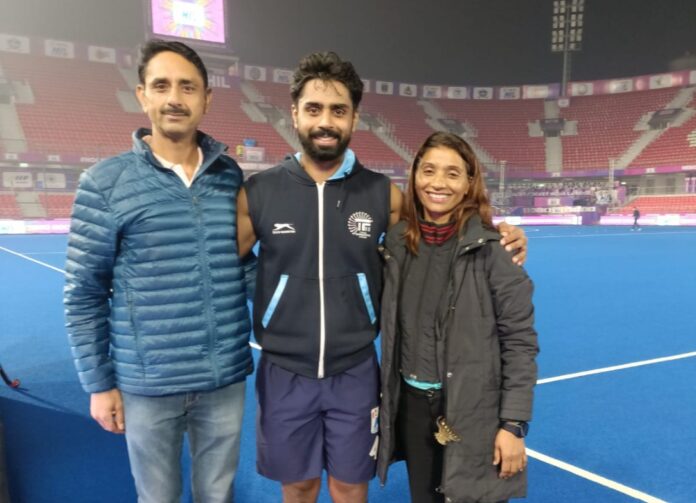
Pritam Rani Siwach. The name itself is enough for memories to gush forth like a river: the epochal triumph at the Commonwealth Games in 2002, the watershed moment in the 1998 Asian Games, the redoubtable comeback after giving birth her first child in 2000, being the captain of the national side, and many more. Pritam also had to overcome enough challenges as a young girl growing up in a village in Jharsa.
Pritam, who runs an academy in Sonipat, is now a proud mother too: her son is representing India at the ongoing World Cup in Belgium and the Netherlands. In a freewheeling chat, RevSportz caught up with the ‘Super Mom’ from Haryana.
Excepts:
Yashdeep Siwach, your son, is playing for India in the ongoing World Cup. Can you say a few words about your feelings? The mother-son duo has created a legacy in Indian hockey…
I am his coach as well as his mother, I feel very good as his mother, but as a coach, I feel that he should have got into the squad earlier. From my academy, enough girls have played for the national team. As a coach, I feel happy that he is the first boy to play (from the academy) for the national team. Yes, I am very happy that he is playing at the same level, that he is playing on the same field (Amstelveen) that I played on.
You must have had conversations with your son, before and during the World Cup…
Play without pressure, enjoy the game. When we were playing, we didn’t have someone who could say all these things. As a coach, I can say certain things. Obviously, after the match, the coach (India coach) only would tell, but I do see his mistakes, then I tell in the evening about the points, “you could have done this, you could have done this better for the team”. So, we talk daily, during the night.
Any fond memories to share of Yashdeep’s childhood days?
During his childhood days, Yashdeep was very active. He was very good in education, but his passion was in sports. Not so much in hockey, but in swimming, horse riding, cricket, football, he was an all-rounder. He was a loving boy. At the school or ground, he was a soft-hearted boy, helping nature. I was practicing for the Commonwealth Games 2002, now he has become so big. I feel happy.
Yashdeep plays as a defender. How do you look at his approach towards hockey?
In hockey, you have to be strong, tough. On the field, he is a fighter, when he came into the junior side, he got selected out of 60 boys. He wasn’t that good then, but he worked very hard, those boys from the village would be rough, used to taunt him, he would go through all that. When someone from the family has already played for the country, and then your child also plays, there would be pressure on you. That his mother was a player. But when he plays on the ground, whatever the position, he is calm and cool. He doesn’t take aggressive decisions or wrong decisions.

Any other memories to share? I remember you playing in the 2006 Nationals, with your kids in the stands…
When the senior national event was happening in Delhi, Kanika (Pritam’s daughter) was very small, so I used to give her milk. I was playing the match, my daughter was crying, and my son was also crying outside, he was hungry, and my match was happening. After 35 minutes, I came inside during half time. I then went near a corner and gave my daughter milk. When Kanika was 1 year old, I played in the Olympic Qualifiers. So, the message is even after having kids, a woman can be a fighter, make a comeback. I was doing the role of a mother, the role of a player too. Now I am doing the role of a coach. So, I am doing three roles.
You made a sterling comeback to the national team after giving birth to Yashdeep…
I was married when I was just 23 years old. I had played for 8 years by then, I started playing in 1991, I got the Arjuna Award in 1998, I had also become the captain. I had achieved enough but I wanted to play more. I said to my husband, “I want to play more”. My husband had back pain, so he could feel how it felt for a sportsperson after leaving sports. He allowed me to play.
You may not believe, when I gave birth to Yashdeep, my weight was 74 kgs. And there was less time to make a comeback. I used to live in a joint family, so I had commitments, father-in-law, mother-in-law, two brothers in law. I used to do kitchen work: washing utensils, clothes. Alongside it, I ensured that I would reduce my body weight. During that time, in my village, very few were allowed to play after marriage. But my husband, my mother and father supported me.
I had joint pain, my weight was more, in between I had to give milk to my child, I also had to do domestic chores. As I worked well, my family also gave me love. My in- laws also said, “let her play”. Then I gave trials, I gave my test. These days, it is YoYo test, for us it was 2.4. I proved myself in that test, and I made a comeback, playing alongside younger girls.
Can you travel back in time and take us through the memorable triumph in the 2002 Commonwealth Games?
In 1998, we won a medal (Asian Games) after 13 years, that same batch continued until the CWG. Suddenly, we lost a game, and there was little chance of getting into the quarterfinals. A new rule had come, carrying forward points, or something like that (second and third placed teams in the two groups had to come through crossovers). We thought that we have lost, we were sad. Gurdial Singh Bhangu, our coach, and a Dronacharya awardee, had returned after attending a meeting. He said to us that we are still in the picture, that we still have a chance. We were very happy. We were like, whatever happens, we have to do this.
We played in tough situations, sometimes it was cold, it rained. When we played South Africa, we were down by two goals, it was very cold. But when we came back during the half time, we motivated each other. And then we scored 3 goals, won the game, and won the semifinal too. When we reached the final, we were very happy, the women’s team was playing the final after a long time. Before the final, the England coach had said in a newspaper that the Indian team isn’t good, we will score a lot of goals in the final, he made it seem like India were easy opponents.
Our coach came with that newspaper cutting and said, “see, they think we are weak, whatever it is, we shouldn’t look at the opponent as weak. We have to play now with this in our mind (as a motivating factor)”. We had nothing to lose, it was their home ground in Manchester. They had the better team, but we were all motivated. It went to the Golden Goal; we put in a lot of effort. A new rule had come up that when you get a PC, the game continues (and cannot end until the ball either leaves the striking circle or a goal is scored). We got a PC, we continued the game, and we scored a goal. Our Sports Minister was Uma Bharti. She had said, “it felt like our girls had taken the Kohinoor back from England”. We got goosebumps. You might know about the Chak De India movie, it was based on this. We felt very happy.
Let’s revisit your childhood days, and delve deeper into the challenges that you faced as a girl…
In Haryana, girls playing was like a foul, it wasn’t allowed. I am from a village called Jharsa in Gurugram. We are from a middle-class family, my father used to work, but we are from a farmer’s family. We used to play Kabbadi, Hockey and all. My PT teacher didn’t give me a chance to play, I wanted to play when I was in the 7th, but he scolded me and asked me to leave. He said, “you’re too fat”, and I came home crying towards my grandmother.
Then my grandmother came alongside me to the teacher and said, “let her play” (in hindi). He agreed. I got only a broken, small stick. I was sad, I am seeing other girls play, not me. I used to dribble with a small pebble outside. When I came back and saw my brother, I was feeling embarrassed as I had got a broken stick. I used to hide it, so that my brother wouldn’t taunt me. For 10-11 days I kept going to the ground, I didn’t get a chance. Slowly but steadily, the teacher also felt I could play a little bit.
The teacher also got interested, the teacher used to hit us. The ground was 6-7 kms away in the city, we weren’t getting money from home, we used to travel by auto for credit. Lots of girls left playing. I would feel sad, how could I go alone, the village people would taunt me, “marry her off, others also have married”. But my father would say, let her play. But to play, I also need teammates, I would play with boys. I got selected for the junior national camp. I got selected for the junior side, I was the top scorer in the Junior Asia Cup in Kuala Lumpur in 1991, I was awarded with the best player. My villagers recognised me. I got a job at 17. Then it was like everyone said, “time to marry her”, but I wanted to play, my career had just started. I fought with my family members. I used to say, “give me two years”. Like that I made it to 1998 from 1991. It was difficult for me as I had to convince all of them; family members, neighbours.
Returning to present times, the Indian men’s team suffered a loss to England while the women’s team are on a roll in the ongoing World Cup…
Wins and losses happen, in a tournament you could play one bad match. But I would look at it in a way that is lucky as it happened now, not in the future games. We made mistakes, in between our defenders made mistakes. England is not a weak team. But it will serve as a lesson, and they will play with more alertness. In the women’s section, by winning the match (against South Africa), we are in a good position, as our scoring was good in that match. England have lost to China; we can definitely beat England and top the group.

The post Super mom, proud mother, a pioneer: The story of Pritam Rani Siwach appeared first on Sports News Portal | Revsportz.