

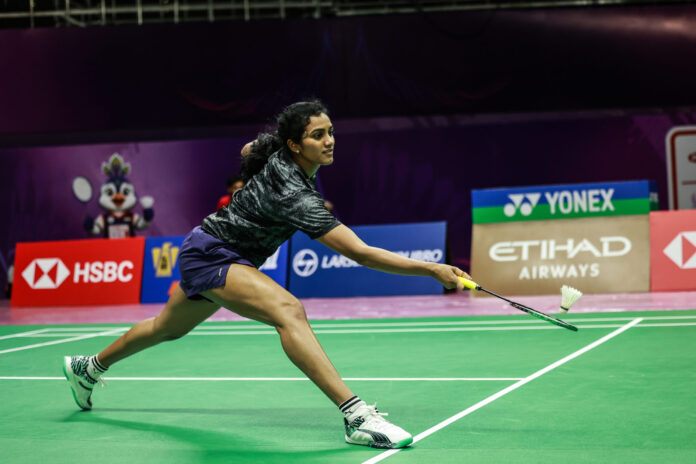
Seven years can feel like an eternity in elite sport. Since her historic World Championship Gold in Basel in 2019, PV Sindhu’s trophy cabinet has expanded, she won her second Olympics medal, solidifying her status as arguably India’s greatest badminton icon. However a lean patch followed her, but the hunger for world dominance remains entirely unsated for India’s No.1.
At the pre-tournament press conference, the double Olympic and five times World Championship medalist spoke about the excitement of playing Worlds at home, recent form, losses that helped her become stronger, the sports science team and her 2009 worlds experience.
You recently won the Japan Open, that must have given you renewed confidence…
Sindhu: Definitely, it gives me a lot of confidence. I’m really looking forward to the World Championships, especially since it’s happening in India. Winning the Japan Open gave me a lot of confidence and a boost.
You have won five World Championship medals. Looking back, which moments shaped your career and made you tougher?
Sindhu: Having five medals at the World Championships is an amazing journey. Each win and each medal gave me a different kind of experience. Bronze in 2013, bronze again in 2014, then silver in 2017 and 2018, and finally gold in 2019.
The transition was wonderful, but there were also a couple of moments that made me stronger. One of them was losing the 2017 World Championships final to Okuhara in Glasgow. It was a very hard-fought match, almost one hour and 50 minutes. I was very hard on myself because I was almost there but couldn’t get the gold. It was a matter of one or two points, and that made me much stronger.
There were other moments too, like in 2018 when I was leading, lost the first game and eventually lost the gold. These moments, especially at the World Championships, made me stronger and helped me come back stronger.
You have five World Championship medals, the most in the world, but it has been seven years since your last medal. How special would it be to win one at home?
Sindhu: Definitely, it’s very special because it’s happening in India. I won the World Championships in 2019, so it has been almost seven years.
The Japan Open has given me a lot of confidence, and I hope I can carry that confidence forward. Everything is going well, and for me, it’s one match at a time.
Hopefully, I can get a lot of support from the Indian crowd. I’m really happy that we are playing the World Championships in India and that we get to play on home ground. I hope I get a medal here too.
How have you changed over the last seven years?
Sindhu: There have been quite a few changes, in terms of my game, how I think and how I strategise. Badminton itself has changed as a sport.
Earlier, women’s singles was more attacking and faster-paced. Now there are more long rallies and you have to stay on court for a longer period. So you need a lot of patience.
As a person, there have also been a lot of changes in terms of experience. I feel much more experienced now in terms of how to deal with situations on court.
Do you still get butterflies in the stomach before a big tournament?
Sindhu: I have a lot of experience. I’ve played many first-round matches where I had butterflies and there was a lot of pressure. I won’t deny that there is pressure, yes there is.
But at the same time, for me, there’s nothing to lose. I just want to give my best because I know I have trained hard and worked hard in my training sessions. I just have to go out there on court and give my best, irrespective of the result.
I think the hunger towards the game hasn’t changed. I know it is still in me and I can still do it. The hunger towards the sport hasn’t changed.
There were concerns about the facilities, monkeys and other issues. How do you see the arrangements this time?
Sindhu: Whatever is the best, people are doing it, and I really appreciate their effort.
I came yesterday and I’m here today, and we’ve had really good sessions. I haven’t been uncomfortable. Everything is comfortable and everything is good.
To be very fair, from the washrooms to the people here, if we need any help, there are people here day in and day out. They are putting all their efforts into making this happen. They have achieved what they wanted and this will be one of the greatest World Championships. What else do we need? Being an Indian, I can proudly say that we are happy and fortunate to play here at home.
What are your preparation methods? Do you have any superstitions or rituals?
Sindhu: Everybody has their unique way of doing it. We all believe and trust in God. But you just have to go out there because you can’t predict the result. You never know what is going to happen tomorrow.
Whatever it takes to win, everyone has their unique ways whether it’s a racquet, a T-shirt, a dress, the way you dress up, your ponytail or your shoes. For me, I just trust in God, go out on court and give my best.
You have had a consistent year, with several deep runs before winning the Japan Open. Was this a breakthrough year for you?
Sindhu: I’ve had a really good team around me. We had to build that team and it took some time to get everyone together in terms of sports science, physiotherapy and training. We all came together, sat down and noted what was required and what was needed. We discussed it with the coach and worked on those things. All of it played a major role.
People only see us when we play a match, but there is a lot that happens behind the scenes. We have to change things smartly because sometimes your body might not cooperate when you are playing.
You have to make sure you get enough rest and make those decisions smartly so that you can be at your peak at the right time. I think we’ve been doing that correctly, and that has made the difference.
You recently spoke about changes with your sports science team. How do you feel physically and mentally?
Sindhu: It was very important to have a sports science team around me, in terms of strength and conditioning and physiotherapy. The coach is always there as well.
Wayne Lombard heads the strength and conditioning, Heera Mundluru is my physiotherapist and Shreyasi Sanjay looks after the S&C. It’s very important to build around that because sometimes your body is not at 100%, but you still push. Injuries don’t tell you before they come — they just happen.
So, before that, what precautions do you take and how smartly do you change things? We have all these gadgets now to record your strain, how tired you are and whether you can push yourself or not. These are the metrics we use to make sure we take precautions. Maybe the next day you can do a different kind of training. These are the small things that you change.
It has helped me. Physically and mentally, it has been quite good. I can see the changes in my game and movement, so I’m happy that it’s going in the right direction.
What are your memories of the 2009 World Championships in India?
Sindhu: I was a very small girl. I used to come and watch matches from morning until evening. We would just play around and watch matches.
At that time, it was just like, ‘Okay, you get to see a lot of top players.’ You didn’t know how serious it was back then. But now, when I look back, I got to experience the best. I’m playing the World Championships in India again after 17 years, so it’s really good to see the journey from then until now.
The whole journey has been memorable. It’s always good to play in India, and this time I’m hoping that I can get a medal on home ground.
We always speak about An Se-young, but you have also played Wang Zhi Yi several times, including at the World Championships. How do you see this rivalry?
Sindhu: We have played a lot of times. I won against her at the last World Championships, and the last time we played, I was leading but lost from there.
She is doing well and is among the top players in the world. You just need to give your best. Everybody wants to give their best at the World Championships or any tournament. We might know each other’s games, but at the same time we have to make changes according to the court and shuttle conditions and make sure it is comfortable for us to play against each other.
Every athlete has a different style of play. Whether it’s Wang Zhi Yi, Yamaguchi or An Se-young, I’m not saying it will be easy. It will be hard, there will be tough matches and I need to be prepared.
Women’s singles has changed, with veterans returning and a new generation coming through. How do you assess the changes, especially with the new-scoring format?
Sindhu: There is a younger generation coming up in badminton, especially in women’s singles.
Regarding the scoring system, yes, it is going to be different and very challenging. With 21 points, if you are 7-0 down, you still have time to come back. With 15 points, if seven points are gone, almost half the match is done.
You need to be on your feet from point one. You can’t take it easy and think you will come back later. With the 15-point system, you need to be alert from the beginning.
There is some good young talent coming up. Being experienced, I feel the game is changing and evolving all the time.
Earlier, it was more of a faster game. Now it has become more competitive, with slower and longer rallies. With 15 points, it might become different, with shorter, quicker and faster rallies. You have to adapt.
I’m happy to see changes in the sport. Anything is good for Indian sport. You have to get used to it because that’s how sport is. The game changes, the scoring changes and the shuttles keep changing. You have to change too, you don’t have a choice.
Over a period of time, how has been your working relationship with coach Irwansyah?
Sindhu: It has been good. He has been with me for the last one and a half years. We have made some changes to my game. Initially, when you get a new coach, it takes some time to understand what the coach needs. But now it is working out well.
As I mentioned, it is important for the coach and sports science team to come together, understand the requirements and work accordingly. That’s what we are doing. We need to make sure that we also make those changes accordingly.
Follow RevSportz for latest sports news
The post The Hunger hasn’t changed: PV Sindhu, ahead of the World Championships appeared first on Sports News Portal | Revsportz.