

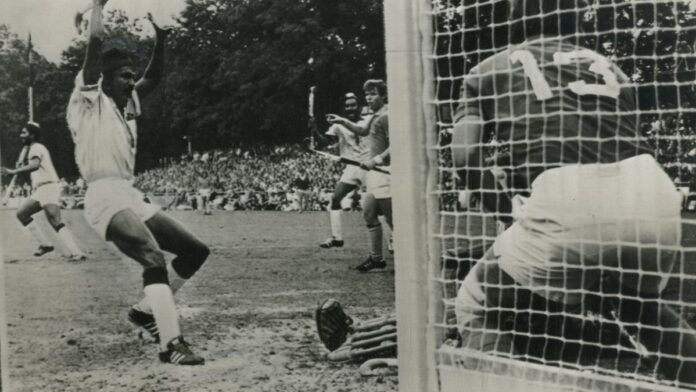
There are some defeats that disappear with time. Others stay with a team, passed from one generation to another. For Indian hockey, one such night happened on September 2, 1973. The place was the Wagener Stadium in Amstelveen. India were playing the Netherlands in the final of the 2nd Hockey World Cup. More than 12,000 home supporters had packed the stadium. India had reached the final unbeaten, and confidence was high after a 1-0 semi-final win over Pakistan, courtesy of a reverse flick from B.P. Govinda.
G.S. Bodhi was the coach, Balbir Singh Sr. the manager and MP Ganesh led the team on the field. India started the final at a furious pace. Within nine minutes, the home crowd had been silenced as defender Surjit Singh Randhawa converted two consecutive penalty corners with powerful drag-flicks to put India up 2–0 early.
But the Dutch were not going to surrender on their own turf. Their comeback was led by Ties Kruize, one of the biggest names in world hockey at the time.
Kruize converted a penalty stroke in the 16th minute after a penalty corner. The Netherlands found another opening early in the second half, and Kruize struck again. The match was level at 2-2.
From there, it became one of those finals where every chance seemed to carry the weight of history.
India continued to push. At one point, MP Ganesh produced a brilliant run down the flank before Ashok Kumar, the son of the legendary Dhyan Chand, found himself with a chance to put the ball into an open goal. But Dutch defender André Bolhuis threw himself into the path of the ball and somehow cleared it off the line.
India had another huge opportunity in extra time. A penalty stroke was awarded. B.P. Govinda stood over the ball. The Indian forward, wearing his familiar headband, had the chance to win the World Cup for his country. But Dutch goalkeeper Maarten Sikking, wearing a face mask, read the flick and made the save.
The 2-2 scoreline survived regulation time, extra time and sudden death. Then came the penalty shootout. Paul Litjens scored for the Netherlands. Govinda stepped up again, but Sikking saved once more. Kruize made it 2-0. Harmeek Singh gave India hope. Jeroen Zweerts restored the Dutch advantage before Ajit Pal Singh scored to make it 3-2. India were still alive when Charles Cornelius saved Nico Kranenberg’s attempt. Then came Harcharan Singh. One goal would have levelled the shootout. Instead, his stroke went wide of the right post. Bart Taminiau finished it for the Netherlands.
For the Indian players, it was a painful night. But perhaps nobody knew then just how important that pain would become.
Two years later, many of those players would return to the World Cup stage in Kuala Lumpur. Ashok Kumar and several members of the 1973 squad were still there. This time, India went all the way.
In the 1975 World Cup final, India defeated Pakistan 2-1 and lifted the trophy.
Now, more than five decades later, Indian hockey is preparing to return to the same part of the world. The 2026 World Cup will once again be played in the Netherlands, with Amsterdam and Amstelveen at the centre of the tournament, alongside co-host Belgium. And six days from the start of India’s campaign, the Wagener Stadium carries a familiar feeling. And this time, India will hope the story of Wagener Stadium has a different ending.
Also Read: When the Grass Disappeared: The Turf Revolution That Changed Indian Hockey
The post Fifty-Three Years Later, India Return to Wagener Stadium With an Old Heartbreak Still Alive appeared first on Sports News Portal | Revsportz.