

Trisha Ghosal, London
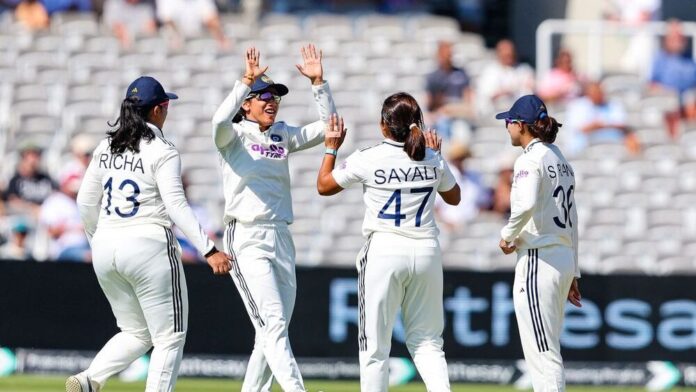
The scoreboard tells only part of the story. India need just four more wickets to complete what would be a famous victory at Lord’s. England, meanwhile, begin the fourth morning still needing 327 runs with only four wickets in hand. Yet the numbers alone fail to explain how the visitors have established such complete control over this one-off Test.
More than any technical or tactical battle, this contest has been defined by intensity.
Across all three days, India have looked sharper, more proactive and more willing to dictate the tempo. England, by contrast, have spent long periods responding rather than imposing themselves on the contest. There have been bright spots. Amy Jones has compiled successive half-centuries under pressure, Sophie Ecclestone fought back with a deserved five-wicket haul in India’s second innings, and Lauren Bell consistently challenged the batters with the new ball. But those moments have arrived in isolation rather than forming part of a sustained fightback.
Context matters.
England entered this Test less than a week after a heartbreaking defeat in the T20 World Cup final, a loss that still appears to linger over this group. In that final, Sophie Ecclestone delivered an uncharacteristic wide down the leg side at a crucial stage—a rare mistake from a bowler of her calibre. As the match slipped away, she sat on the field with her head bowed, overcome with emotion.
There was an eerily similar image at Lord’s on Day 3. After completing a hard-earned five-wicket haul in India’s second innings, Ecclestone was once again seen sitting on the turf in the same pose. When India declared and England walked off for tea, she was visibly in tears as teammates came over one by one to embrace her. Speaking after play, Ecclestone admitted she had broken down even while walking onto the field, knowing it would be the final time she would share it with Heather Knight and Tammy Beaumont. She described the week as “a whirlwind”, acknowledging just how much the squad had been through in such a short period.
The World Cup final defeat, the retirements of two of England’s modern greats have combined to make this an emotionally draining period. None of that diminishes India’s performance, nor should it be used as an excuse for England’s struggles. It does, however, provide context for why the hosts have often looked a step behind a side that has maintained its intensity from the opening session.
India, meanwhile, have capitalised on every opportunity presented to them.
After gaining the upper hand in the first innings through Kranti Gaud’s maiden five-wicket haul, Harmanpreet Kaur’s side never allowed England back into the contest. Smriti Mandhana and Yastika Bhatia resumed positively on Day 3 before Bhatia transformed her overnight score into a memorable century. Even when Ecclestone rediscovered her rhythm to complete a five-for, India continued to score with purpose. Richa Ghosh’s attacking half-century allowed Harmanpreet to declare with a commanding lead of 456, leaving England with an almost impossible task.
Perhaps the clearest illustration of India’s mindset came from Bhatia herself. Reflecting on her innings, she revealed that a hundred had never been her objective. The instruction from the dressing room was straightforward: score quickly enough to leave ample time to take ten wickets. It was an innings shaped entirely by the team’s needs rather than personal milestones.
England’s task on the fourth morning extends beyond survival. They must rediscover an intensity that has deserted them for much of this match. India, meanwhile, stand on the threshold of one of their finest overseas Test victories. Four wickets now separate Harmanpreet Kaur’s side from another defining chapter in the remarkable rise of Indian women’s cricket.
Follow Revsportz for latest sports news
The post India’s Relentless Intensity Has Left England Chasing Shadows at Lord’s appeared first on Sports News Portal | Revsportz.