

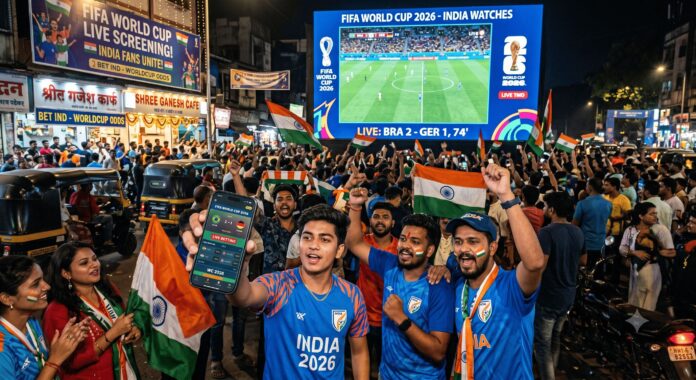
The FIFA World Cup 2026 is already the biggest football tournament in history – 48 teams, 104 matches, three host countries across the United States, Canada, and Mexico. For Indian fans, who are following the tournament in record numbers, it has also become one of the biggest sports betting events of the year. Platforms covering the intersection of sport and digital entertainment – including Lucky Star and other regional outlets tracking the trend – are reporting a sharp spike in reader and user interest as the tournament progresses through its group stage.
India may not have a team in the competition, but that has never stopped Indian fans from finding someone to cheer for. Brazil and Argentina remain the sentimental favourites across the subcontinent, with France and England attracting strong followings among younger, more tactically engaged viewers. The expanded 48-team format, which sees eight third-placed group finishers advance to the knockout rounds, has added new layers of suspense – and new betting opportunities – to every match week.
The tournament favourites and what the odds say
Spain currently lead the outright winner market, and the case for them is hard to argue against. They are technically dominant, tactically balanced, and entering the tournament fresh from winning UEFA Euro 2024. France are priced closely behind, with Kylian Mbappé at the head of the Golden Boot market with odds of 7/1. England, under Thomas Tuchel, qualified with matches to spare and are considered genuine contenders for the first time in decades. Argentina, as reigning champions, remain dangerous despite Lionel Messi now being 38 – still performing at a high level for Inter Miami, but facing questions about sustainability across eight matches.
Brazil entered the tournament with historical baggage and renewed optimism in equal measure. Their opening group win was their first clean performance in years, but the betting market prices them as a dark horse rather than an outright favourite – reflecting just how competitive the expanded field has become.
How Indian fans are engaging with the World Cup
For Indian viewers, the World Cup 2026 represents something of a cultural shift. Football has long played second fiddle to cricket in India, but the sport’s growth in schools, academies, and cities like Kolkata, Goa, and Kerala has created a genuine domestic football culture that now has a global event to rally around.
Viewing figures for the group stage have been strong on Indian streaming platforms, with matches broadcast in Hindi, Telugu, Tamil, and Bengali. Social media engagement – particularly on Instagram Reels and YouTube Shorts – has driven awareness among younger audiences who may not sit through a full 90-minute match but consume highlights, analysis, and punditry voraciously.
Sports betting on the World Cup has surged in parallel. Online platforms offering UPI deposits and INR-denominated markets have seen significant registration spikes since the tournament draw was announced. The combination of late-night match timings – most USA-based games kick off between 11 PM and 3 AM IST – and a large population of night-shift workers, college students, and young professionals has created a highly engaged live-betting audience.
The new 48-team format and what it means for bettors
The expanded format has changed the mathematics of World Cup betting in ways that many casual punters are still catching up with. In the old 32-team structure, only the top two sides from each group advanced – meaning a single defeat could spell elimination for a major nation. Under the 2026 rules, 12 groups of four teams each send their top two finishers through automatically, while the eight best third-place records also qualify for the knockout stage.
This creates a more forgiving environment for elite teams and, paradoxically, a more unpredictable one for bettors. Group winners are no longer as straightforward to predict. Third-place qualification betting has become its own market. And with 104 matches generating constant data points, in-play and over/under markets have become far more active than in any previous tournament.
A moment for Indian football to grow
Beyond the betting markets and the television numbers, the 2026 World Cup represents an opportunity for football to consolidate its growing presence in Indian sports culture. Every viral moment – a Mbappé goal, a giant-killing upset, a last-minute qualifier – is shared instantly across Indian social networks, building familiarity with players, teams, and the sport itself.
India’s national team remains far from World Cup qualification. But a generation of fans watching this tournament closely, placing informed bets, and following the narratives of 48 nations across six weeks is exactly the kind of deep engagement that turns casual interest into genuine sporting passion.