

Shamik Chakrabarty, Ahmedabad
The 2026 IPL would be defined by opening batsmen pushing the envelope. The very foundation of it was set by Abhishek Sharma and Travis Head two seasons ago, and a teenager from Bihar has taken it to the next level this term. The hard numbers are staggering.
Vaibhav Sooryavanshi scored 776 runs in 16 innings in this IPL at a strike rate of 237.30. In the process, he became the fastest to 1,000 runs in terms of balls faced — 440 deliveries, bettering Andre Russell’s 545. He scored the most runs by a teenager in a single T20 tournament. He became the first to 500 powerplay runs in a single T20 tournament. In microcosm, over the last two months, Sooryavanshi became the very personification of the new-age opening batting that thrives on power and panache.
In the hullabaloo, Shubman Gill ran the risk of becoming a misfit, especially after his T20 World Cup omission. Amid the upstarts, he was the grandee — never mind that he is 26 years old — who could have fizzled out. Gill kept a stiff upper lip after the World Cup snub. In this IPL, he has let the bat do the talking. A tally of 722 runs in 15 innings attests to that. He scored those runs at a strike rate of 163.71 — not Vaibhav-esque, but pretty impressive. Whether this will leave the T20I door ajar again remains to be seen, but as regards pure aesthetics, he remains unmatched; a connoisseur’s delight.
At times during Gill’s 53-ball 104 in Qualifier 2 against Rajasthan Royals on Friday, it felt like time was standing still. That lofted drive against Jofra Archer — goodness gracious! Gill was batting like a prince. “I was in the kind of zone where I was just looking at the gaps and the bowler and see my zone, and try to hit it there,” Gill told the host broadcaster at the post-match presentation. “That’s what happens when you’re batting well, you see the gaps and middle it.”
Now he is back at his favourite place, where his T20 average is 54. This IPL is actually the remaking of Gill as a T20 opener. Maybe he needed that World Cup jolt. It ostensibly prompted him to change. He no longer plays a conservative game. As per an ESPNcricinfo stat, Gill has left his crease on 56 occasions this IPL.
What Gill has done in his mid-20s, Virat Kohli did in his late 30s. In 2024, his last season as Royal Challengers Bengaluru captain, Kohli’s strike rate was 154.69. His team was knocked out in the Eliminator. Last year, it fell to 144.71. Kohli’s strike rate has risen to 164.38 this term. The change has happened without a radical overhaul. His batting template remains the same. He has added a layer to his batting that sees him manoeuvre the bowling and the field even better. And of late, Kohli has been going aerial a lot more. In 15 innings so far this IPL, he has hit 22 sixes.
Kohli has done this without resorting to fancy shots. He doesn’t play reverse scoops or outrageous laps. During his half-an-hour batting stint at the Narendra Modi Stadium on Friday, he was focused on playing conventional shots. The focus was mainly on playing lofted shots (pretty copybook) and finding the gaps. A switch has been flicked and it doesn’t look manufactured. This is greatness.
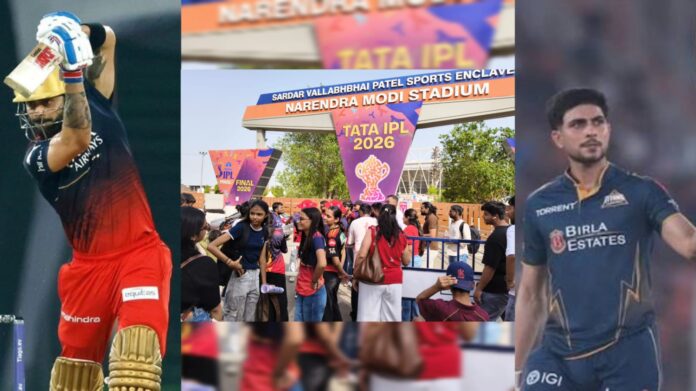
Kohli and Gill come from the same school of batsmanship — very traditional, yet one that has embraced modernity. The cultured amalgamation adds to the wow factor. On Sunday, as RCB face GT in the final in Ahmedabad, they will be on opposite sides and fans will be thronging the ground to watch them.
Around 4 pm on the eve of the match, the atmosphere outside the stadium had a festive look. Lots of fans, and the RCB supporters comfortably outnumbering their GT counterparts, turned up to be part of the build-up, ignoring the sweltering sun. Kohli is still the biggest crowd-puller in Indian cricket. Gill is the ‘home’ boy. The master and his heir apparent.
Follow Revsportz for latest sports news
The post Virat Kohli and Shubman Gill, master and heir apparent — welcome to IPL final appeared first on Sports News Portal | Revsportz.