

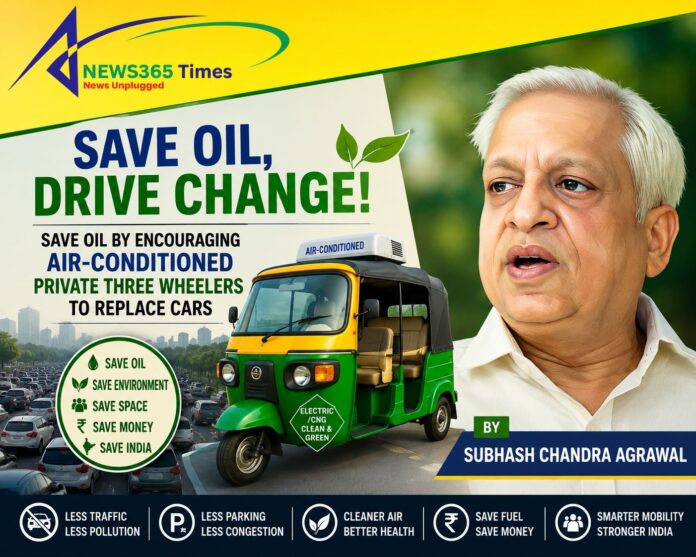
Subhash Chandra Agrawal calls for a bold new mobility policy to reduce oil dependence, save road space, and promote practical transportation for the masses
As global crude oil prices continue to rise amid escalating geopolitical tensions involving the United States, Israel, and Iran, India faces increasing pressure on its fuel-import bill and economic stability. The growing uncertainty in global energy supply chains has made it imperative for the country to adopt urgent short-term and long-term strategies aimed at drastically reducing petroleum consumption.
One of the most practical yet overlooked solutions lies not in promoting more private cars, but in encouraging a new generation of modern, air-conditioned three-wheelers that can replace conventional cars for millions of middle-class Indians.
While authorities in Delhi recently doubled parking charges to discourage excessive car usage, the simultaneous reduction of GST on small cars from 28 percent to 18 percent sends a contradictory signal. Such measures appear influenced by strong automobile industry lobbying. Though the increase in GST on luxury vehicles to 40 percent was a welcome step, India still lacks a coherent and future-ready automobile policy focused on national interest rather than market glamour.
It is time for Indian automobile manufacturers to innovate aggressively in the segment of premium air-conditioned auto-rickshaws. Modern electric or CNG-powered three-wheelers equipped with comfortable seating, safety features, and air-conditioning can emerge as an ideal urban mobility solution. These vehicles occupy far less road and parking space, consume substantially less fuel, and are far more environmentally sustainable than private cars.
Interestingly, even diplomats have recognized the practicality of such transport systems. A former Mexican Ambassador to India had reportedly preferred travelling in a luxurious private auto-rickshaw rather than using a conventional luxury car — a symbolic reminder that utility often outweighs prestige.
The late Union Environment Minister Jairam Ramesh had once famously described SUVs as “Socially Useless Vehicles,” criticizing the misuse of subsidized diesel by affluent vehicle owners. Similarly, former Delhi Chief Minister Sheila Dikshit had repeatedly emphasized the need to discourage oversized cars that consume disproportionate public space.
India today urgently requires a completely new automobile policy framework where the production and purchase of large, expensive vehicles are actively discouraged. Luxury cars with ex-showroom prices exceeding ₹10 lakh should attract significantly higher road taxes, insurance premiums, registration charges, and other levies. Classification of cars should be based on price rather than engine size or vehicle length.
More importantly, bank financing for ultra-luxury personal vehicles should be restricted. Expensive cars are largely status symbols rather than necessities, and those seeking social prestige through such purchases should bear the full financial burden themselves.
Simultaneously, automobile manufacturers should be encouraged to diversify into sectors that serve larger public interests. Instead of endlessly expanding luxury car production, companies can shift portions of their manufacturing capabilities toward metro coaches, electric public transport systems, and premium three-wheelers. India’s rapidly expanding metro rail networks present enormous opportunities for domestic manufacturing and exports.
Government departments must also set an example. Except for constitutional dignitaries such as the President, Vice President, Prime Minister, and visiting foreign heads of state, official government transport should increasingly shift toward economical vehicles and even advanced air-conditioned three-wheelers where feasible. Past instances of state governments purchasing fleets of luxury vehicles during periods of financial strain drew rightful public criticism and highlighted the disconnect between governance priorities and public realities.
The misuse of subsidized diesel in private vehicles must also end. Diesel pricing policies were originally intended to support public transportation and goods movement. Allowing private luxury cars to benefit from cheaper diesel defeats that purpose entirely. India should gradually eliminate diesel-powered passenger cars and move toward cleaner mobility systems.
Likewise, the current vehicle scrapping policy requires a more balanced and scientific approach. Automatically scrapping diesel vehicles after ten years and petrol vehicles after fifteen years unfairly penalizes many citizens — especially senior citizens who use their vehicles sparingly and maintain them well. Rather than enforcing arbitrary age limits, authorities should mandate advanced computerized fitness and pollution testing through authorized workshops. Vehicles meeting environmental and safety standards should be permitted continued use irrespective of age.
There is also a pressing need for standardization within the automobile sector. Common specifications for tyres, batteries, and essential spare parts across manufacturers can significantly reduce maintenance costs for consumers. Excessive pricing of spare parts and monopolistic practices by manufacturers deserve scrutiny by regulatory authorities to protect consumers from unreasonable profiteering.
India’s mobility future cannot be built around the unchecked expansion of luxury private vehicles. The nation must choose between oil-intensive elitism and practical, people-centric transport solutions. Modern, comfortable, air-conditioned three-wheelers can become symbols of smart urban mobility — reducing fuel consumption, easing congestion, cutting pollution, and democratizing transportation.
At a time when the world is grappling with energy insecurity and climate challenges, India has an opportunity to redefine urban transport through innovation rooted in practicality rather than prestige. The road ahead should belong not to larger cars, but to smarter mobility.