

Prime Minister’s Appeal to Save Oil Must Be Backed by Structural Reforms, Not Symbolic Messaging Alone
By Subhash Chandra Agrawal
Prime Minister’s repeated appeals to citizens for conserving fuel and reducing unnecessary consumption are both timely and welcome. However, merely asking citizens to save oil will not achieve meaningful results unless governments themselves undertake bold structural reforms in transport, automobile policy, and public expenditure.
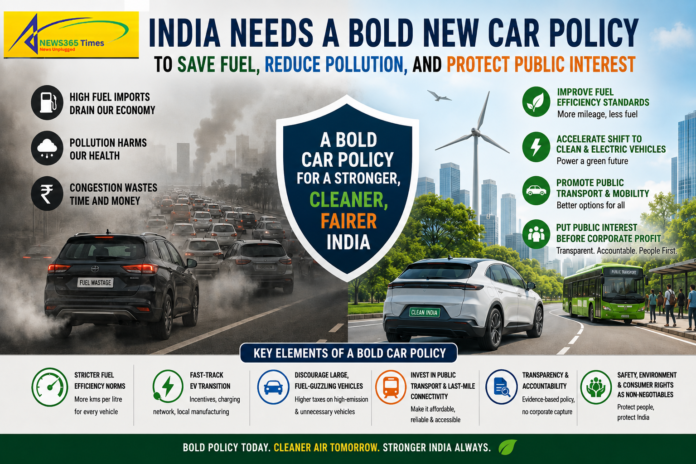
India today stands at a critical crossroads where rising fuel imports, worsening urban congestion, increasing pollution, and growing economic inequality require a complete rethink of the country’s automobile ecosystem. The nation cannot continue promoting luxury car culture while simultaneously appealing for fuel conservation and environmental responsibility.
One of the first steps should be a serious review of excessive government expenditure on luxury vehicles. Several state governments in the past have faced criticism for purchasing expensive fleets of cars for officials even during periods of economic distress and public hardship. Governments must lead by example. Except for constitutional authorities and select security-sensitive positions, official vehicle procurement should be restricted largely to economical and fuel-efficient categories.
Similarly, India needs stricter regulation on large political roadshows, convoys, and extravagant election rallies that consume massive quantities of fuel and create avoidable traffic and environmental burdens. Security agencies should scientifically examine whether convoys of VIPs can be rationalized without compromising safety.
An equally important reform lies in reimagining urban mobility. Instead of blindly encouraging private car ownership, India should invest aggressively in public transport, metro rail expansion, electric mobility, and innovative low-space transportation systems. Air-conditioned electric or CNG auto-rickshaws can become an efficient middle-class mobility alternative if properly modernized and promoted. Such vehicles consume less energy, occupy less road space, reduce parking pressure, and are significantly more eco-friendly.
The current taxation structure also reflects contradictions in policy priorities. While luxury vehicle sales continue to expand, smaller and affordable vehicles often do not receive proportional encouragement. The country needs a fresh automobile policy that discourages excessively large and fuel-consuming luxury vehicles while incentivizing compact, efficient, and environmentally sustainable mobility solutions.
The observations once made by former Union Environment Minister Jairam Ramesh describing SUVs as “Socially Useless Vehicles” remain relevant even today in the context of urban congestion and fuel misuse. Large vehicles consume more fuel, occupy greater road and parking space, and contribute disproportionately to traffic stress in crowded cities.
India should also reconsider indiscriminate expansion of car financing for luxury categories. Expensive cars have increasingly become status symbols rather than necessities. Financial institutions and policymakers must encourage responsible mobility instead of aspirational overconsumption. At the same time, import duties on luxury imported vehicles should remain high to discourage unnecessary foreign exchange outflow.
The issue of diesel vehicles also deserves urgent attention. Diesel pricing historically existed to support public transportation and goods movement. Allowing private luxury diesel vehicles effectively subsidizes affluent consumers at the expense of public interest. Stronger restrictions on diesel-powered private cars would significantly aid pollution-control efforts in major urban centers.
India must additionally rethink its vehicle scrappage framework. Blanket scrapping rules based purely on age can unfairly burden senior citizens and low-mileage vehicle owners whose cars remain roadworthy. Instead, scientific fitness-based assessments through authorized workshops should determine whether vehicles remain suitable for use. Pollution-control systems should become stricter, standardized, transparent, and technology-driven.
Another area requiring reform is the pricing monopoly surrounding automobile spare parts. Consumers frequently discover that purchasing individual spare parts costs disproportionately more than the vehicle itself over time. The government’s anti-profiteering mechanisms should examine excessive spare-part pricing practices and push for greater standardization of consumables like tyres and batteries across manufacturers.
India’s future mobility vision cannot merely revolve around increasing car ownership numbers. A truly developed nation is not one where every citizen owns a car, but one where citizens can move efficiently, safely, affordably, and sustainably without depending excessively on private vehicles.
The time has come for India to adopt a comprehensive, people-centric, and environmentally responsible automobile policy that balances economic growth with public welfare, urban sustainability, and national energy security.