

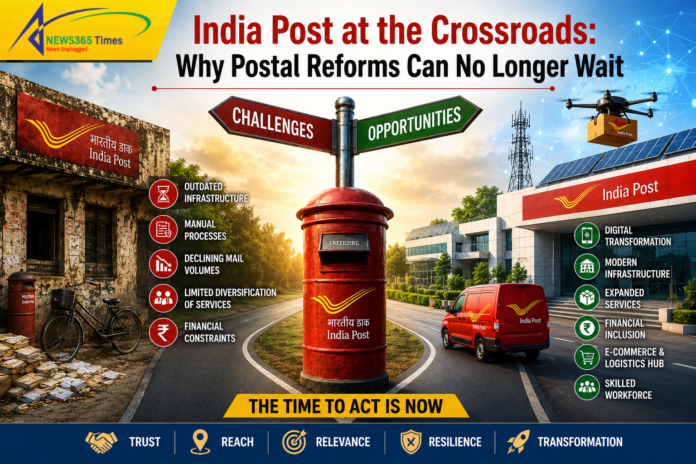
Cashless confusion, declining accessibility, irrational tariffs, and outdated systems are pushing citizens away from one of India’s most historic public institutions
By Subhash Chandra Agrawal for News365 Times
India’s postal network has historically been one of the strongest pillars of public service delivery — connecting villages, towns, businesses, institutions, and citizens across the country for generations. Yet today, at a time when digital transformation should have strengthened the Department of Posts, several operational decisions and outdated administrative practices are ironically making postal services less accessible, less user-friendly, and less competitive.
If timely reforms are not introduced, the Department risks losing further ground to private courier companies, despite possessing the largest logistics and communication network in the country.
Cashless Speed Post Booking: Reform or Administrative Inconvenience?
One of the most impractical changes introduced recently is the insistence on cashless-only payments for Speed Post and other postal services in many post offices.
Under this arrangement, citizens who wish to make small payments in cash are often forced to first stand in one queue to purchase postal stamps and then join another queue for booking their Speed Post article after manually affixing those stamps. What was once a quick and efficient process has now become unnecessarily cumbersome.
This system not only inconveniences the public but also creates avoidable operational inefficiencies for the Postal Department itself. Valuable departmental resources are wasted in printing and processing stamps merely to avoid accepting direct cash payments.
Technology should simplify public services — not complicate them.
The Department of Posts must restore the earlier system where customers were allowed to pay either in cash or digitally for Speed Post and related services. True modernization means offering flexibility, not forcing impractical uniformity.
Need for Uniform Speed Post Timings Across India
Another major issue faced by users is the lack of uniformity in Speed Post acceptance timings across post offices.
Shockingly, some post offices — including the one at Delhi Railway Station — reportedly begin accepting Speed Post articles only after noon. Such arbitrary operational timings defeat the very purpose of a premium express postal service.
India Post must establish standardized timings nationwide for acceptance of Speed Post consignments.
In major urban centres and commercial zones, dedicated 24×7 Speed Post counters should operate seamlessly without unnecessary interruptions. Since most counters already deploy more than one staff member, rotational break systems can easily ensure uninterrupted public service.
Technology Installed, But Not Utilised
Ironically, while the Department has invested in modern receipt-printing machines and barcode-based systems, many of these machines remain underutilized because of something as basic as shortage of paper rolls.
This reflects a deeper systemic problem — infrastructure deployment without operational planning.
Ensuring uninterrupted availability of paper rolls and consumables would not only improve customer experience but also save public money by reducing manual paperwork, gum usage, and processing delays in government offices maintaining dispatch registers.
Old Delhi’s Commercial Hub Deserves Postal Services Again
The gradual closure of post offices in the commercial heart of Old Delhi has created immense inconvenience for traders, businesses, and ordinary citizens.
Rather than strengthening postal accessibility in dense commercial zones, the Department appears to be retreating from them — inadvertently pushing people toward expensive and often unreliable private courier operators.
This decline is not entirely because of falling postal demand. In many cases, users are simply moving away due to operational inefficiencies and poor accessibility.
During the redevelopment of Chandni Chowk, a dedicated public utility complex was constructed at Bhai Mati Dass Chowk (Fountain) to house public-sector services such as banking, insurance, and postal facilities. Unfortunately, the building reportedly remains largely vacant.
The Postal Department should immediately coordinate with the Municipal Corporation of Delhi to establish a modern post office there. Such a move would revive accessibility in one of India’s busiest commercial markets.
Banking Partnerships Can Expand Postal Reach
With government savings schemes increasingly shifting to banks and digital platforms, the role of many traditional post offices has narrowed significantly.
India Post should therefore explore partnerships with banks, allowing bank branches to host mini postal counters for Speed Post and related services against a nominal commission structure.
Such integration can dramatically increase public access while reducing infrastructure costs.
Postal Tariffs Need Rationalisation — Not More Complexity
India’s postal tariff structure also requires urgent rationalization.
The continuation of heavily subsidized printed postcards — often misused for political campaigns, commercial reminders, or entertainment requests — imposes avoidable burdens on the public exchequer.
Subsidized inland communication systems that are no longer widely used by ordinary citizens should be reviewed pragmatically.
Equally irrational is the levy of GST on selected postal services such as Speed Post while ordinary postal services remain exempt. Since both entities involved belong to the government ecosystem, this effectively becomes a transfer of money from one government pocket to another while unnecessarily increasing compliance and administrative costs.
A simplified, citizen-friendly tariff structure with rounded pricing slabs and GST-free premium postal services would benefit both consumers and the Department alike.
India Post Must Compete — Not Retreat
Private courier companies are expanding aggressively because they prioritize convenience, accessibility, and customer experience.
India Post already possesses unmatched infrastructure, trust, and geographical reach. What it lacks today is operational agility and service innovation.
The objective of reforms should not merely be cost-cutting, but revenue expansion through modernization, sponsorship models, philately innovation, and customer-centric services.
Sponsored Postal Stamps Can Become a Revenue Engine
The proposal for sponsored postage stamps deserves serious consideration.
Allowing corporations, institutions, campaigns, and organizations to sponsor postage stamps — under a regulated approval framework — could create substantial new revenue streams for the Postal Department while simultaneously increasing postal usage.
Likewise, issuing fresh definitive stamp series every financial year could revive public interest in philately and generate additional collectible demand.
“My Stamp” Scheme Requires Serious Review
The “My Stamp” initiative, which allows individuals to print personal photographs on postage stamps, may have started with innovative intentions. However, media reports suggesting misuse of the scheme by questionable individuals expose serious reputational risks.
India Post must either introduce strict screening mechanisms or reconsider continuation of the programme altogether.
RTI Stamps: A Practical and Public-Friendly Reform
A particularly important suggestion is the introduction of dedicated RTI (Right to Information) stamps.
With low-denomination postal orders becoming increasingly unviable and difficult to procure, RTI applicants often face unnecessary hurdles in making small payments.
Special RTI stamps in denominations such as ₹2, ₹10, and ₹50 could significantly simplify compliance under the RTI Act while reducing administrative costs for both citizens and public authorities.
Unclaimed Deposits Need Structural Safeguards
The issue of dormant and unclaimed postal savings deposits is another area demanding immediate reform.
Large sums remain unclaimed because many depositors pass away without informing heirs or updating records. Such inactive accounts create vulnerabilities and potential risks of fraud.
India Post should introduce a system of periodic verification, public disclosure mechanisms for dormant accounts, and “successive nomination” facilities similar to those followed by institutions like LIC of India This would protect depositors, legal heirs, and the integrity of the postal financial system.
Reinventing India Post for the Future
India Post is not merely a logistics network. It is a national institution deeply woven into the social and economic fabric of India. But institutions survive only when they evolve with public expectations.
The future of the Postal Department lies not in resisting change, but in embracing smart reforms that combine technology with public convenience, financial prudence with accessibility, and modernization with trust.
If implemented thoughtfully, postal reforms can transform India Post from a declining legacy institution into a modern public-service powerhouse capable of competing effectively in the digital age — while continuing to serve the common citizen with dignity and efficienc