

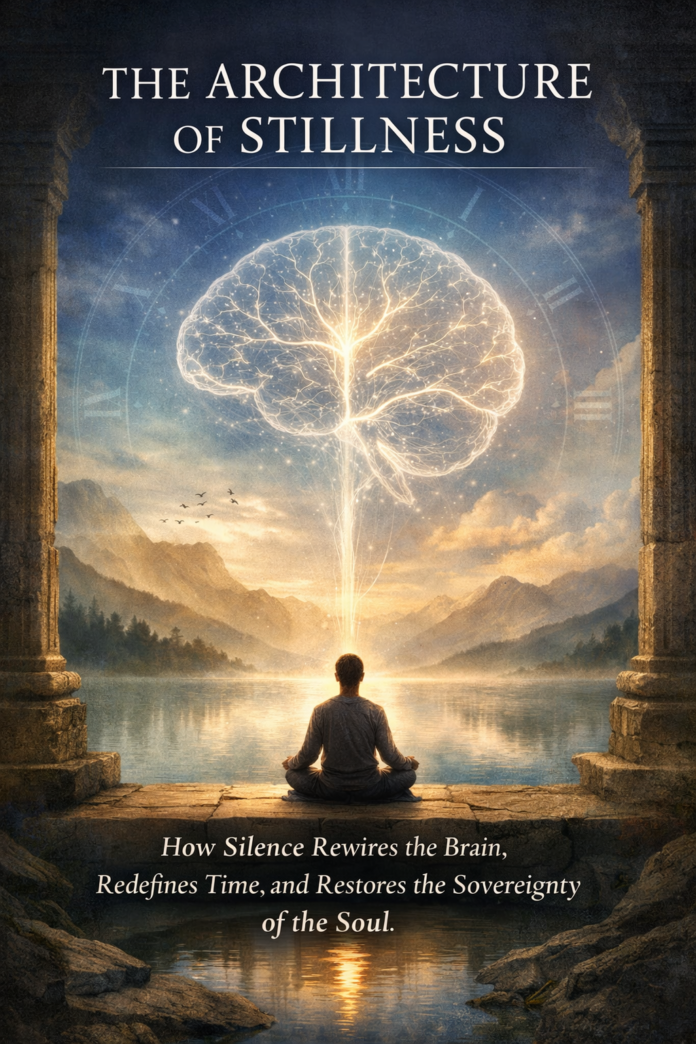
There is a silence deeper than sound. There is a stillness beyond motion.
There is a space within the human system where time does not tick — it dissolves.
We are conditioned to believe that productivity is noise, that relevance is speed, and that existence must be measured by visible action. Yet the most powerful transformations in the human body occur in states of profound stillness.
Stillness is not inactivity.
It is biological intelligence in its purest form.
The Parasympathetic Symphony
When the body enters a state of deep calm — what ancient traditions call Samadhi — the parasympathetic nervous system reaches peak efficacy.
The heart slows.
Breath deepens.
Cortisol declines.
Neural pathways reorganize.
Modern neuroscience confirms what mystics intuited centuries ago: silence is not emptiness — it is recalibration.
The brain, addicted to chaos, initially resists tranquility.
It prefers the familiar turbulence of stress.
Absence of threat feels unnatural.
But when we persist in observation without reaction, something remarkable happens — neuroplasticity begins its quiet labor.
Time: A Mental Construct in Motion
The Persian polymath Avicenna described time as the magnitude of motion between past and future.
Centuries earlier, Aristotle defined time as the quantifier of change — arising from the perception of sequential movement.
Time, therefore, is not an external dictator.
It is a cognitive interpretation of motion.
In stillness, motion is reduced.
When motion reduces, psychological time stretches.
When thought pauses, time softens.
The clock continues ticking outside, but internally, the observer stands sovereign.
The Body: An Archivist of Patterns
The body records everything.
• Heartbeats synchronize mother and child in the womb.
• A deep sigh releases accumulated emotional tension.
• Yawning cools the brain and redirects energy.
• Sudden fatigue waves signal recalibration from prolonged stress.
These are not random events.
They are intelligent adjustments.
The nervous system constantly negotiates survival and restoration.
When stress dominates, the sympathetic system takes charge.
When stillness prevails, restoration begins.
Silence, therefore, is cellular governance.
The Observer: Beyond Samsara and Nirvana
In deep meditative states, awareness becomes independent of mental fluctuations.
Thought rises and falls. Emotion surges and dissolves.
The body ages. But observation stands astute.
This is the space beyond duality — beyond chaos and tranquility.
A state where faith is not dogma but direct experience.
Mind has no permanent residence. It lives in memory cells. The soul does not occupy space — it permeates awareness.
When we learn to witness without clinging, we step beyond conditioned responses.
The Corporate Brain and the Sacred Pause
In today’s corporate architecture, constant stimulation is glorified.
Leaders operate in hyper-sympathetic overdrive — decision fatigue, emotional volatility, reactive communication.
Yet the most strategic minds cultivate structured silence.
Great leadership does not emerge from noise. It emerges from calibrated stillness.
The parasympathetic system is not weakness. It is precision.
Stillness enhances clarity. Clarity refines judgment. Judgment shapes destiny.
The Clock Within
Energy moves in rhythms:
• The heartbeat
• The breath
• Muscle recalibration
• Emotional tides
These are internal clocks — biological timekeepers more ancient than mechanical devices.
When we align with these rhythms, we do not chase time.
We flow with it.
Conclusion: Sovereignty Through Silence
The architecture of stillness is not escapism. It is mastery.
In silence, the brain rewires. In stillness, time softens. In observation, identity stabilizes.
The world may celebrate motion, but evolution favors equilibrium.
Silence is not the absence of life —it is the refinement of it.
And in that refinement, the human being rediscovers sovereignty.