

Special Report:
The Dry Pipeline — Why India’s ₹3.6 Lakh Crore Jal Jeevan Mission is Paralyzed
By News365 Times Investigative Desk | Sunday, February 8, 2026
NEW DELHI — India’s “Har Ghar Jal” (Water in Every Home) dream is hitting a wall of administrative and fiscal reality. Fresh data for the 2025-26 fiscal year reveals a startling “execution paralysis”: despite ambitious targets, the government has managed to release barely 41.2% of the budgeted funds for its largest schemes in the first nine months.
At the heart of this slowdown is the Jal Jeevan Mission (JJM). Once the crown jewel of rural infrastructure, the mission’s ecosystem has effectively collapsed into a toxic cycle of unpaid bills, outdated data, and bankrupt contractors.
The “Shrinking” Budget: From Promise to Revision
The gap isn’t just in the spending; it’s in the expectation. The government has revised the total allocation for its top 53 schemes down from ₹5.1 lakh crore to ₹3.8 lakh crore.
Key Underperformers (9-Month Utilization):
| Scheme | Budget Estimate (BE) | Actual Release (9 Months) |
| Jal Jeevan Mission | ₹67,000 Crore | ~40% (Utilized via old balances) |
| PM Schools (PM-SHRI) | ₹7,500 Crore | ₹473 Crore |
| PM Krishi Sinchayee | ₹850 Crore | ₹150 Crore |
1. The Contractor’s Grave: Debt and NPAs
The backbone of the JJM—thousands of small and medium-sized contractors—is snapping. Across India, firms have taken to the streets, protesting over pending bills worth an estimated ₹15,000+ crore.
• The Debt Trap: Small contractors, having mortgaged homes to fund initial pipe-laying, now face NPA (Non-Performing Asset) status as banks freeze their credit.
• The Payment Black Hole: In states like Maharashtra, payments are routed through a centralized processing system that contractors describe as a “black hole” where bills vanish for months.
• Discrimination: Protesting groups allege that while local firms are ignored, a lion’s share of limited funds is diverted to large corporate entities, leaving the local ecosystem to rot.
2. The Population Dilemma: Ghost Villages vs. Real People
A critical “data ghost” is haunting the mission. JJM targets are largely based on the 2011 Census, which is now 15 years out of date.
• The Missing Millions: Since 2011, rural populations have shifted and grown. Infrastructure designed for a village of 500 now faces a demand from 800.
• Capacity Crunch: Pipes being laid are often too narrow to sustain the mandatory 55 liters per person, as the “actual” population far exceeds the “recorded” one.
• Source Depletion: The mission relies heavily on groundwater. As the population grows and climate stress deepens, these sources are going bone-dry before the first tap is even turned on.
3. The State-Specific Collapse
The crisis is most acute in five key regions where the ecosystem has hit a dead end:
• Kerala (₹4,874 Cr Debt): The “Arrear Capital.” Over 800 contractors have stopped work because the Kerala Water Authority (KWA) hasn’t cleared bills in 18 months.
• Uttar Pradesh: While showing the highest “connections,” it accounts for 84% of all complaints. A massive corruption crackdown has paralyzed the bureaucracy; officials are too scared of audits to sign off on legitimate payments.
• Jammu & Kashmir: Projects are “90% finished but 0% paid.” Overhead tanks stand ready, but without final funding for testing, equipment is being vandalized and stolen.
• Gujarat: Aggressive penalties (over ₹120 crore recovered from agencies) have created a supply chain vacuum, with new firms refusing to bid
The Human Cost: Tap but No Water
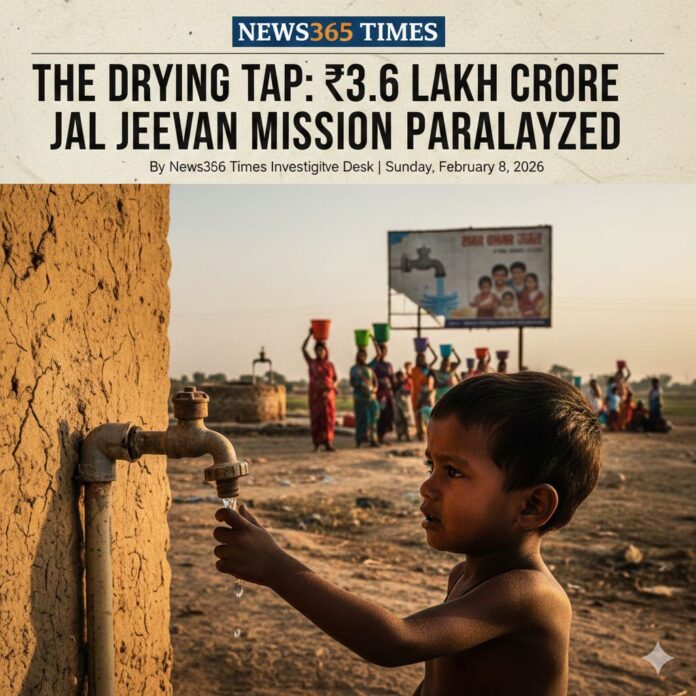
The rush to meet “saturation targets” has led to a focus on quantity over quality. Thousands of villages now have “paper-only” water connections—the taps are installed, but the pipes are dry, the pumps are broken, or the contractors have walked away midway.
“The government is making higher allocations and then slashing them in the revised budget to create an impression of concern,” says Aruna Agrawal, a policy researcher. “But you cannot build national infrastructure by bankrupting the people building it.”
As the clock ticks toward the revised December 2028 deadline, the Jal Jeevan Mission stands as a warning: without addressing the financial health of contractors and the reality of a 2026 population, the world’s largest water project risks becoming a graveyard of dry pipes.