

RTI Consultant | Guinness World Record Holder
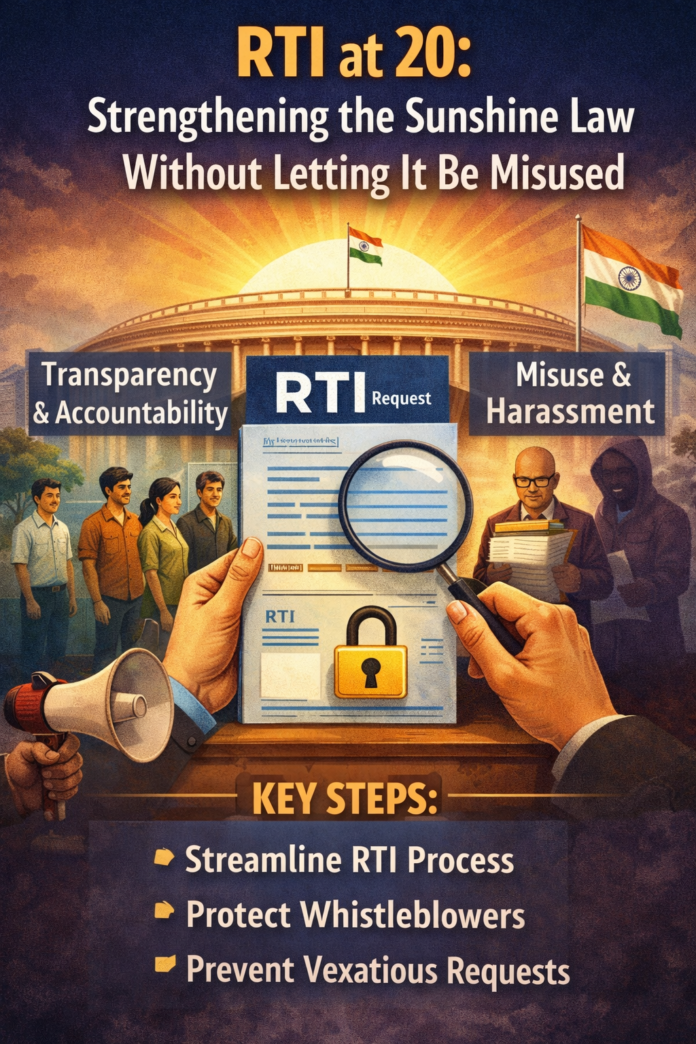
Twenty years after its implementation on 12 October 2005, the Right to Information (RTI) Act remains one of India’s most powerful democratic instruments. Yet, every attempt to streamline or modernise it is often met with misplaced criticism that the “sunshine law” is being diluted. A closer look shows the opposite: the RTI framework is being strengthened—what needs reform are its rules and operational practices to prevent misuse and improve efficiency.
Why the 2019 Amendment Didn’t Dilute RTI
The 2019 amendment—focused on the tenure and service conditions of Information Commissioners—did not curtail citizens’ rights under RTI. Likewise, the insertion of Section 44(3) in the Digital Personal Data Protection Act, 2023, which removed ambiguous riders to Section 8(1)(j) of the RTI Act, was necessary to protect parliamentary privilege and eliminate confusion arising from the loosely interpreted phrase “public interest.”
Importantly, the Central Information Commission (CIC) now operates at full strength, with the Chief Information Commissioner and ten Information Commissioners sworn in on 15 December 2025—a significant institutional milestone.
Quality Adjudication: The Real Strength of RTI
The effectiveness of RTI depends on quality adjudication, not just volume. Former Information Commissioner Vinod Kumar Tiwari set a benchmark by disposing of 12,700 cases in just 24 months, delivering well-reasoned, detailed judgments. In notable cases, penalties were imposed on erring Public Information Officers (PIOs), compensation was awarded to applicants, and systemic malpractices—particularly in the health sector—were flagged.
In one such matter involving Delhi’s Directorate of Health Services, even the Delhi High Court dismissed a writ petition against the CIC’s order on the first day of hearing (16 January 2026), reinforcing judicial confidence in RTI adjudication.
The present Chief Information Commissioner Raj Kumar Goyal echoed similar concerns, observing that even after two decades, many PIOs and First Appellate Authorities remain inadequately sensitised to their legal duties.
Recognition Matters Too
RTI is not only about penalties. Commendation also drives compliance. In a 2025 order, the CIC publicly appreciated a PIO from the Delhi Development Authority for clear, professional presentation of facts—a practice that should be encouraged across public authorities to improve administrative culture.
What Really Needs Reform: RTI Rules, Not the Act
To preserve RTI’s credibility, rules—not the Act—require urgent modification:
1. Expand the Definition of Public Authority
- Public–Private Partnerships, sports bodies, cooperative societies, and entities receiving subsidised land or government accommodation should fall under RTI.
- Future allotments at concessional rates must carry mandatory RTI coverage.
2. Bring Private Sector Banks Under RTI
With vast public deposits, RBI oversight, DICGC insurance (₹5 lakh per depositor), and repeated governance failures, private banks effectively handle public money and must be accountable under Section 2(h) of the RTI Act.
3. Rationalise RTI Fees
- The Supreme Court (20 March 2018) capped RTI fees at ₹50.
- A uniform ₹50 fee, inclusive of the first 20 pages, would deter frivolous applications.
- No fees should apply for first or second appeals.
4. Replace Postal Orders with RTI Stamps
Postal orders cost the exchequer far more than their face value. Introducing RTI stamps (₹2, ₹10, ₹50)—available at post offices and public authority counters—could save crores annually.
5. Make RTI Truly Accessible
- Accept post-free RTI applications at all 1.6 lakh post offices, not just a limited few.
- Mandate auto-emailing of RTI replies and appellate orders instead of forcing applicants to search portals.
- Enforce uniform NIC-designed RTI portals nationwide to end half-baked “online” systems.
6. Mandatory ID Proof
Following a Punjab & Haryana High Court (2012) ruling, ID proof should be compulsory with RTI applications and appeals to prevent misuse through fictitious identities.
7. Repeal Obsolete State RTI Laws
With the Delhi High Court (2018) clarifying that the RTI Act, 2005 overrides earlier state laws, all pre-2005 state RTI statutes must be repealed to avoid legal confusion.
The Way Forward
RTI remains India’s most potent accountability tool—but credibility is its lifeline. Sensible rule reforms, wider institutional coverage, and technology-driven transparency can strengthen RTI without weakening citizens’ rights.
The debate should move beyond rhetoric. A stronger RTI is not one that is misused—but one that is respected, efficient, and fair.
Subhash Chandra Agrawal is a noted RTI consultant and holds a Guinness World Record for the most letters published in newspapers.