

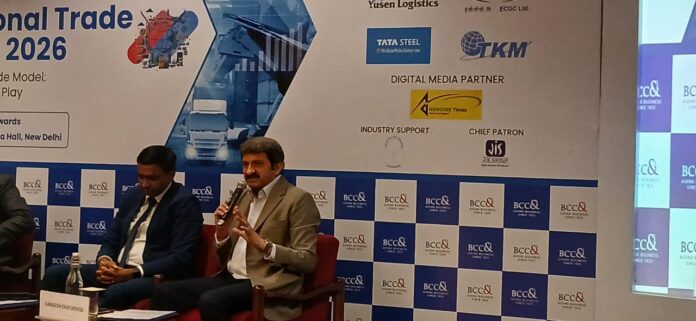
New Delhi : Mr. Ganesh Chaturvedi, Head – Export Planning & Documentation, Tata Steel, while speaking at the International Trade Conclave organised by The Bengal Chamber of Commerce and Industry, offered a reflective and future-facing view on the evolving challenges of exports—particularly for MSMEs—in an era of rapid technological and structural change.
Opening on a lighter yet insightful note, Mr. Chaturvedi remarked that “the dawn of yesterday is not the dawn of today—it has evolved into an elevated avatar.” While challenges will always exist, he emphasised that intent to progress* is what determines whether businesses truly move forward.
Understanding MSMEs Before Addressing Their Challenges
Mr. Chaturvedi stressed that before discussing challenges, it is critical to clearly define what MSMEs are. Referring to the MSME Development Act, 2006, he explained that MSMEs are classified based on investment and turnover, with current thresholds extending up to ₹50 crore in investment and ₹250 crore in turnover. Interestingly, while MSMEs constitute a large base, nearly 97% of export value comes from medium enterprises, highlighting the diversity and imbalance within the segment.
He pointed out that challenges vary significantly between large enterprises and MSMEs—what large companies can absorb or automate, smaller firms often cannot.
From Paper to Phygital: The Battle for Speed
Drawing a powerful analogy from his first computer experience—where machines were massive but far less powerful—Mr. Chaturvedi compared it to today’s compact yet highly efficient digital tools. He identified speed as one of the biggest challenges facing exporters.
The solution, he noted, lies in moving decisively from paper-based processes (pre-2010) to a digital and phygital ecosystem. In today’s world, traditional models like B2B and B2C are rapidly evolving into B2AI, A2AI , and even more advanced human–machine trade interfaces by 2030.
Compliance as a Competitive Advantage
The second major challenge he highlighted was compliance. Far from being a burden, Mr. Chaturvedi positioned compliance as a trust enabler. In global trade, an importer’s willingness to engage with an exporter depends heavily on credibility, data integrity, and traceability .
He noted that one of today’s critical gaps is the absence of a single, trusted source of data, which affects confidence in transactions. Strengthening compliance frameworks and digital data stamps, he argued, will be central to building long-term trade trust.
Concluding his address, Mr. Chaturvedi underlined that speed is no longer a differentiator—it is a hygiene factor. Businesses that fail to keep pace risk being left behind. Combined with strong compliance and trusted data systems, speed can move exporters into the “strength” quadrant of global competitiveness.
His message was clear: the future of exports belongs to those who adapt faster, comply smarter, and build trust by design—not by chance.