
When Wisdom Became Spectacle and Silence Became Power
The Triple Gems — Tisarana are not merely philosophical anchors. They are authenticated entertainment for the awakened mind. Wisdom (Buddha), Compassion (Dharma), and Purity of Collective Practice (Sangha) together form an internal theatre where fear, desire, and doubt dissolve into mindfulness, exaltation, and finally—enlightenment.
The Gautama Buddha never authored scripture. He engineered consciousness. What he transmitted was not doctrine, but mindful behaviour—a precision training of senses, breath, perception, and neural discipline.
This is not mythology.
This is neuro-spiritual engineering.
The Two Faces of the Awakened Mind
Buddha is often remembered for his tranquil face. But enlightenment was never passive.
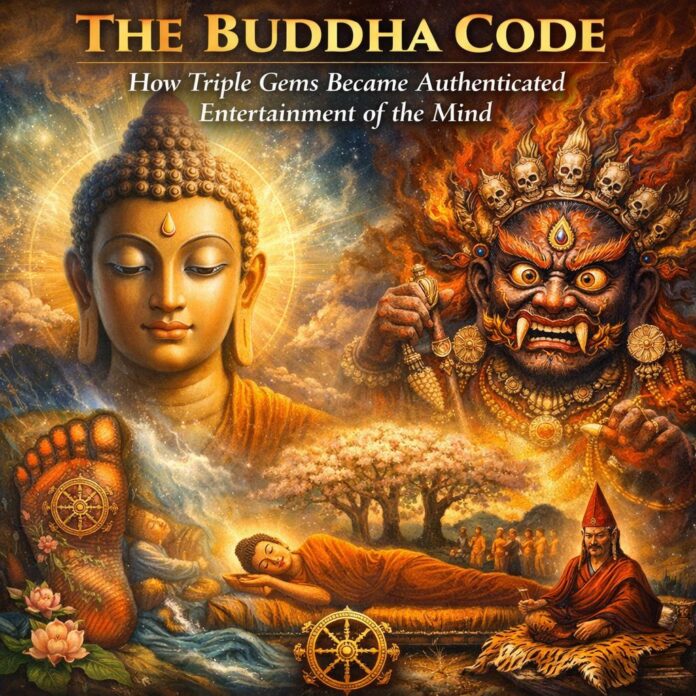
In deep visualisations, the Buddha mind appeared ferocious yet compassionate, drenched in luminous colours, with bulging eyes that held entire heavenly landscapes. This wrathful intelligence was not anger—it was clarity without hesitation. Tibetan traditions preserved this as the Yidam, the fierce protector of wisdom.
Tranquility without vigilance decays.
Ferocity without compassion destroys.
The Buddha unified both.
How Did He Look? A Science of Sacred Form
The Body as a Map of Consciousness
- Footprints with a Wheel (Dharmachakra):
His footprints bore the wheel, symbolising the Path of Dharma—movement guided by ethics, insight, and balance.
- Thirty-Two Marks of a Mahapurusha:
Born with the classical signs of a super-human being, his body encoded purpose.
- Long Earlobes:
Not ornamentation—Indian nobility. A reminder that renunciation followed privilege, not poverty.
- Hair Curling Toward the Auspicious Sunrise:
Neural alignment with renewal and awakening.
- Pointed Cranial Form:
A visual metaphor for upraised wisdom.
- Golden, Delicate Skin:
I perceive this as photon-spark skin—a harmony of light, microbiome, and cellular resonance.
- Aristocratic, Youthful Face:
Serenity without fatigue. Authority without arrogance.
- Half-Closed Lotus Eyes:
Seeing inward and outward simultaneously.
- Full Lips:
Confidence, nourishment, and fulfilled longing.
Eyes: Where Oceanic Energy Met Insight
During meditation, Buddha’s eyes were one-quarter open—glassy, reflective, alive.
Within them played the aqueous and vitreous humour, like tides in the anterior and posterior chambers. I visualise:
- Oceanic energy
- Bubbles in flow and float
- Gamma waves igniting memory cells
The retina became a screen of liberation—past memories observed, not clung to.
This oscillation—to and fro—trained intuition and insight.
Let go, yet learn.
Remember, yet release.
Ears: The Mathematics of Mantra
His auditory system was tuned to ostinato and pedal-point codes—repetition with variation.
- Repetitive lyrics
- Spiral motion
- Easy recollection
These patterns harmonised atoms into waves, motion, and entanglement. Sound became architecture. Chanting was not devotion—it was neurological entrainment.
Lips: Trauma, Nourishment, and Lotus Confidence
Siddhartha’s early life was biologically fragile.
- Difficult birth
- Deprivation of vaginal microbes
- Loss of breast milk
- Mother’s death seven days post-delivery
By science, his immune status would have been compromised.
By prophecy, he was sheltered indoors, destined to renounce.
Then came Sujata, a woman of humble birth, offering Dharma Kheer after his starvation in the cave.
In that moment:
- Siddhartha received nourishment
- Sujata received fulfillment of her prayer
Exaltation flowed both ways.
To me, Buddha’s lips resemble a lotus with super-hydrophobic intelligence—repelling suffering the way advanced surfaces repel water. A metaphor for self-cleaning consciousness, anti-corrosion of the soul.
Nose & Breath: The Engineering of the Middle Path
Why is Buddha’s nose pointed?
Because breath was his technology.
He identified three channels:
- Pingala – Male energy
Reaction, emotion, amygdala-driven impulses
- Ida – Female energy
Logic, reason, prefrontal cortex
- Sushumna – The Middle Path
Default Mode Network, error detection, integration
By breathing through both nostrils, he blended reaction and response, calming the sympathetic system and awakening parasympathetic intelligence through mudra, chanting, and breath regulation.
Yidams, Lamas, and the Theatre of Transmission
Buddha left no script. He left living wisdom.
Disciples chose Yidams—fierce protectors who presided over human vices to ensure transformation. Lamas wore high pointed caps, sat on tiger skins, symbols of impermanence and mastery over fear.
Power was never denied—only transcended.
Death: The Final Teaching as Liberation
At the end, Buddha asked Ananda to prepare a couch in a Sal Grove at Kushinagar.
The twin Sal trees symbolised:
- Impermanence of all conditioned things
- Sacred symmetry of birth and death
- Tranquility of nature
- Witness for the Sangha
His last teaching—Maranasati—was radical clarity:
- Let go of fear, attachment, regret
- Interrupt the cycle of birth and death
- Anicca – Impermanence
- Tanha – Non-attachment
- Wholesome mental states
- Inner strength amid chaos
- Samvega – Spiritual urgency
At death, the mind enters gamma-wave recall—dreamlike, lucid, hearing-conscious, breath shifting into Cheyne–Stokes rhythm. The face relaxes. The eyes turn glassy.
And wisdom—remains awake.
The Ultimate Entertainment
Buddha did not distract humanity.
He entertained consciousness into awakening.
This is authenticated entertainment—where neuroscience bows to silence, and art becomes liberation.
The Triple Gems are not to be worshipped.
They are to be embodied.