

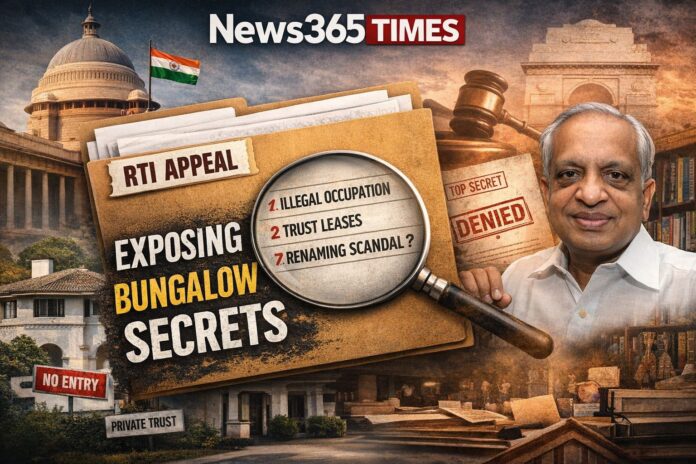
Activist Subhash Chandra Agarwal Seeks Full Disclosure on Illegal Occupation, Trust Leases and Renumbering of Government Residences
By News365 Times Bureau
New Delhi
A fresh Right to Information (RTI) first appeal has once again brought the spotlight on the opaque administration of government bungalows in New Delhi, raising serious questions about illegal retention, court-stayed evictions, allotment to private trusts, and arbitrary renumbering of official residences in the national capital.
The appeal has been filed by Subhash Chandra Agarwal, noted RTI activist, Guinness World Record holder, and one of India’s most persistent voices against corruption and misuse of public property, before the Directorate of Estates, Ministry of Urban Development.
What the RTI Appeal Seeks to Uncover
The appeal challenges the response to an online RTI application dated 16 November 2025, seeking complete records, file-notings, and correspondence relating to:
- Government bungalows still occupied by persons who have lost entitlement
- Residences under litigation, including dates of court stay orders
- Bungalows allotted to private trusts and foundations, including memorial projects of departed leaders
- Rules governing allotment of government residences to non-government entities
- Full occupation history of Bungalow No. 6, Krishna Menon Marg, from Independence till date
- File-notings on conversion of Bungalow No. 7 into 8-A, Krishna Menon Marg
- Rules permitting or prohibiting change of bungalow numbers
- Restoration steps where original numbering has been altered
- Internal file movement of the RTI application itself
RTI Reply Under Challenge
In his appeal, Agarwal has questioned the stand taken by the Central Public Information Officer (CPIO), who denied information on several key points citing Section 7(9) of the RTI Act, arguing that disclosure would “disproportionately divert resources”.
Agarwal contends that:
- The number of government bungalows in New Delhi is finite and well-documented
- Information on exceptions—illegal occupants or special allotments—should be limited and readily available
- Such information ideally should already be in the public domain
He has sought directions for the information to be provided free of cost under Section 7(6), citing unjustified denial.
Missing Documents and Ignored CIC Orders
The appeal also flags that documents claimed to be enclosed with the RTI reply were not actually provided, prompting a demand for immediate disclosure.
More significantly, the denial of information related to Bungalow No. 6, Krishna Menon Marg has been challenged on the ground that a Central Information Commission (CIC) order dated 7 May 2012 had already directed the Ministry to place complete occupancy details of the bungalow in the public domain.
Agarwal argues that ignoring a binding CIC verdict amounts to institutional non-compliance and defeats the very purpose of transparency laws.
Subhash Chandra Agarwal: A Relentless Crusader Against Official Opacity
Subhash Chandra Agarwal is widely recognised for his decades-long crusade against corruption, secrecy, and arbitrary exercise of power in public offices. Through thousands of RTI applications and legal interventions, he has consistently pushed for accountability in government functioning, particularly in matters involving public resources and taxpayer-funded assets.
His latest appeal, observers note, is not just about a few bungalows—it raises larger questions about who controls prime public property in Lutyens’ Delhi, under what authority, and for how long.
Why This Matters
Government bungalows in New Delhi represent some of the most valuable public assets in the country. Any deviation from rules—be it illegal retention, preferential allotment, or renumbering to suit individuals—directly impacts public trust, rule of law, and constitutional equality.
The outcome of this RTI appeal could set a precedent for greater transparency in the management of government residences and reinforce the RTI Act’s role as a citizen-driven tool to hold power to account.