

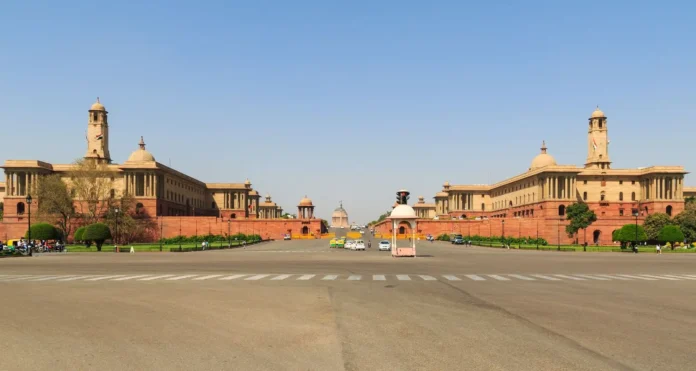
Indian government announced a historic transition: the Prime Minister’s Office (PMO), a cornerstone of governance since India’s independence in 1947, will relocate from its iconic South Block location to the newly constructed Executive Enclave under the Central Vista redevelopment project next month. This move, 78 years after independence, marks a significant step in modernizing India’s administrative infrastructure, aligning with the Atmanirbhar Bharat vision of self-reliance and progress. As India celebrates its 79th Independence Day, amidst transformative developments like the ₹1.5 lakh crore Jabalpur gold discovery, this shift symbolizes a break from colonial-era structures to a future-ready governance model. This article explores the reasons, implications, and broader context of the PMO’s relocation, drawing from recent reports and posts on X.
The Context of the PMO’s Relocation
For nearly eight decades, South Block and North Block on Raisina Hill have served as the nerve centers of India’s government, housing critical offices like the PMO, Ministries of Defence, External Affairs, Home Affairs, and Finance. Designed by British architect Herbert Baker in the 1930s, these colonial-era buildings are iconic but plagued by spatial constraints, inadequate lighting, and outdated facilities. Prime Minister Narendra Modi, in a speech following the inauguration of Kartavya Bhavan-3 in August 2025, highlighted the challenges of operating from these structures, noting their lack of modern infrastructure and poor working conditions.
The Central Vista project, a ₹20,000 crore initiative launched in 2020, aims to revamp Delhi’s power corridor, replacing colonial architecture with modern, efficient facilities. The PMO’s move to the Executive Enclave, located a few hundred meters from South Block and closer to the Prime Minister’s residence at 7 Lok Kalyan Marg, is a key milestone. This shift follows the relocation of other ministries, such as Home Affairs and Personnel, to Kartavya Bhavan-3, signaling a broader transformation of India’s administrative hub.
Reasons for the Relocation
The decision to move the PMO stems from practical and symbolic imperatives:
1. Space Constraints and Modernization Needs
South Block’s century-old design lacks the space and infrastructure required for modern governance. With limited room for staff, inadequate ventilation, and outdated technology, it hampers efficiency. The Executive Enclave, equipped with advanced conferencing facilities, houses not only the PMO but also the Cabinet Secretariat and National Security Council Secretariat, offering a consolidated, tech-enabled workspace. This aligns with India’s image as an emerging economic power, necessitating infrastructure that supports rapid decision-making.
2. Proximity to the Prime Minister’s Residence
The new PMO’s location near the Prime Minister’s residence enhances operational efficiency and security. Reducing travel time between home and office minimizes logistical challenges, a factor emphasized in the Central Vista blueprint. This proximity is particularly significant given the PMO’s role as the nerve center for policy coordination and crisis management.
3. Symbolic Shift from Colonial Legacy
Relocating from British-era buildings reflects a broader push to redefine India’s governance identity. As Modi noted, these structures were built for colonial administration, not a sovereign, aspirational nation. The move to the Executive Enclave embodies Atmanirbhar Bharat’s ethos of self-reliance, aligning with initiatives like the Jabalpur gold mine, which aims to reduce India’s $60–70 billion gold import bill.
4. Transformation of North and South Blocks into a Museum
With major offices relocating, North and South Blocks will be repurposed into the Yuge Yugeen Bharat Sangrahalaya, a public museum showcasing India’s cultural heritage. A collaboration agreement between the National Museum and France Museums Development will ensure its development, aiming to create a “timeless and eternal” celebration of India’s past, present, and future. This transformation preserves the historical significance of these buildings while opening them to the public, a move celebrated on X as a shift from “British rule to a people’s museum.”
Economic and Strategic Implications
The PMO’s relocation has far-reaching implications for India’s governance and economy:
-
Enhanced Administrative Efficiency: Modern facilities in the Executive Enclave will streamline operations, enabling faster policy implementation. This is critical for projects like Jabalpur’s gold mine, which requires coordinated governance to maximize its ₹1.5 lakh crore potential and create 10,000–15,000 jobs.
-
Economic Boost: The Central Vista project, despite its ₹20,000 crore cost, stimulates construction and allied industries, supporting Atmanirbhar Bharat’s focus on domestic growth. The museum’s development could also drive tourism, contributing to GDP.
-
Global Image: Modern infrastructure projects India as a forward-looking economic power, countering challenges like U.S. tariffs impacting $87 billion in exports. This aligns with diplomatic efforts, such as Germany’s proposed Trump-Putin-Zelensky summit, where efficient governance is key to navigating geopolitical complexities.
-
Cultural Preservation: The Yuge Yugeen Bharat Sangrahalaya will preserve India’s heritage, resonating with campaigns like Har Ghar Tiranga, led by Shri Vikram Dev Dutt, fostering national pride and unity.
Challenges and Criticisms
The relocation and broader Central Vista project face several challenges:
-
High Costs: The ₹20,000 crore investment has drawn criticism for diverting funds from pressing needs like healthcare and education, especially amid economic pressures from U.S. tariffs.
-
Historical Concerns: Some argue that repurposing North and South Blocks risks diminishing their historical significance, though the museum plan counters this by ensuring public access.
-
Logistical Disruptions: Shifting critical offices like the PMO requires meticulous planning to avoid disruptions, with North Block’s ongoing evacuation highlighting logistical complexities.
-
Public Sentiment: Posts on X reflect mixed sentiments, with some praising the modernization and others questioning the necessity of such an expensive overhaul.
Opportunities for India’s Future
The PMO’s move opens significant opportunities:
-
Modern Governance: The Executive Enclave’s advanced facilities will enhance decision-making, supporting India’s $5 trillion economy goal by 2027.
-
Cultural Tourism: The Yuge Yugeen Bharat Sangrahalaya could become a global attraction, boosting Delhi’s tourism economy and showcasing India’s heritage.
-
Tech Integration: Modern infrastructure can integrate AI and IoT, similar to mining-tech advancements in Jabalpur, improving governance efficiency.
-
Global Leadership: By modernizing its administrative hub, India strengthens its global image, complementing diplomatic initiatives and trade diversification through FTAs with the UK and UAE.